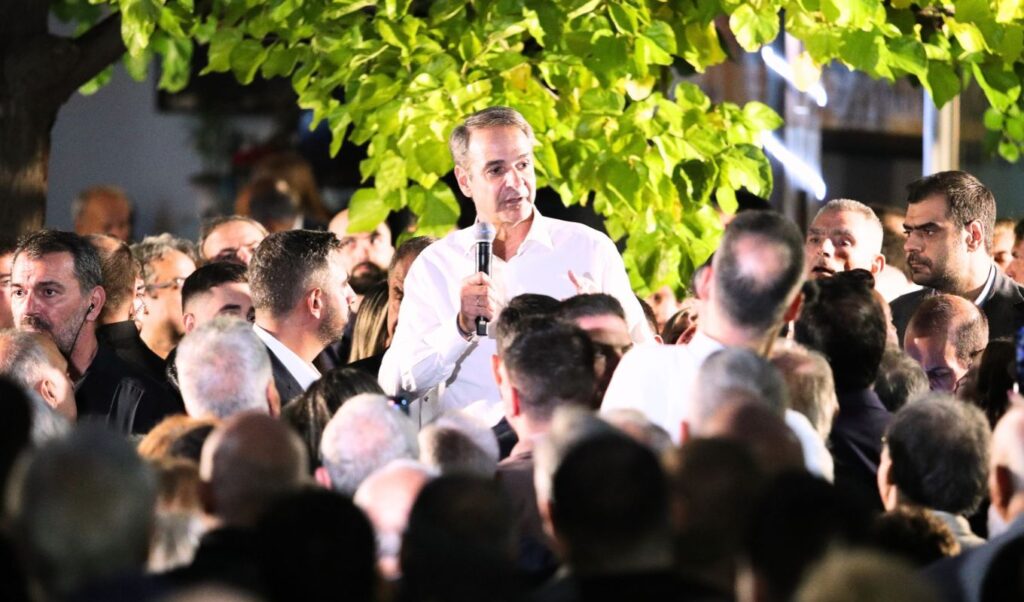
With the aim of strengthening New Democracy’s presence among voters and showcasing the government’s track record, Prime Minister Kyriakos Mitsotakis continues his tour of Attica today, with his next stop being the district of Ilioupoli. The prime minister is turning his attention to the southern suburbs, seeking to strengthen direct communication with citizens and highlight government priorities ahead of the upcoming elections.
Mitsotakis: A campaign tour against the backdrop of the cost-of-living crisis
At 5:30 PM, at a central café in Flemming Square, Mr. Mitsotakis is expected to meet with local residents as part of the strategy mapped out by the Prime Minister’s Office to increase outreach and maintain more systematic contact with the public. The economy — and in particular the cost-of-living crisis — sits at the top of the government’s agenda, as it remains the dominant concern of Greek households and a key factor shaping their political choices.
Within the prime minister’s inner circle, there is a clear acknowledgment that the cost of living remains by far the most pressing problem identified in polling, with public dissatisfaction running persistently high. For this reason, the government’s planning for the final six months before the elections is focused on interventions that will have a direct or indirect economic impact on citizens, with an emphasis on supporting household incomes.
New economic relief package in the works
According to sources, the Prime Minister’s Office is already working on a new, targeted economic relief package, which is expected to be activated during the first months of the new year. The relevant announcements are expected to be made personally by the prime minister, with the most likely timing being the parliamentary debate and vote on the state budget in the plenary session of the Hellenic Parliament. The scope of the measures will be determined based on final fiscal data and the overall capacity of the economy.
In the meantime, November 30th has been set as the date for the disbursement of rent rebates to eligible recipients, as well as the €400 financial support payment, as announced by Minister Domna Michailidou in a statement to SKAI television.
The government’s response on non-performing loans
Alongside the economic agenda, the government is also seeking to highlight its interventions in the area of private debt management, partly in response to the political controversy surrounding a proposed parliamentary inquiry committee into non-performing loans.
Government spokesperson Pavlos Marinakis defended the government’s approach, arguing that New Democracy has implemented more interventions to manage debt and protect borrowers than all the measures combined during previous years — including the period of the financial crisis. He emphasized that government policy addresses both financially vulnerable citizens and borrowers with a good repayment record, drawing a contrast between the government’s concrete actions and the opposition’s proposals.
“All of this is the best answer to the vague rhetoric, the outdated sloganeering, and the cheap — and above all — uncosted promises of the opposition parties,” Mr. Marinakis said during his briefing to political correspondents.
Poll gains and pre-election planning
Today’s visit to Ilioupoli is part of a broader plan by the Prime Minister’s Office to intensify tours by the prime minister and government officials across the country. The central goal is to shift political activity out of government offices and party headquarters, with a greater presence in local communities and a more systematic projection of the government’s achievements. This mobilization is intensifying at a time when the government camp is expressing cautious optimism about New Democracy’s polling performance. In most surveys, the ruling party is approaching or exceeding the 30% mark in voting intention, though it has yet to close the gap to an outright parliamentary majority.
Indicative of this trend is the latest Metron Analysis poll for Mega television, which records New Democracy at 29.5% in voting intention, followed by Greek Solution at 15.3% and PASOK at 13.3%. On the question of suitability for the role of prime minister, Kyriakos Mitsotakis holds a clear lead at 29%, compared to 13% for Alexis Tsipras. Despite a positive reading of these polling figures, the government’s inner circle is well aware that sustaining this momentum requires strengthening political visibility and maintaining continuous contact with voters. As a result, the planning is taking on an increasingly pre-election character, with the mobilization of the party machinery expected to intensify in the months ahead.
The battle for first place in the South Sector
Of particular political interest is the prime minister’s choice to visit the South Sector of Athens — the largest electoral constituency in Greece — where New Democracy recorded 42.32% of the vote in the 2023 elections, electing nine members of parliament. This is a constituency with a strong presence of prominent government and party figures, where intra-party competition is expected to intensify as the next election draws closer. Pre-election activity has already begun, as candidates seek to raise their profile and strengthen their presence within local communities.
The names on the New Democracy ballot
The coming months are set to see fierce competition among New Democracy candidates, with Nikos Dendias widely considered to hold a strong lead for the top spot. Also active in the same constituency are, among others, Takis Theodorikakos, Konstantinos Kyranakis, Vasilis Spanakis, Andreas Loverdos, Sofia Voultepsi, Haris Theoharis, Anna Karamanli, Nikos Romanos, Giannis Kallianos, and Tasos Gaitanis, all of whom have already begun stepping up their pre-election outreach. As part of New Democracy’s broader effort to refresh its candidate roster, the candidacy of lawyer Elena Florou has also been announced, adding a new face to the already crowded electoral contest in the South Sector.