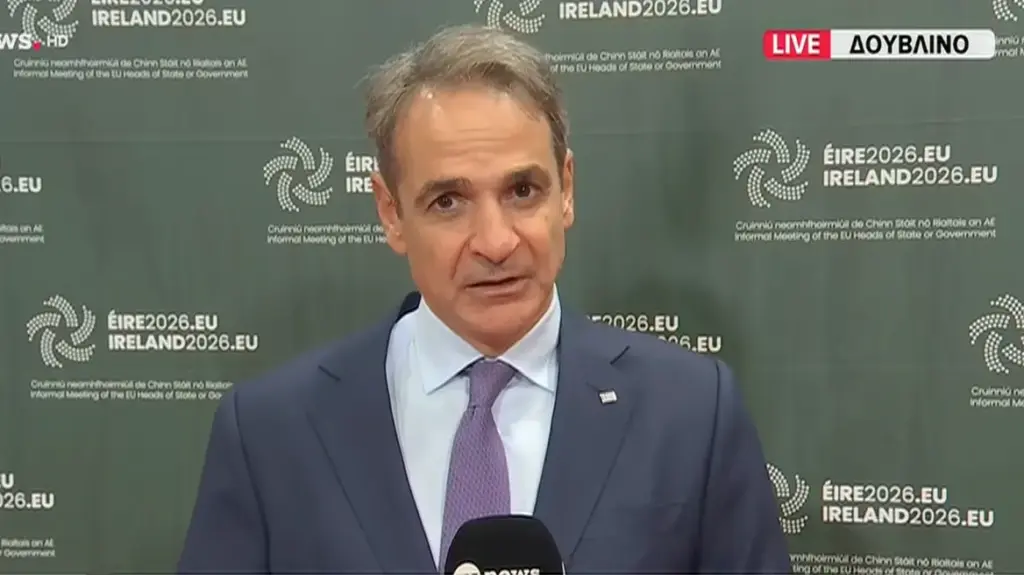
Greek Prime Minister Kyriakos Mitsotakis addressed the potential of artificial intelligence and the opportunities it presents for the functioning of the public sector in the years ahead, speaking upon his arrival at the informal European Council summit taking place in Dublin. The Prime Minister expressed his satisfaction that “we will dedicate an entire extraordinary European Council to the issues surrounding artificial intelligence,” while emphasizing that Greece has been at the forefront of European initiatives for years, working to shape a national strategy around a technology that, as he noted, has the potential to transform every aspect of daily life and the economy.
He placed particular emphasis on the prospects of leveraging artificial intelligence within the public sector, describing it as an invaluable tool for boosting productivity. In this context, he set a clear goal: within the next three to four years, all civil servants should be familiarized with the core functions and applications of artificial intelligence.
Mitsotakis: Europe needs to develop a comprehensive strategy on artificial intelligence
The Prime Minister stressed that a key government priority is harnessing artificial intelligence to accelerate and simplify public procurement processes, while simultaneously strengthening transparency. He noted that this technology can make a meaningful contribution both to reducing waste and saving public resources, as well as to improving oversight mechanisms.
Turning to concerns about the impact of artificial intelligence on the labor market and education — and in particular how it can be integrated into schools without undermining the development of students’ critical thinking — Mr. Mitsotakis highlighted the need for substantive dialogue with major AI companies and digital platforms. He also noted that Greece is prepared to introduce national legislative measures wherever deemed necessary.
He further reminded attendees that Greece will be the first and only European country to implement a ban on social media access for children under the age of 15, effective January 1, 2027. He emphasized that this decision sends a clear message to major digital platforms that they must comply with national legislation.
“We believe we are doing the right thing to protect the mental health of our children and to keep them away from toxic algorithms whose sole purpose is to exploit the vulnerability of children and teenagers in order to generate even greater profits. This is something the Greek government cannot accept,” he stated.
Closing his remarks, the Prime Minister underlined that Europe needs to develop a comprehensive strategy on artificial intelligence, expressing his confidence that Greece will play a leading role in the relevant initiatives.