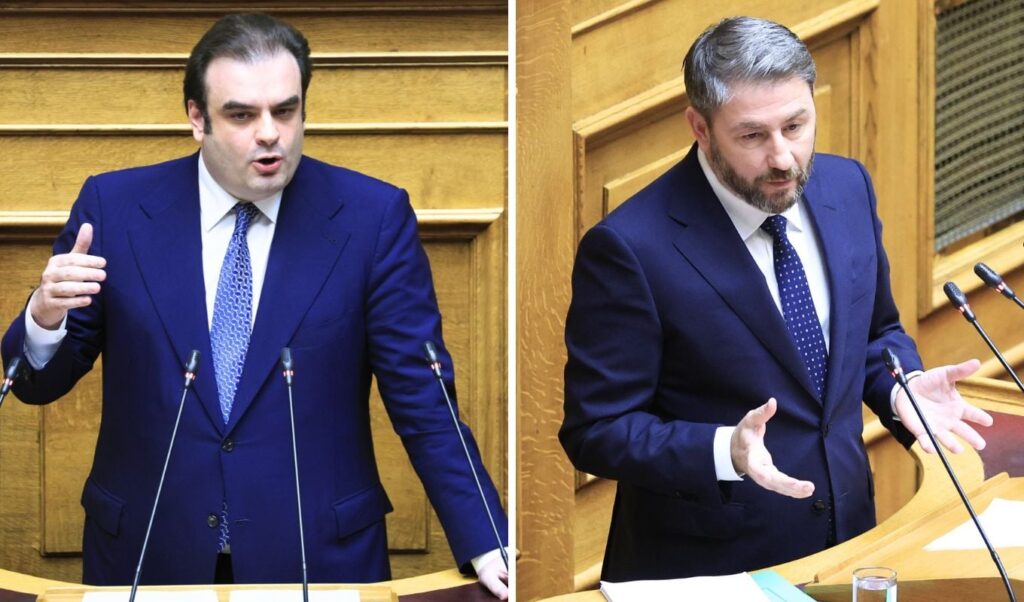
Greece’s Minister of National Economy and Finance Kyriakos Pierrakakis and opposition leader Nikos Androulakis exchanged sharp blows in what can only be described as a parliamentary showdown. The heated confrontation was triggered when Pierrakakis told the PASOK leader not to become a “Lafazanis” — a pointed political jab that immediately provoked a fierce response from Androulakis.
Read also: Pierrakakis fires back at Tsipras and debt funds: “History cannot be rewritten” — What he said about Article 23
Pierrakakis attacks Androulakis
Addressing the need for political consensus, Pierrakakis stated: “You say we should agree with PASOK’s amendment. We obviously agree with the parts that are reasonable, but on certain other points, as I described earlier… come on… don’t turn into a Lafazanis just to outflank Tsipras from the left.”
Androulakis fired back immediately, taking the exchange back to the era of Greece’s bailout memorandums: “You’re calling us Lafazanis? You seem to forget who tried to push Greece into the drachma. And it certainly wasn’t PASOK.” He further argued that it was New Democracy that had moved in that direction — both in 2009 and in 2012.
“We have institutional memory,” Androulakis said pointedly, accusing New Democracy of trying to present itself today as a responsible political force while conveniently ignoring its own past conduct. Responding to Androulakis, Pierrakakis replied with equal composure: “For ten years I have been part of a pro-European, reformist movement with its eyes on the future, not the past. If you’re looking for someone to blame for why you’re competing for second or third place, don’t look at me — look in the mirror.”
Pierrakakis targets Tsipras
Earlier in the session, Pierrakakis had launched a sharp offensive against former Prime Minister Alexis Tsipras, focusing on the issue of non-performing loans and SYRIZA’s role in transferring loan portfolios to debt management funds. “Who institutionalized the operation of credit servicers and the framework for transferring loans to funds? Law 4354 of 2015 — Alexis Tsipras. Who introduced electronic auctions? Law 4472 of 2017 — Alexis Tsipras,” he stated emphatically, also citing Laws 4346/2015 and 4549/2018 on primary residence protection.
Escalating his attack, Pierrakakis referenced Bank of Greece data showing that by March 2019, funds held loan claims worth approximately €18 billion. He then contrasted this figure with Tsipras’s side’s reference to €375 million in mortgage loans, highlighting what he described as glaring contradictions in the former prime minister’s claims. “From ‘not a single euro,’ after one meeting we jumped to €375 million. That’s progress of sorts — there’s just the remaining €17.5 billion to account for,” Pierrakakis quipped sharply.
“Mr. Tsipras can change his narrative as many times as he likes. He can remember what suits him and forget what exposes him. But there is one thing he cannot change: reality and history. History cannot be rewritten or erased,” he stressed.
Turning fire on the opposition
Pierrakakis then shifted his focus to the broader opposition, using the backdrop of the now-withdrawn Article 23 to accuse opposition parties of deliberately misrepresenting the provision as a sweeping threat to borrowers. “We withdrew the clause making the bilateral agreement under Article 23 an enforceable title in order to remove the last pretext — so you can no longer use it as a smokescreen to bury all the other provisions of this bill,” he said pointedly.
According to Pierrakakis, the original provision concerned a consensual agreement between creditor and debtor, and did not grant servicers a unilateral ability to obtain enforceable titles. He also rejected claims that judicial protection was being abolished, citing Article 933 of the Code of Civil Procedure, which explicitly provides for the right to contest enforcement proceedings. He then turned directly to the PASOK benches, attacking the main opposition over the amendment it had tabled seeking to abolish the enforceability of debt restructuring agreements under the out-of-court settlement mechanism.
Defending the existing framework, Pierrakakis argued that restructuring proposals are generated automatically, with the debtor being fully informed of the terms and free to decide whether to accept them. “We are not going to undermine a mechanism that offers real solutions to borrowers just to serve political improvisations,” he said firmly.
He also called on all opposition parties to clarify their positions on the remaining provisions of the bill, noting that “on television, a slogan is often enough — but in Parliament, concrete positions are required.” “While you search for arguments to attack the government, we will be creating rights for every borrower,” Pierrakakis added.
“The rules will be enforced”
On the substantive side of the debate, the minister highlighted two additional regulatory measures: a fixed interest rate of 3% for vulnerable and eligible borrowers who have entered the out-of-court settlement mechanism, and a tenfold increase in the maximum supervisory fine the Bank of Greece can impose on servicers — from €500,000 to €5 million. He noted that debt management companies will be required to respond to complete restructuring requests within three months and to conclude the process within six months at the latest.
Additional provisions include free debt information within 45 days, a suspension of interest accrual in the event of delays, a cap on advance payments of up to 15% of the principal in bilateral arrangements, and stricter penalties for violations against borrowers. “The rules will be enforced, borrowers’ rights will be respected, and every violation will have consequences,” Pierrakakis emphasized, insisting that the government is legislating to protect borrowers — not to serve the interests of debt servicers.