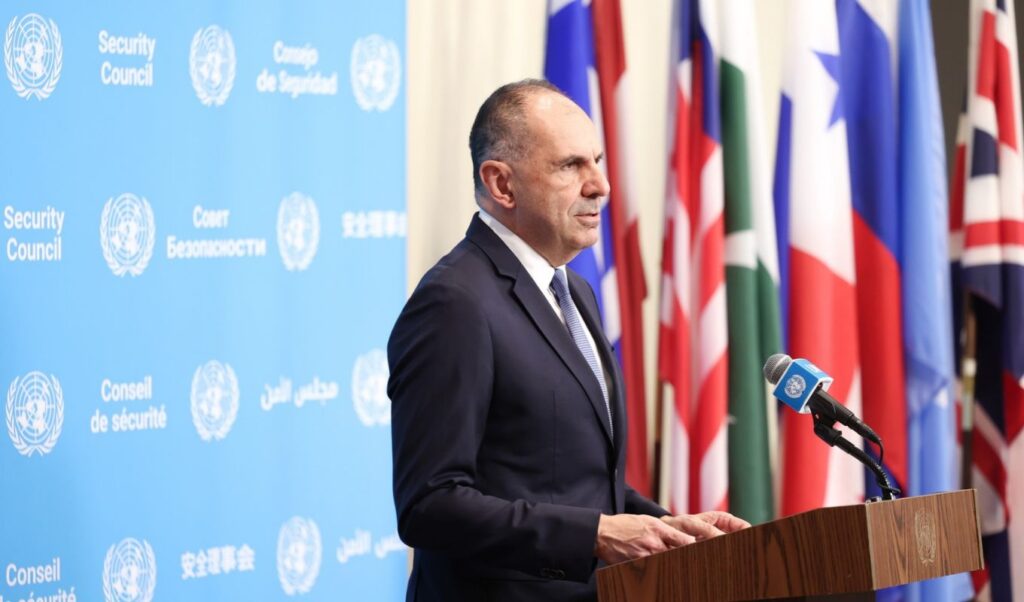
Greece made a powerful intervention from the United Nations podium, condemning the decision of the Libyan Parliament in Tobruk to ratify the illegal maritime zones agreement between Turkey and Libya. Foreign Minister Georgios Gerapetritis, internationalizing the issue and joined by representatives of the European Union, Cyprus, Egypt, Bahrain, and the United Arab Emirates, condemned the maneuvers of Turkey and Libya, describing them as an “undermining of the international legal order.”
Read more: UN: Five countries and the European Union issue a strong response to the ratification of the Turkey-Libya maritime deal — “Null, void, and contrary to international law”
Turkey-Libya maritime deal: How Athens can respond with EEZ, 12-mile limit, and drilling operations
As he stated in his address, “the acceptance of bilateral agreements that disregard applicable rules and principles of international law would set a dangerous precedent, undermining the international legal order and the principles upon which peaceful dispute resolution rests. The so-called Turkey-Libya memorandum runs counter to these fundamental principles. It ignores geographical reality and the rights of all coastal states involved over maritime zones, including the rights of islands, in accordance with the United Nations Convention on the Law of the Sea,” the Greek Foreign Minister noted, adding: “International law, and in particular the United Nations Convention on the Law of the Sea (UNCLOS), as well as customary international law, constitute the legal framework for the delimitation of maritime zones.”
Earlier, United Nations Secretary-General António Guterres, speaking from Cairo, sent a clear message to Turkey and Libya, stating that “anything that is not compatible with the Convention on the Law of the Sea should not be respected or accepted.” The United States State Department also reversed its initial position, characterizing the ratification of the memorandum as a “provocative” and “unconstructive” development.
Erdoğan’s stance
Nevertheless, the Turkish President, in a statement issued the previous day, dismissed reactions to the Turkey-Libya memorandum, claiming they “lack any legal basis.” In response to Turkey’s tactics, Athens appears determined to exhaust all available diplomatic tools in order to have the Turkey-Libya memorandum effectively rejected as null and void, while securing its sovereign rights in the Eastern Mediterranean.
The most prominent first move is the previously announced extension of the partially delimited Exclusive Economic Zone (EEZ) with Egypt, beyond the boundaries agreed upon in 2020. According to well-informed sources, this extension can be pursued by both sides, moving eastward toward Crete and also toward Cyprus.
How Greece can defend its rights
Developments following the ratification of the Ankara–Tripoli agreement appear to be overcoming Egypt’s initial hesitation to extend the delimitation beyond the 28th meridian — an area where Kastellorizo was previously considered to have limited influence — making it increasingly plausible that the Greek-Egyptian zone could be extended eastward to cover the maritime area around Rhodes.
Commenting on the shift in Egypt’s position, Professor of International Law Angelos Syrigos emphasizes that “it is significant that Egypt now accepts that there is a Greek continental shelf east of Rhodes, because it did not accept this before. Now it does accept it and is discussing it. That is important. Whether they will reach a conclusion soon, I don’t think so, because Egyptians are tough negotiators and these things usually take time. So let’s not expect anything to happen in the next six months.”
Meanwhile, Cairo — despite pressure from Ankara and the visit of Saddam Haftar to Egypt on Sunday — is expressing strong displeasure over the ratification of the Turkey-Libya agreement and over Ankara’s growing foothold in neighboring Libya, which Egypt views as an attempt to turn the country into a Turkish protectorate, threatening vital Egyptian interests and acting as a destabilizing force. According to Professor Syrigos, however, Turkey’s outreach to Egypt is running into serious obstacles. As he explains, “right now the dispute is about control over Libya. And the ratification of the agreement was a blow primarily against Egypt — that’s how I read it. And that’s where we’re all heading in the days ahead. The next chapter is the unification of Libya. So everything revolves around the issue of Libyan unification. Will Turkey be the dominant player in Libya? Will it be Egypt? That’s the whole game. And that’s why all of this happened — primarily the Turkey-Libya memorandum. Egypt is directly affected by this situation.”
The assessment that Turkey’s sphere of influence in Libya causes greater concern in Cairo than in Athens is shared by Professor of International Politics Antonis Klápsis, who focuses on Ankara’s effort to establish a friendly regime in Libya. As Professor Klápsis explains, Turkey “wants to create a Muslim Brotherhood state in Libya — that’s what this is about. Egypt has lived through this. The Muslim Brotherhood came to power and was overthrown in a coup. There is a fear that a destabilized Libya could act as a catalyst for internal destabilization within Egypt itself — that similar figures, Muslim Brotherhood members, could start competing for power in Egypt again. So the ratification of the Turkey-Libya memorandum is not simply a matter of international or diplomatic concern for Egypt. I believe it is a matter of the internal survival of a regime.”
Against this backdrop, Greek diplomacy is preparing its own counteroffensive, focusing on two specific operational moves. First, the extension of territorial waters south of Crete to 12 nautical miles, which Foreign Minister Georgios Gerapetritis announced by stating that “Greece will extend its territorial waters and will do so in the manner and at the time that Greece itself chooses.” Second, the activation of the so-called “Maniatis Law,” which stipulates that, in the absence of a delimitation agreement with neighboring states, the outer limits of the Greek continental shelf and EEZ coincide with the “median line.”
Analyzing how Greece can defend its rights on the ground, Professor of International and European Studies Charalampos Papasotiriou advocates for conducting drilling operations beyond the 12 nautical miles south of Crete, based on the median line, sending the message that “I will do whatever I want here, because this is mine — because I do not accept that Crete has no influence.”
According to Professor Papasotiriou, such a move would trigger a controlled crisis that would dismantle Turkish claims at the international level: “It will create a crisis in this maritime area. If Greece conducts drilling operations 15 miles south of Crete on the basis of the ‘median line’ and Turkey reacts by sending warships, you will create a crisis that will attract enormous international attention — one that will expose the absurdity of Turkey’s position and its argument that a large island like Crete has zero influence beyond its territorial waters.” He also believes it will demonstrate in practice the groundlessness of the stance taken by those states that limit themselves to vague calls for negotiations.