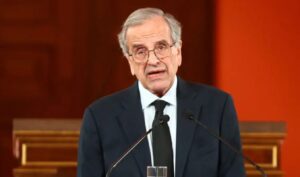
The Greek government is now moving decisively into “counterattack” mode — both institutionally and rhetorically — on the major foreign policy issues currently at stake. In recent days, it has faced intense criticism from opposition parties, as well as interventions from former prime ministers Antonis Samaras and Kostas Karamanlis, through a published article and a public speech respectively. The flashpoints: the ratification of the illegal Turkey-Libya maritime memorandum by the Benghazi parliament, and the agreement reached between Saint Catherine’s Monastery on Mount Sinai and the Egyptian government concerning the present and future of the historic monastery.
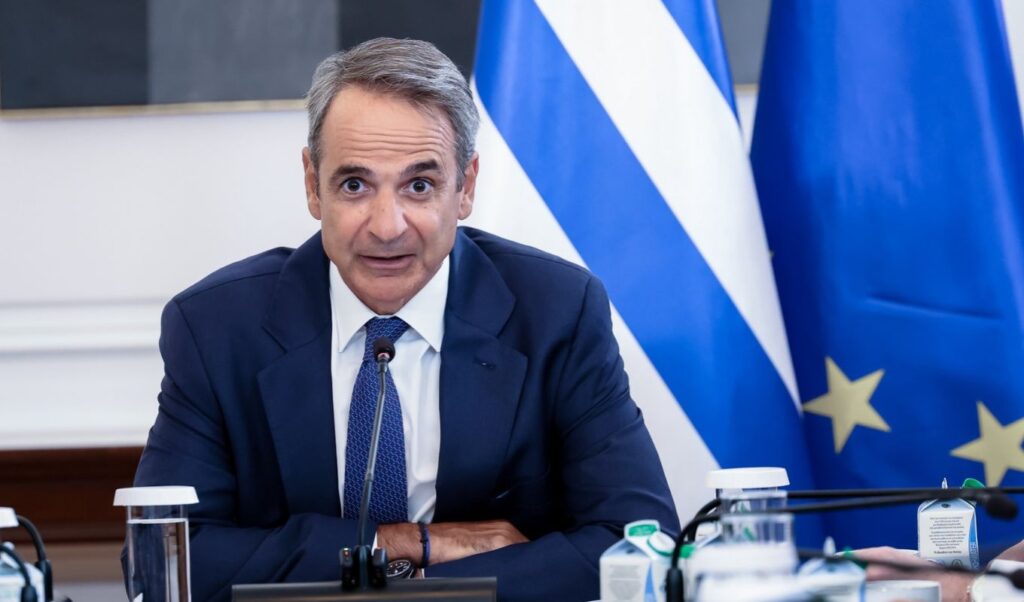
Mitsotakis launches a two-front counteroffensive following criticism from Karamanlis, Samaras, and the opposition
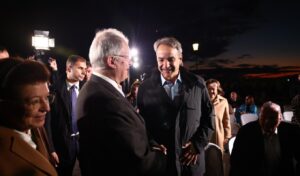
Yesterday morning, on the feast day of Saint Demetrios, Kyriakos Mitsotakis visited the Municipality of Agios Dimitrios in Attica, attending the Divine Liturgy at the namesake church. There, he listened with evident satisfaction to the words of the presiding Archbishop of Australia, Makarios, who praised him for the outcome of the Sinai Monastery agreement and the repatriation of relics to northern Greece. “Because we in the Church cannot judge political matters — but we can judge ecclesiastical ones — allow me to offer you my heartfelt congratulations for this agreement, which you managed to co-sign in cooperation with the Egyptian state, in order to safeguard the oldest monastic institution in the world today. As you know, the Monastery of Saint Catherine in Sinai is older even than Mount Athos. It is the most precious thing we have,” the Archbishop of Australia emphasized, among other remarks.
Shortly afterward, in New York, the European Union, Egypt, Cyprus, Bahrain, the United Arab Emirates, and Greece jointly submitted a statement to the United Nations declaring the Turkey-Libya memorandum to be “falsely titled,” stressing that it “remains null and void” and adding that it “cannot serve as a legitimate basis for the delimitation of maritime zones, nor can it produce legal effects for third states.” As the joint statement by the EU and the five countries makes clear from the outset, “the recent decision by the Libyan House of Representatives to ratify the falsely titled ‘Memorandum of Understanding between Turkey and Libya on the delimitation of maritime jurisdiction areas in the Mediterranean’ of 2019 raises serious concerns for regional security and stability. It also highlights a broader challenge to the international legal order: the need to ensure that arbitrary bilateral agreements do not undermine established rules of international law, nor infringe upon the rights of third states.”
At the same time, speaking from Egypt, UN Secretary-General António Guterres — without directly referencing the illegal Turkey-Libya memorandum — reiterated the United Nations’ commitment to upholding international law and the UN Convention on the Law of the Sea, stressing that “the rule of law must prevail over the law of the strongest.”
Marinakis takes aim
In Athens, prior to these developments but following the latest announcement from the U.S. State Department, government spokesperson Pavlos Marinakis directed pointed remarks at multiple targets, stating that “this response, along with all the official announcements from the European Commission, aligns not simply with Greece — it aligns with legality, with international law of the sea, and constitutes the best possible answer to all those who are trying to see defeats in order to justify their own political relevance.” His response to the criticism leveled by former Prime Minister Karamanlis regarding the government’s foreign policy — particularly toward Turkey — was notably measured, reflecting Maximos Mansion’s clear reluctance to make an adversary of the former premier. “We have the utmost respect for the former prime minister and we listen very carefully to everything he says and to his counsel — especially on matters of foreign policy. I also take note of the closing words of his speech, in which he calls on everyone — and this is something we must underline — to stand united and in solidarity. That is where I choose to remain,” said Mr. Marinakis.