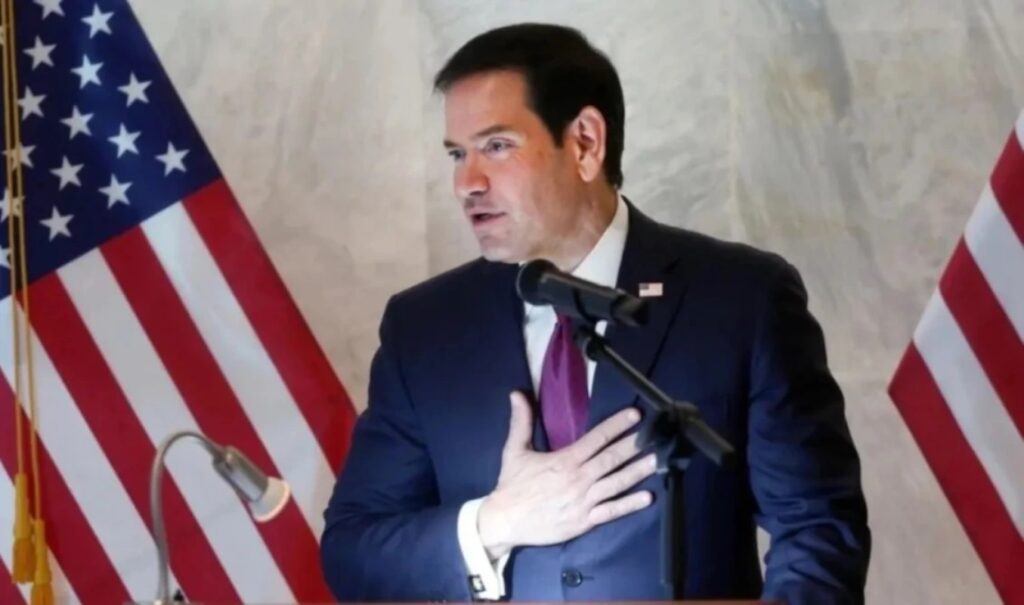
The Turkey-Libya maritime memorandum and the need to clearly reaffirm the United States’ position on Greece’s sovereign rights in the Eastern Mediterranean are the focus of a letter sent to U.S. Secretary of State Marco Rubio by the president of the American Hellenic Institute (AHI), Nick Larigakis. The move follows a recent clarification from the State Department, which described the ratification of the memorandum as “unconstructive and provocative,” while reaffirming that the U.S. position has not changed. The AHI welcomes this statement, but is calling on Washington to restate its longstanding principles on international law and the rights of Greek islands with greater clarity.
Turkey-Libya memorandum: What the AHI is asking of Marco Rubio
In his letter, Nick Larigakis calls on the U.S. government to publicly reaffirm that the Turkey-Libya maritime memorandum cannot infringe upon Greece’s sovereign rights, given that Greece is not a party to the agreement between Turkey and Libya. The Institute points out that this position is grounded in fundamental principles of international law, under which a bilateral agreement between two states cannot create obligations for — or affect the rights of — third countries without their consent.
At the same time, the AHI is urging the State Department to explicitly restate that islands, including Crete and the Dodecanese, are entitled as a general rule to maritime zones under the applicable rules of international law. This specific point carries particular weight given the geographic position of the Greek islands and the ongoing disputes surrounding maritime boundary delimitation in the Eastern Mediterranean.
The prior U.S. position and the 2020 precedent
The AHI president recalls the positions articulated by the United States in 2020, when Washington noted that the Turkey-Libya memorandum cannot legally affect the rights and obligations of third states, including Greece. The Institute considers it essential that this position be restated without ambiguity, in order to ensure continuity in U.S. foreign policy toward the region’s maritime disputes.
In the same vein, the AHI is asking Washington to maintain a firm and consistent approach grounded in the application of international law. According to the Institute, a clear U.S. stance can contribute to regional stability and reduce the uncertainty that continues to affect commercial and energy activities across the Eastern Mediterranean.
Crete, Souda Bay, and U.S. strategic interests
The letter makes particular reference to the strategic importance of Crete, the presence of the U.S. naval base at Souda Bay, and the energy investments being developed across the broader region. Nick Larigakis argues that clearly articulating the U.S. position is not solely about protecting Greek rights — it is directly tied to American national interests.
According to the AHI, legal certainty is a critical prerequisite for commercial investment and the development of energy projects, particularly in areas where maritime boundary disputes remain unresolved.
The letter concludes by emphasizing the need for a consistent American policy that, according to the Institute’s president, will strengthen respect for the rights of U.S. allies, reduce uncertainty, and safeguard Washington’s commercial and strategic interests in the Eastern Mediterranean.