Saudi Arabia and the United Arab Emirates are among the world’s top eight oil-producing nations and two of the largest Arab states in our broader region. Strengthening ties and upgrading cooperation with both countries has been a strategic priority for the Greek government for several years — one that is now taking on new significance in light of the ongoing conflicts in the Middle East, developments in the Eastern Mediterranean, and the illegal Turkish-Libyan memorandum.
Mitsotakis in Riyadh: Patriots, energy deals, and the cable to Europe
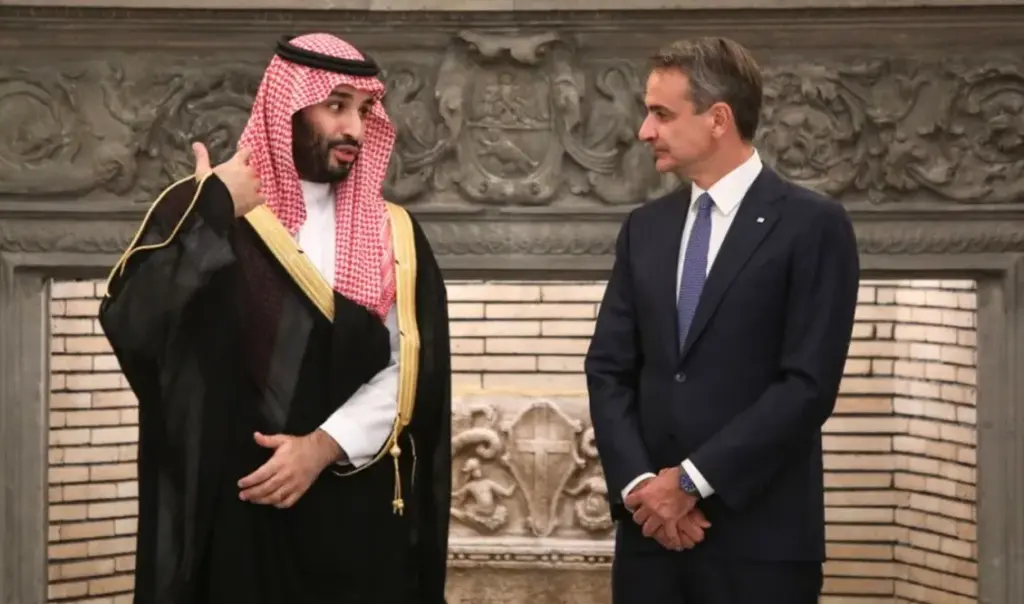
Against this backdrop, Kyriakos Mitsotakis has pursued — and secured — meetings with both leaders within the span of just a few days. On Thursday, he met at the Maximos Mansion with the Crown Prince of Abu Dhabi, Sheikh Khaled bin Mohamed bin Zayed Al Nahyan, while today he is in Riyadh for a meeting with the Crown Prince of Saudi Arabia, Mohammed bin Salman.
Among the key outcomes expected from the meeting is confirmation that the Patriot missile battery will remain in Saudi Arabia — a move that has clearly shifted the tone of bilateral relations and, as has been repeatedly communicated to Athens, is highly valued by Riyadh. “The Patriots protect critical energy infrastructure and supply security,” a close associate of the Prime Minister told Parapolitika, noting that the final decision on extending the deployment of the anti-aircraft missiles will be made shortly at a meeting of the Government Council on Foreign Affairs and Defence (KYSEA).
The same source emphasized that Greece is demonstrating its commitment to its allies during a difficult period, and recalled that the strategic partnership began five years ago with the Prime Minister’s visit to Riyadh in 2021. Last January, Mitsotakis, accompanied by a number of ministers, attended the Greece-Saudi Arabia Supreme Council for Strategic Partnership (Saudi-Hellenic Strategic Partnership Council) in the city of AlUla. It was the inaugural session of the body that the Greek Prime Minister and Mohammed bin Salman had agreed to establish in Athens in 2022 — yet another step toward deepening bilateral relations and expanding the rapidly growing Greek-Saudi partnership.
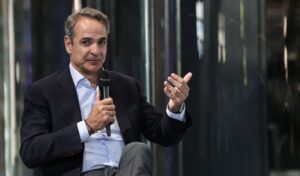
Perhaps the most ambitious joint project the two countries are planning is the construction of the East to Med Data Corridor (EMC) — an undersea cable that would transform Greece into a data gateway to the EU while simultaneously connecting it to the Middle East and Asia. Alongside this, a power transmission cable from Saudi Arabia to Europe via Greece would position the country as a critical “bridge” between the Middle East and Europe. “I consider my country, Greece, to be a bridge between Europe and the Gulf — two regions whose security, prosperity, and economic futures are increasingly intertwined. In an era of profound geopolitical uncertainty, bringing these two regions closer together is not merely an economic opportunity. I believe it is a strategic necessity,” Mitsotakis said in his address at the Greece-UAE Strategic Forum organized by Enterprise Greece, underscoring the Greek government’s clear strategic vision.