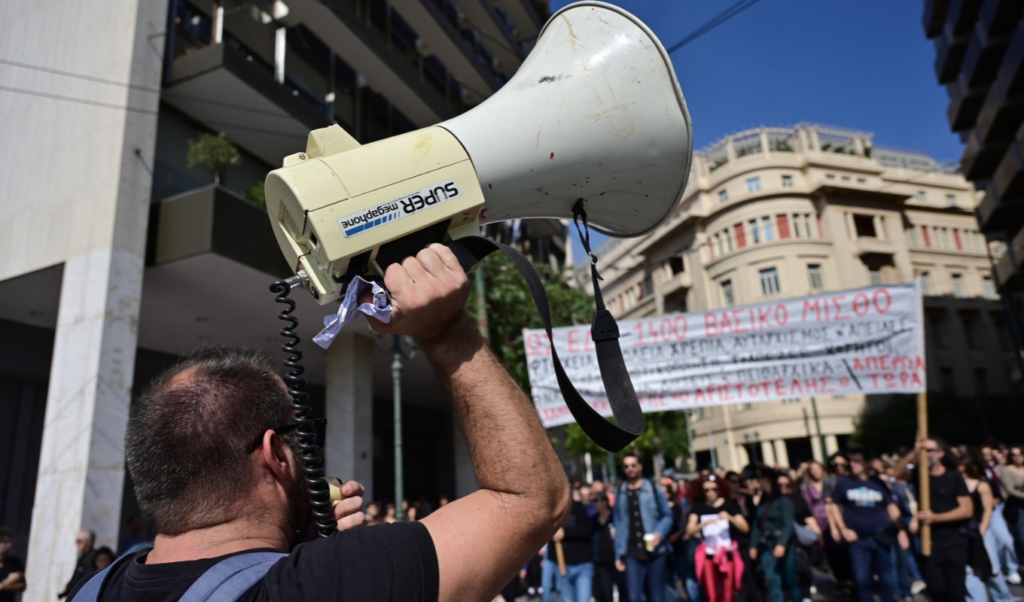
The “virus” of unrest and riots seen in Paris, Milan, Tirana, and elsewhere ultimately failed to spread to Greece — but that doesn’t mean the country is immune. In a nutshell, this is the prevailing mood at Maximos Mansion in recent days, where there is a sense of satisfaction that the protests held across the country were largely peaceful, with only sporadic and limited incidents.
Maximos Mansion: Satisfied with peaceful protests, but not letting its guard down ahead of future demonstrations
Nevertheless, there is no complacency, and the government’s aim is twofold: first, to ensure that any future mobilizations remain within the same peaceful framework; and second, to pre-empt potential occupations of schools and universities before they begin. At the same time, the government is seeking to respond as quickly as possible and defuse potential flashpoints for widespread unrest — as was the case, for example, with the fishermen’s strike, which was followed by a doubling of the fuel subsidy for fishing vessels.
Schools and universities in the spotlight — Zacharaki’s plan for direct dialogue with students
On the issue of student mobilizations, Education Minister Sofia Zacharaki is pursuing direct communication with students and their participation in the public dialogue on education. She is planning to invite 15-member student councils to the Ministry of Education for face-to-face discussions about the issues affecting them.
Pan-educational rallies: Teacher participation rates recorded by the Ministry of Education
It is also worth noting that the protests and pan-educational rallies held across the country last Wednesday fell short of the expected turnout — something the government has taken note of, without wishing to make any further comment on the matter. For example, according to data gathered by the relevant services of the Ministry of Education and Religious Affairs, teacher participation in the strike action reached just 20.61% in primary education (elementary schools) and a mere 11.16% in secondary education (middle and high schools). In other words, only one in ten secondary school teachers responded to the call for a pan-educational work stoppage, while two in ten primary school teachers joined the pan-educational strike.
Only one in ten secondary school teachers responded to the call for a pan-educational work stoppage, while two in ten primary school teachers joined the pan-educational strike.
“Those who were banking on chaos and violence didn’t get what they wanted”
“Those who were banking on chaos and violence — whoever they may be — didn’t get what they wanted. The police did their job exemplarily, protecting the demonstrators and their constitutional right to protest and express dissent, as provided for by the law and the constitution of every democratic country,” said government spokesperson Pavlos Marinakis. In the same vein, the secretary of the ruling party, Konstantinos Kyranakis, noted that “despite the Left’s ‘wishes’ for a general uprising, unrest, and a ‘France-style’ atmosphere, students chose to protest peacefully and with dignity.”
Government strategy on the cost-of-living crisis
On the pressing issue of the cost-of-living crisis — which lies at the heart of demonstrators’ demands across Europe — the government is also counting on the measures announced at the Thessaloniki International Fair, which are set to be voted on within November, as well as measures to be implemented during the same month. These range from an increased heating oil subsidy to a rent rebate scheme — which also covers student housing costs — with a maximum rebate of €800.
Published in Parapolitika