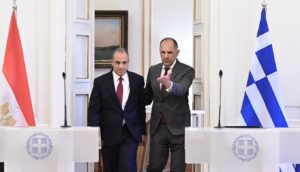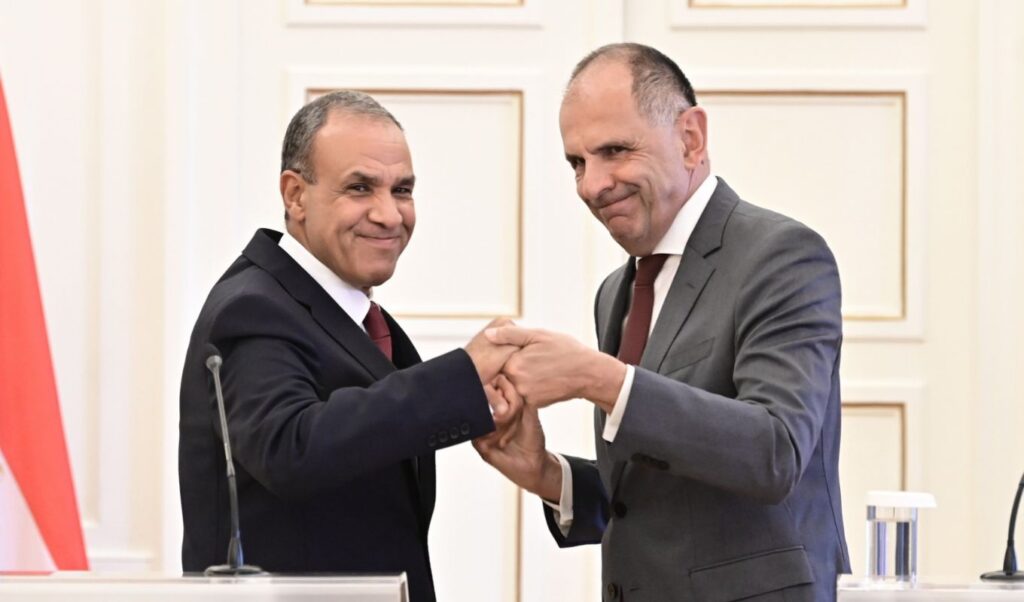
The diplomatic cooperation between Greece and Egypt is entering a decisive and immediate phase, serving as a direct response to the ratification of the Turkish-Libyan memorandum. The two sides have decided to move forward with expanding the bilateral agreement of 2020, which concerned the partial delimitation of the Exclusive Economic Zone (EEZ). This political will was confirmed during a phone call between Greece’s Foreign Minister, Giorgos Gerapetritis, and his Egyptian counterpart, Badr Abdelatty.
Read also: The illegal Turkish-Libyan memorandum backfires on Erdogan and Libya — Instead of isolating Greece, it has brought Athens and Cairo closer together and revived the 2020 EEZ agreement
Greece and Egypt’s checkmate move against Turkey on EEZ expansion: How the Turkish-Libyan memorandum will be nullified in practice
Building on the long-standing strategic relationship between the two nations, both foreign ministers agreed to jointly safeguard the geostrategic interests of Greece and Egypt against the Turkey-Libya agreement, which they describe as “illegal, null, and void.” The primary objective of the new Greek-Egyptian agreement is to render the Turkish-Libyan memorandum effectively void, as the newly delimited maritime zones will directly overlap with the areas that Turkey and Libya arbitrarily designated between themselves.
According to Professor of International Politics, Antonis Klapsis, this initiative represents an exceptionally well-calibrated and powerful diplomatic response on Greece’s part. As he argues, “it is a good response that the Greek side can give — namely, to extend the Greek-Egyptian agreement across the entire southern front of Crete, that is, beyond the boundaries of the Aegean Sea into the Libyan Sea, in order to demonstrate our resolve and to practically contest the Turkish-Libyan memorandum.” According to Professor Klapsis, the new delimitation between Greece and Egypt will overlap with and run adjacent to the areas covered by the Turkish-Libyan memorandum. “In other words, it will be stating in practice that areas which have been allocated to Libya or Turkey — agreed between themselves, not with us — we are now declaring do not fall under the jurisdiction of either Libya or Turkey, but rather under the jurisdiction of Greece and Egypt, respectively, depending on the case.”
Of particular geopolitical significance is the extension of the delimitation line beyond the 28th meridian, which is expected to encompass the broader maritime area of Kastellorizo. As Professor Klapsis emphasizes, “the issue of Kastellorizo has been contentious in the past, as the 2020 agreement had stopped the delimitation at the midpoint of Rhodes due to reservations held by the Egyptian side. The decision to extend the line further east inevitably includes Kastellorizo, which means that another significant regional state — Egypt — will officially recognize that Kastellorizo holds full maritime zone rights, a development that is considered extremely significant for Greek national interests.”
Consultations between the two sides are expected to begin immediately, as it is assessed that the delimitation of the new EEZ cannot afford long-term delays and requires prompt action. A firm foundation for the negotiations is provided by the explicit political will of both countries to fully implement the United Nations Convention on the Law of the Sea (UNCLOS). Egypt’s position carries particular weight, as it is the largest Arab state in the region with specific strategic interests in Libya. The Turkish-Libyan agreement directly affects Egyptian interests, given that Cairo seeks to prevent Libya from being transformed into a Turkish protectorate — a scenario that could act as a destabilizing catalyst within Egypt itself.
This diplomatic move is part of Athens’ broader efforts to ensure concrete consequences for Libya and Turkey as a result of their operating outside the framework of international legality. In this context, Greek diplomacy is planning further steps, including seeking restrictions on European Union funds directed toward Libya, as well as linking these illegal actions to Turkey’s European accession process.