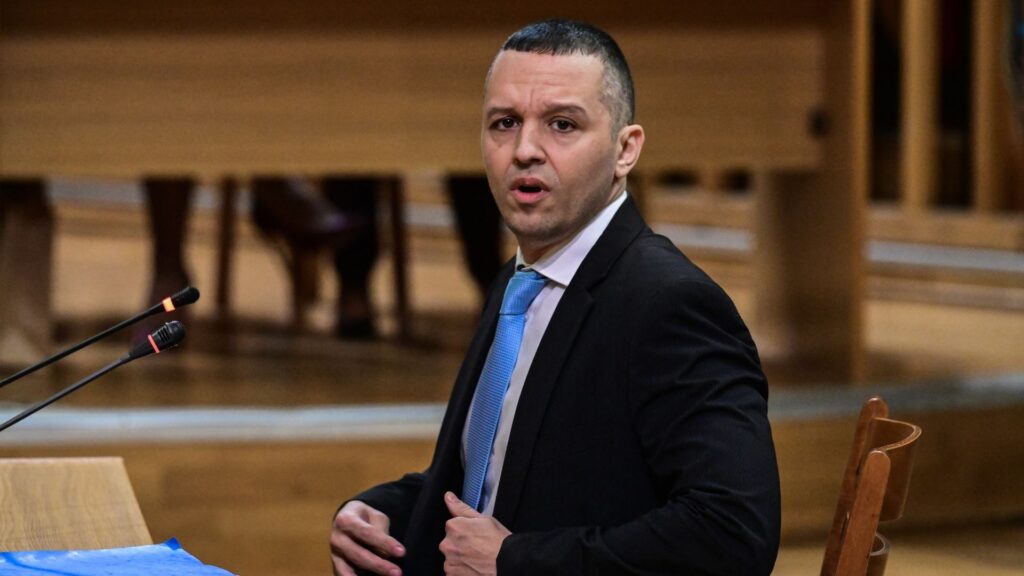
Ilias Kasidiaris is expected to be released from prison on September 15, and is already reportedly weighing his next political moves — with his primary goal being to keep the door open for a return to active politics and participation in the next national elections.
His release fundamentally changes the landscape compared to the previous electoral contest. In 2023, the legislative measures enacted and the relevant rulings by Greece’s Supreme Court (Areios Pagos) served as the main institutional barrier to his candidacy. The court’s reasoning at the time was based on the fact that he was incarcerated and convicted of leading a criminal organization, and that his conduct was incompatible with the free functioning of a democratic system.
However, the critical point ahead of the next election is that the existing legislation does not, in and of itself, constitute an absolute and blanket ban on any possible electoral participation by Kasidiaris. The matter will ultimately be determined by how he attempts to structure his political comeback — and, crucially, whether and to what extent that comeback can be formally linked to a new party formation.
Under the current legal framework, the primary obstacle concerns the ability of a person subject to specific prohibitory provisions to establish or lead a political party. Of particular significance would also be any scenario in which it could be demonstrated that a person who does not formally appear as party leader is in fact the “hidden” leader operating behind the scenes. In such a case, scrutiny by the Supreme Court would be decisive.
This is precisely where the political scenario being widely discussed comes into play — one that could potentially be exploited to his advantage: the creation of a party structure in a way that does not produce an institutional link to Kasidiaris himself, while he would separately attempt to participate in the electoral process in a different capacity — even as an independent candidate or through an electoral alliance with the new formation (following its approval by the Supreme Court).
This is essentially a variation of the strategy employed in the previous elections involving the “Spartans” party. At the time, Kasidiaris — while imprisoned and unable to stand as a candidate himself — had publicly declared his support for that particular party after the Supreme Court approved its participation in the elections. The Spartans ultimately managed to cross the electoral threshold and enter parliament. Subsequently, the party’s relationship with Kasidiaris became the subject of intense political and legal controversy, with the case engaging both the criminal courts and the Electoral Court.
The question now opening up is whether a similar political strategy can be repeated — this time with Kasidiaris outside prison and with far greater capacity for public intervention. The critical variable will not be his intention alone, but also whether a new political formation would be able to pass Supreme Court scrutiny without any connection emerging that would trigger the provisions of the existing legislation.
In other words, his release does not automatically translate into a return to the electoral stage. It does, however, create a new field of maneuver — one in which he appears to be actively searching for an institutionally viable path back into the electoral process. The final outcome will depend on the moves that are made, as well as on the judicial review of the legality of those choices by the competent courts.