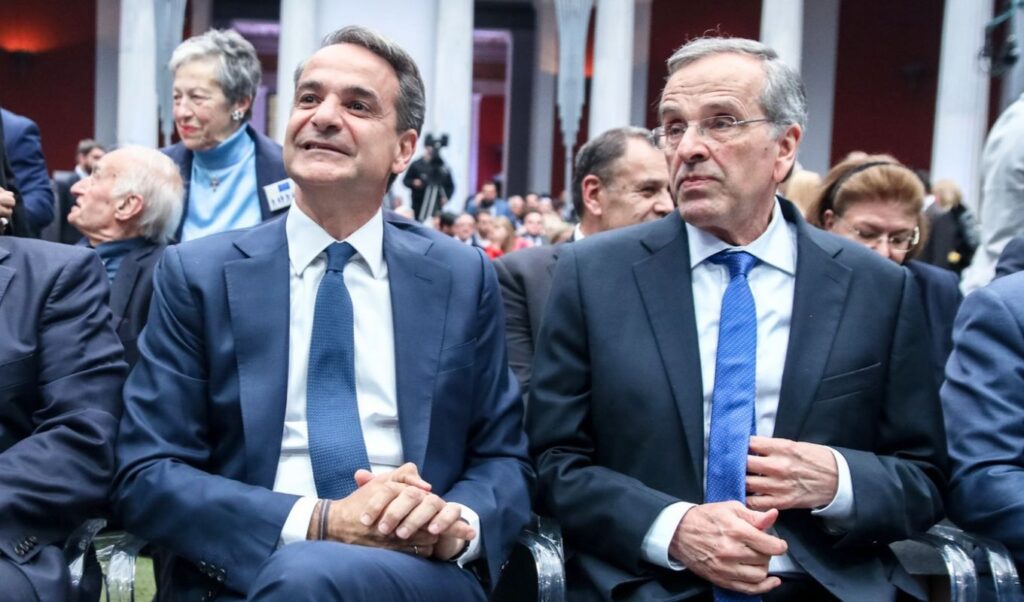
The clash between Kyriakos Mitsotakis and Antonis Samaras has reached an entirely new level. Those closely following developments within Greece’s center-right political sphere know that the moment the prime minister chose to respond to his predecessor in such harsh terms from Thessaloniki, the game fundamentally changed. The reference to Antonis Samaras’s “expertise” in damaging New Democracy was no throwaway remark — nor was the pointed advice to consider his own legacy. The message could not have been clearer: if the former prime minister decides to push things further, the government will no longer be watching in silence. Samaras’s response came on exactly the same wavelength. His accusation that New Democracy has become “Mitsotakis’s party” strikes at the very heart of the political confrontation. For the former prime minister, the issue is not simply who occupies the Maximos Mansion. It is about what remains of the party’s ideological and political identity.
Stubbornness and the government’s response
At the Maximos Mansion, it has long been understood that the Samaras affair will not be resolved with a single statement or a quiet behind-the-scenes agreement. This is precisely why the government’s inner circle appears to be gradually shifting from a strategy of avoidance to one of direct confrontation.
Adonis Georgiadis made sure to set the tone. His comparison of Samaras’s rhetoric to that of Zoe Konstantopoulou ranks among the harshest political attacks made by a government official in recent memory. The phrase “stubbornness is blinding” did not go unnoticed — because behind that specific reference lies an entire government reading of the situation: that the former prime minister’s campaign can no longer be explained in purely political terms.
Dora Bakogianni, however, offered a different interpretation. She argued that the more aggressively Antonis Samaras attacks New Democracy and Kyriakos Mitsotakis, the more likely he is to ultimately rally the party’s base around the government. The feedback she said she received from New Democracy voters in Thrace following Samaras’s intervention is telling of how the situation is being read at Maximos: the former prime minister may end up serving as the most effective force for uniting New Democracy.
Legacy becomes a political weapon
One word keeps resurfacing with striking frequency: legacy. Kyriakos Mitsotakis had already used the same term several months ago, when he essentially warned Antonis Samaras against making a move that could damage the party. Now, however, the framing has become far more aggressive — and that signals something significant. The government appears to have concluded that the prospect of a new party to the right of New Democracy is no longer a theoretical exercise on paper, but a real possibility that must be confronted both politically and organizationally.
The “war room” and the leaks
Meanwhile, circulating reports about the activities of those in Samaras’s inner circle have added another layer of intrigue. References to a “war room” in central Athens, combined with leaks suggesting a new political movement could be announced as early as September, have created a growing sense that the plan has moved from concept to active preparation.
Antonis Samaras himself, however, continues to keep his cards firmly hidden. And for those who understand how he operates politically, that is not necessarily a sign of uncertainty. It may simply be part of the strategy. After all, the timing of when he reveals his hand is the last major card he has left to play.
Personal rivalry or political rupture?
This is precisely where the key divide between the two sides lies. Within the government camp, there are officials who see Samaras’s stance as a personal vendetta driven by stubbornness, with the ultimate goal of denying New Democracy an outright parliamentary majority.
Those in the former prime minister’s circle tell a completely different story. They insist the disagreement is purely political and centers on a range of issues that, in their view, have fundamentally altered New Democracy’s identity: foreign policy, immigration, the economy, and of course the much-debated “woke agenda.” And that is really where the heart of the matter lies. This conflict is not only about Mitsotakis. It is also about what kind of New Democracy will exist in the days that follow.
From intra-party grievances to electoral arithmetic
The latest interventions from government officials signal that Maximos is already preparing for the possibility that this confrontation could spill into an electoral battle. Makis Voridis launched an attack on the former prime minister over his comments about party officials with PASOK backgrounds, while Thanos Plevris was even more direct: if Antonis Samaras forms a party, he will be treated as a political opponent — full stop.
That may be the most significant message of all.
Until now, Samaras could speak as a former prime minister and a historic figure within the party. If he fields his own electoral list, he will be speaking as a party leader. And New Democracy’s response will be of an entirely different nature.
The question now preoccying the party’s strategists is a single one: how much could such a move cost them at the ballot box? Because a Samaras party does not need to become large to cause serious damage to New Democracy. It only needs to capture enough votes to deny the party an outright majority. And if that happens, today’s exchange of fire will look like nothing more than the opening chapter of a far larger story.
The fault line within Greece’s center-right has already opened. And now everyone is waiting for Samaras’s next move.