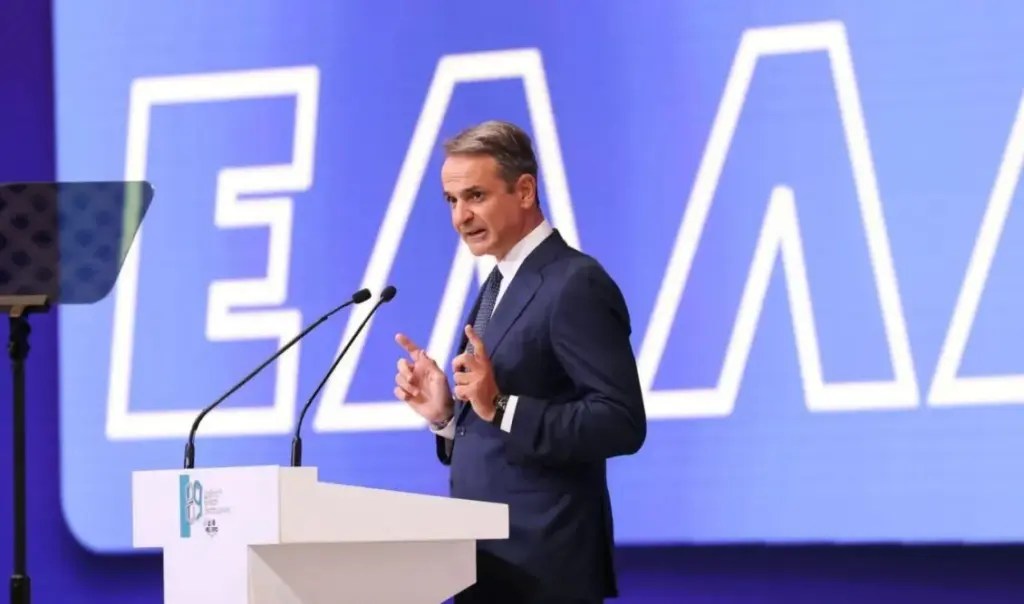
A sweeping package of measures covering millions of citizens and businesses — spanning families with children, retirees, civil servants, private sector employees, freelancers, and farmers — will be announced tonight by Prime Minister Kyriakos Mitsotakis as part of his keynote address at the opening of the 90th Thessaloniki International Fair (TIF).
Mitsotakis at TIF: Relief measures worth approximately €2 billion for 2027
Framing this year’s Thessaloniki International Fair as a pre-election event — but emphatically not “an exhibition of unbridled handouts, but rather a package of costed relief measures worth approximately €2 billion for 2027, with a planning horizon extending to 2030” — close associates of Kyriakos Mitsotakis are sending a clear signal ahead of tonight’s speech: “Everything you hear at TIF from the Prime Minister will be put into action.”
The Prime Minister is taking the stage at the International Fair for the eighth time, with the stated aim of signing a new “Contract of Truth” with Greek society and presenting his vision for the country through the end of the decade. In this context, the words “credibility,” “consistency,” and “trust” are expected to dominate the Prime Minister’s address, as the government — during the current pre-election period — seeks to tie its campaign narrative to the need for stability, while also highlighting its track record of matching words with deeds, insisting that Kyriakos Mitsotakis’ commitments to citizens are always fulfilled.
Boosting disposable income at the heart of Mitsotakis’ announcements
The cornerstone of tonight’s announcements will be measures to increase disposable income. The Prime Minister has already pre-announced a minimum wage hike ahead of the next elections, pushing the bar above €950, with a target of €960–970. The scenario of increasing the annual November bonus for pensioners to above €400 — and potentially up to the level of the national pension of €448 — is considered very likely.
In the final hours before the speech, a proposal has also been placed on the table for an additional half-month’s salary every March for civil servants — a measure that would acquire a permanent character, effectively acting as a partial restoration of the 13th-month salary. Along similar lines, the Prime Minister is expected to announce interventions aimed at tackling the rising cost of living, with the government focusing on social groups that have been disproportionately affected by multiple crises in recent years.
Positive news is expected for small and medium-sized businesses, freelancers, families with children, and farmers. For families, the focus is on financial relief for those with three or four or more children. Notably, a significant portion of the announcements is expected to concern three-child families, with the possibility of equalizing the benefits available to them with those currently granted to larger families — a longstanding demand — while increases of up to 30% in family allowances are also under consideration. Among the “surprise measures” on the table is also a new state-funded children’s savings model for children up to 18 years of age.
Tax-compliant citizens and the middle class in Mitsotakis’ crosshairs
The government’s focus is also turning to two key segments of the population: first, tax-compliant citizens — those who consistently meet their tax and social security obligations — and second, the middle class. In recent months, the economic policy team has been working on a tax relief package targeting freelancers, small and medium-sized enterprises, and the middle class, aimed at easing the discontent generated by the implementation of the presumptive taxation system for self-employed professionals.
In this light, a reform of the presumptive taxation system and a reduction in advance tax payments are considered likely. Also under consideration is the full abolition of the professional activity fee for businesses, as well as a reduction in the corporate profit tax rate. Further measures in the same spirit include a new reduction of employer social security contributions by half a percentage point, continuing the policy of gradually reducing non-wage labor costs that has been pursued in recent years. Additionally, the introduction of a protected professional bank account — exempt from seizure — for businesses is also part of the broader discussion.
Housing policy: New measures for first-time homebuyers
Housing policy is expected to be a particularly significant chapter of tonight’s announcements, as the high cost of purchasing and renting property remains one of the most pressing challenges facing Greek households. In this context, the continuation or expansion of low-interest financing programs for young people seeking to buy their first home is considered likely.
Farmers represent another sector expected to feature prominently in tonight’s announcements, with further tax reductions anticipated for the agricultural community. This professional group — much like freelancers — has traditionally been a key constituency for the ruling New Democracy party, and the government’s objective is to reconnect with these groups ahead of the upcoming elections. On the road to the ballot box, Prime Minister Kyriakos Mitsotakis is signaling a broader outreach to the farming community, placing agricultural sector interventions high on his party’s pre-election agenda.
The overarching message of tonight’s announcements, however, is that the fiscal space created will be distributed in accordance with European and budgetary rules — with government officials underscoring that the Mitsotakis administration pursues sound economic governance and is returning the dividends of growth back to society. In this context, the Prime Minister is expected to emphasize the costed nature of the measures and to draw a sharp contrast between his government’s approach and those of his political opponents. The Maximos Mansion — the Greek Prime Minister’s office — is seeking to frame the dilemmas of the upcoming election by placing on one side of the scale what it describes as the “costless and unworkable promises” of Alexis Tsipras, and on the other its own economic plan — one that, according to the Prime Minister’s associates, consists of realistic policies and a clear roadmap for the future.
In any case, the measures to be announced tonight will be broad-based, permanent in nature, and the overwhelming majority will take effect in 2027.