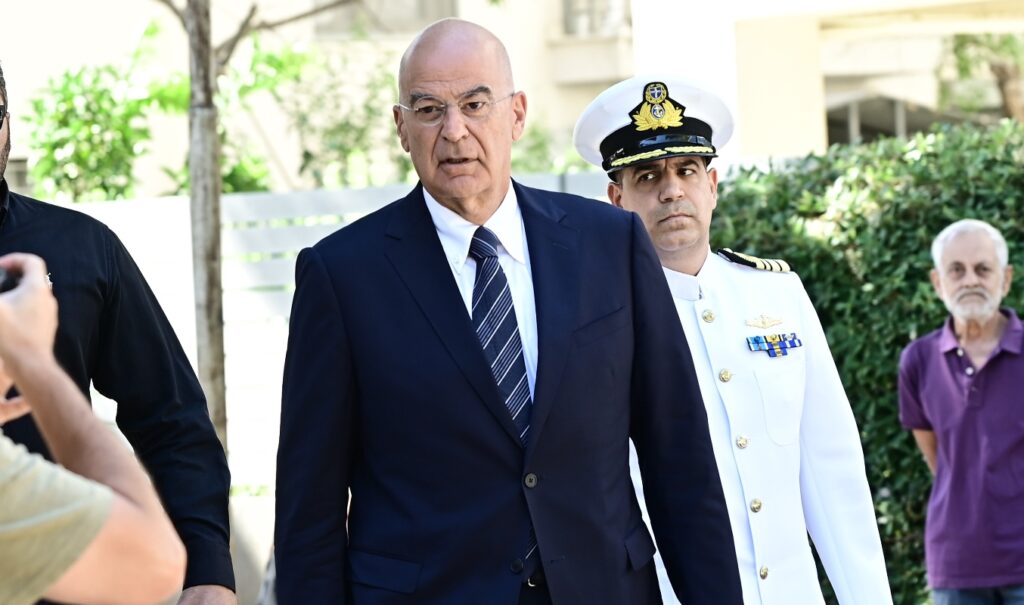
The Shield of Achilles is one of the key pillars of the comprehensive reform of Greece’s Armed Forces being implemented through Agenda 2030, with Defense Minister Nikos Dendias outlining a new philosophy for the country’s defense and deterrence strategy. In a statement to Vima tis Kyriakis and an official announcement from the Ministry of National Defense, the minister described the new system as “an important link in the reform of the Armed Forces” and “a necessary response to the geopolitical and technological challenges of our time,” stressing that through Agenda 2030, “our country is entering a new reality” and “a new concept of defense and deterrence.”
Read also: Kyriakos Mitsotakis: Meeting with the President of Lebanon on Monday, August 31, at Maximos Mansion
Shield of Achilles: The five layers of protection
According to Nikos Dendias, the name of the new system “was not chosen at random.” The shield of the Homeric Achilles featured “five overlapping layers,” and similarly, the modern Greek “Shield” is designed as “a multi-layered architecture for the protection of Greek territory,” spanning five distinct domains: “sea, land, air, cyberspace, and space.” The Defense Minister described it as essentially “a transition from a collection of weapons systems to a holistic deterrence system.”
This new architecture incorporates ships, aircraft, ground assets, autonomous systems, and new satellites, as well as “every platform equipped with sensors.” All of these will be interconnected “within a unified network-centric architecture,” underpinned by “an integrated Command & Control system.” As Dendias explained, this system “prioritizes threats, assesses them, and recommends the optimal response,” transforming “information into operational capability.” At the same time, the fleet’s new vessels and 4.5th and 5th generation aircraft will not be limited “to the narrow defense of the Aegean,” but “will be able to assume a broader deterrent role.”
Satellites and a new dimension in space
Space occupies a prominent role within the Shield of Achilles. The Defense Minister referenced the installation in Greece of one of the two nodes of the European secure governmental satellite communications program GOVSATCOM, which, he said, “highlights our country’s geopolitical and strategic role as a pillar of security and stability within the European Union.” He also noted that “Greece has acquired a fleet of microsatellites and is preparing for its first large geostationary satellite.” Satellite communications, he added, “constitute an additional dimension of the Shield of Achilles,” representing “the extension of our holistic approach into the space domain,” which is becoming increasingly critical to modern defense.
Agenda 2030 and the Greek defense industry
The plan is also directly tied to another central objective of Agenda 2030: “the creation of a modern defense innovation ecosystem and the strengthening of the Greek defense industry.” Dendias reiterated the requirement for “the participation of the Greek defense industry at a rate of at least 25% in all procurement programs,” while emphasizing “the substantive transfer of know-how and production to the Greek defense ecosystem” and “access to the source code of these systems.”
“The goal is for Greece to no longer remain a passive buyer and user of defense systems,” the minister stated, underlining that the country must “actively participate in their design, production, and development, strengthening domestic expertise.” In closing, he described the “Shield of Achilles” as “a new approach to the use of weapons systems, with a holistic dimension,” one that “reflects the new reality of Agenda 2030 and a different concept of national defense.”