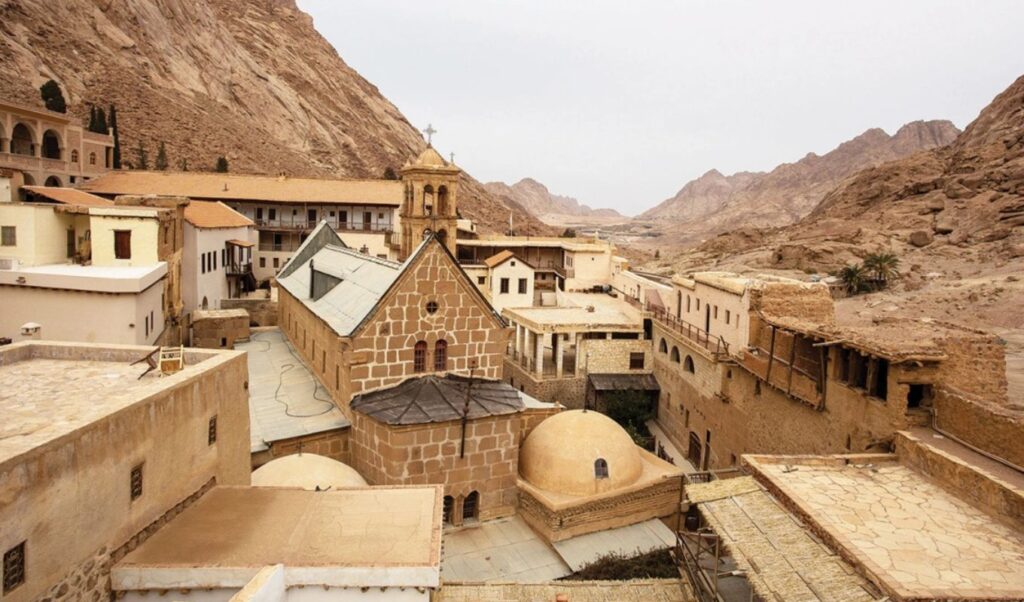
The court ruling expected this Sunday on the ownership status of the Monastery of Saint Catherine in Sinai is set to become a key barometer for Greek-Egyptian relations, arriving at a moment when Athens and Cairo — despite months of negotiations — have yet to definitively resolve a dispute that continues to test an otherwise close strategic partnership.
The final hearing before Egypt’s Court of Cassation has been scheduled for August 23, with the Greek side closely monitoring developments. The issue has remained unresolved for more than a year, following a court ruling in May 2025 that caused serious concern in Athens and within the monastic community. The Egyptian side had at the time rejected interpretations suggesting the monastery would be closed or seized, arguing that its religious character, its operations, and the monks’ right to use its premises were fully safeguarded. The critical point, however, concerned the lands and properties surrounding the monastery complex — areas for which the court’s ruling introduced new questions regarding ownership.
Sinai Monastery: Key decisions expected in the coming days
The case had taken on particular political weight because just weeks earlier, during Egyptian President Abdel Fattah el-Sisi’s visit to Athens on May 7, 2025, Prime Minister Kyriakos Mitsotakis and the Egyptian president had publicly underscored the need to preserve the monastery’s character as a living center of the Greek Orthodox world. Following the court ruling, the two leaders held a phone call and agreed that any solution should be built on the mutual understanding already established between the two sides. A Greek delegation subsequently traveled to Cairo, though the process has yet to yield a final agreement. Since then, negotiations have continued at political, diplomatic, and legal levels. The core objective is to find a formula that protects monastic life and the monastery’s right to use its premises, while remaining compatible with Egyptian law. Discussions have explored the possibility of formally recognizing Egyptian state ownership of the properties, alongside a permanent guarantee of the monastery’s right of possession and use — free of any financial obligation.
Outstanding issues
Unresolved issues, however, persist regarding specific properties and land outside the monastery walls, including the gardens that serve the needs of the monastic community. It is precisely this inability to reach a definitive settlement that makes Sunday’s ruling so significant. Over recent years, Athens and Cairo have built a strategically important relationship, spanning maritime zone delimitation, energy cooperation, and coordination on regional developments. A court outcome that further complicates the prospects of a compromise over the monastery would create a serious political problem within a relationship in which both governments have invested heavily. In Athens, the concern extends beyond simply protecting the monastery’s day-to-day operations.
The need for a clear and durable legal framework
What is considered essential is the establishment of a clear and robust legal framework that would prevent the monastery’s ownership status from remaining perpetually vulnerable to new legal challenges. Adding further complexity to the equation is the question of the monastery’s legal personality, as well as the pending formal recognition by Egypt of the newly appointed Archbishop and Abbot, Symeon.
The intervention of PASOK MEPs
The issue is also being pushed to the European level by Greece’s PASOK party. Four of its Members of the European Parliament — Yannis Maniatis, Nikos Papandreou, Sakis Arnaoutoglou, and Nikolas Farantouris — submitted a joint written question to the European Commission ahead of Sunday’s hearing. Their intervention raises questions concerning the monastery’s legal status, the recognition of its Archbishop, and the effectiveness of legal protections available for its historic ownership rights. They also asked the Commission to clarify whether these developments have been taken into account in the context of European Union funding to Egypt, and whether they are consistent with Cairo’s international obligations regarding religious freedom and the protection of historic religious institutions.
The significance of the ruling
Sunday’s ruling, therefore, is not simply the closing of another legal chapter. The decision could decisively affect the remaining space for a mutually agreed political and legal solution. And precisely because Athens is seeking to keep this specific issue separate from the broader strategic character of its relationship with Egypt, the way Cairo manages the aftermath will serve as a real test of whether both sides can translate the political will they have repeatedly declared into a final and sustainable settlement. It is worth recalling that in recent years Egypt has been carrying out an extensive development program in the Sinai region, aimed at preserving and promoting the monument while advancing religious tourism. At the same time, the Greek state — working alongside the Egyptian government and the Academy of Athens — is actively contributing to the conservation of the monastery’s priceless manuscripts, icons, and mosaics.
Published in Apogeumatini