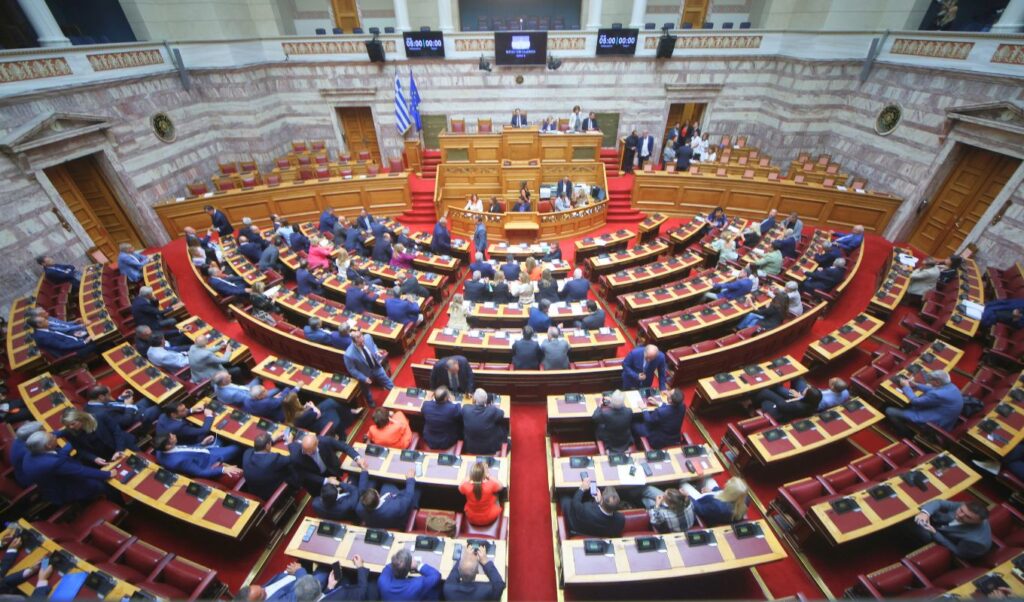
The first act of the Constitutional Revision was completed on Monday evening with the conduct of the open roll-call vote in the Parliament’s Plenary Session. The next milestone is set for after the summer recess, at the end of August, when a second vote will take place on articles that received more than 151 votes in favor. As had become apparent during the proceedings of the relevant committee, consensus was an “impossible dream” — a reality confirmed by the voting results.
Read also: Constitutional Revision: The absentees and independents who voted “present” on articles 16 and 86
Constitutional revision: consensus falls on deaf ears
The proposed revision articles received affirmative votes from New Democracy and certain independent MPs (158 to 161), while PASOK — as it had signaled during committee sessions — voted “present” on articles it agreed with (e.g., articles 16 and 86), and voted against the remaining ones, as did the other opposition parties. A total of 294 MPs participated in the vote, while former Prime Minister Antonis Samaras and independent MPs Marios Salmas and Giannis Kontis were absent.
On article 16, concerning non-state universities, 160 MPs voted in favor, 93 voted against, and 41 declared “present.” Among the 93 who voted against were Nina G. Kasimati (SYRIZA MP for Piraeus B’) and independents Myrto Korovesi and Giota Poulou. The PASOK parliamentary group voted “present,” as did independents Theodora Tzakri, Michalis Chourdakis, Evangelos Apostolakis, Athena Linou, Areti Papaioannou, and Bourhan Baran.
Bakogiannis votes “present” on article 30
Article 30, concerning a single six-year presidential term — an article on which several majority MPs had expressed reservations — was passed by 158 MPs. A total of 135 MPs voted against it, while according to reports, Dora Bakogiannis was the sole “present” vote on this particular article.
Article 86, on the criminal liability of ministers, passed with 159 “yes” votes, was rejected by 95 MPs, while 40 MPs declared “present.” Among those who voted against were Nina G. Kasimati, Myrto Korovesi, and Giota Poulou. The PASOK parliamentary group and independent MPs Evangelos Apostolakis, Theodora Tzakri, Michalis Chourdakis, and Areti Papaioannou declared “present.”
A detailed breakdown of the articles proposed for revision by New Democracy and the votes they received:
New Article 5b: “Artificial intelligence must serve individual freedom and societal well-being, so as to mitigate risks and harness the benefits it offers.”
YES: 161 NO: 94 PRESENT: 39
Article 14: “Broadening of the protection of freedom of expression to cover modern media. Protection of journalists, including against their employers. Removal of detailed provisions that are not appropriate for a Constitution.”
YES: 160 NO: 94 PRESENT: 40
Article 15: “Broadening of the protection of freedom of expression to cover modern media. Protection of journalists, including against their employers. Removal of detailed provisions that are not appropriate for a Constitution.”
YES: 160 NO: 94 PRESENT: 40
Article 16: “State responsibility for the protection and promotion of the Greek language. Protection of the Greek flag as a symbol of the Greek nation. Possibility of providing higher education by university-level legal entities, which may be of public or private character, with full self-governance, under state supervision and subject to ensuring a high standard of studies provided.”
YES: 160 NO: 93 PRESENT: 41
Article 17: “Protection not only of ownership but of property in general. Compensation for restrictions on use without expropriation. Possibility of transferring building coefficients (dynamic urban planning). Utilization of abandoned buildings for social purposes.”
YES: 161 NO: 94 PRESENT: 39
Article 21: “State responsibility for affordable housing. Consideration of intergenerational justice and solidarity in the design of public policies.”
YES: 161 NO: 94 PRESENT: 39
Article 24: “Adoption of measures to address climate change, effectively manage water resources, boost renewable energy sources, safeguard environmental balance in every state intervention, and protect animals.”
YES: 158 NO: 94 PRESENT: 42
Article 29: “Political parties must take into account principles of democratic operation. A law shall define the conditions for the establishment and operation of a political party. The Supreme Special Court under article 100 shall review the fulfillment of the conditions for a political party’s participation in elections.”
YES: 159 NO: 96 PRESENT: 39
Article 30, paragraph 1: “A single six-year term for the President of the Republic.”
YES: 158 NO: 135 PRESENT: 1
Article 30, paragraph 5: “A single six-year term for the President of the Republic.”
YES: 158 NO: 135 PRESENT: 1
Article 41, paragraph 2: “Abolition of the dissolution of Parliament on a national issue of exceptional importance. Dissolution upon a Government proposal and a parliamentary vote to renew the popular mandate (parliamentary self-dissolution).”
YES: 159 NO: 133 PRESENT: 2
Article 41, paragraph 5: “Abolition of the dissolution of Parliament on a national issue of exceptional importance. Dissolution upon a Government proposal and a parliamentary vote to renew the popular mandate (parliamentary self-dissolution).”
YES: 159 NO: 133 PRESENT: 2
Article 44, paragraph 2: “Introduction of rules for the proper conduct of referendums: The question must be formulated in a clear and comprehensible manner for citizens. A sufficient period of at least twenty days must elapse between the calling and the holding of a referendum.”
YES: 161 NO: 95 PRESENT: 38
Article 47, paragraph 3: “Abolition of the possibility of granting amnesty for political crimes.”
YES: 160 NO: 133 PRESENT: 1
Article 47, paragraph 4: “Abolition of the possibility of granting amnesty for political crimes.”
YES: 160 NO: 132 PRESENT: 2
Article 51, paragraph 4: “Possibility of exercising the right to vote by postal ballot also for voters residing within the national territory.”
YES: 159 NO: 95 PRESENT: 40
Article 54, paragraph 1: “The electoral system must ensure reasonable proportionality and governability of the country. A law may provide that the territory is divided into minor and major constituencies.”
YES: 158 NO: 135 PRESENT: 1
Article 54, paragraph 3: “The electoral system must ensure reasonable proportionality and governability of the country. A law may provide that the territory is divided into minor and major constituencies.”
YES: 158 NO: 135 PRESENT: 1
Article 56: “Transfer to legislation of the detailed list of disqualifications and incompatibilities. Establishment of general principles in the Constitution and legislative authorization for implementation from the next-but-one elections or immediately with a two-thirds majority.”
YES: 159 NO: 134 PRESENT: 1
Article 57: “Transfer to legislation of the detailed list of disqualifications and incompatibilities. Establishment of general principles in the Constitution and legislative authorization for implementation from the next-but-one elections or immediately with a two-thirds majority.”
YES: 159 NO: 134 PRESENT: 1
Article 60: “Strengthening the institutional role of the MP in the exercise of their legislative and oversight duties and in communication with their constituency, in accordance with the Constitution and the Rules of Procedure of Parliament, with a corresponding obligation on Government members to respond to parliamentary scrutiny.”
YES: 161 NO: 133 PRESENT: 0
Article 73, paragraph 1: “Constitutional entrenchment of the principles of good lawmaking: adequate pre-legislative consultation, evaluation of the application of laws, and measures for the codification of legislation.”
YES: 161 NO: 133 PRESENT: 0
Article 77, new paragraph 3: “Possibility of referring questions of unconstitutionality of a law after its passage and before its publication by the President of the Republic, the Prime Minister, or Parliament to the Supreme Special Court. The President of the Republic may refer up to one passed bill per parliamentary session. Referral by Parliament requires a request by the absolute majority of the total number of MPs. Passed bills under articles 51 and 54 are mandatorily referred to the Supreme Special Court before their publication. Until the Supreme Special Court issues its ruling, publication of the law is suspended.”
YES: 160 NO: 133 PRESENT: 1
Article 78, paragraph 2: “No tax or any other financial burden may be imposed by a law with retroactive effect.”
YES: 161 NO: 133 PRESENT: 0
Article 78, new paragraph 6: “Incentives may be provided for a stable tax framework for private investments of strategic importance to the national economy.”
YES: 159 NO: 133 PRESENT: 2
Article 79: “The budget must ensure sustainable fiscal operation. Annual reporting and public disclosure obligations for entities funded, directly or indirectly, from the state budget.”
YES: 160 NO: 133 PRESENT: 1
Article 82: “Annual approval of a Unified Government Policy Plan for the following year, which is made public and debated in a special Plenary Session of Parliament.”
YES: 159 NO: 133 PRESENT: 2
Article 86: “Conduct of investigation, preliminary inquiry, or preliminary examination by a Court of Appeals Prosecutor and proposal to prosecute by a supreme judicial body. Abolition of the obligation to transmit any evidence ‘without delay’ to Parliament, as well as Parliament’s authority to conduct preliminary examinations. Prosecution for criminal offenses committed by Government members or Deputy Ministers in the exercise of their duties, by decision of Parliament, with the absolute majority of the total number of MPs, by roll-call vote.”
YES: 159 NO: 95 PRESENT: 40
Article 89: “Assignment of special administrative duties to judicial officers by decision of Parliament, as defined by law, is permitted. Their participation in any capacity in the Government or their appointment to independent authorities for at least three years following their retirement is not permitted.”
YES: 160 NO: 95 PRESENT: 39
Article 90, paragraph 5: “Promotions to the positions of senior judges by a special parliamentary committee, without governmental intervention, from a list of three judges for each position proposed by the relevant plenary assemblies.”
YES: 159 NO: 93 PRESENT: 42
Article 97: “Abolition of the special provision for the trial of political crimes by mixed jury courts.”
YES: 158 NO: 135 PRESENT: 1
Article 99: “Abolition of the Court of Judicial Misconduct Claims and transfer of its relevant jurisdiction to the Supreme Special Court.”
YES: 159 NO: 134 PRESENT: 1
Article 100: “Provision for the jurisdiction of the Supreme Special Court for the preventive constitutional review of a passed bill under article 77, paragraph 3. A ruling on the constitutionality of a passed bill is binding on all courts in their constitutional review. The Supreme Special Court shall be composed of the Presidents of the Council of State, the Supreme Civil and Criminal Court, and the Court of Audit, two Councillors of State and two Supreme Court justices, appointed as members by lot every three years, and two tenured professors of law at Greek university law faculties, appointed as members by lot every three years. The Court shall be presided over by the most senior of the Presidents of the Council of State and the Supreme Civil and Criminal Court.”
YES: 159 NO: 133 PRESENT: 2
Article 101, paragraph 3: “Abolition of the presumption of competence in favor of decentralized administrations. The implementation of the decentralization system may be achieved through the existence of a decentralized state structure and/or through the existence of decentralized services of ministries and other public sector bodies. State responsibility for supporting the primary sector and developing the Greek regions, so as to ensure equal access to public goods throughout the national territory. Principles of good governance, transparency, accountability, and meritocracy. Constitutional entrenchment of the National Transparency Authority.”
YES: 159 NO: 133 PRESENT: 2
Article 101, new paragraph 5: “Abolition of the presumption of competence in favor of decentralized administrations. The implementation of the decentralization system may be achieved through the existence of a decentralized state structure and/or through the existence of decentralized services of ministries and other public sector bodies. State responsibility for supporting the primary sector and developing the Greek regions, so as to ensure equal access to public goods throughout the national territory. Principles of good governance, transparency, accountability, and meritocracy. Constitutional entrenchment of the National Transparency Authority.”
YES: 159 NO: 133 PRESENT: 2
Article 101A: “Selection of Presidents and Members of independent authorities by a parliamentary committee from a list of three candidates proposed by an Expert Council