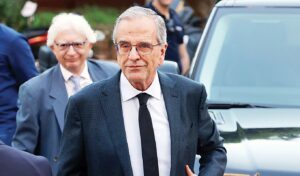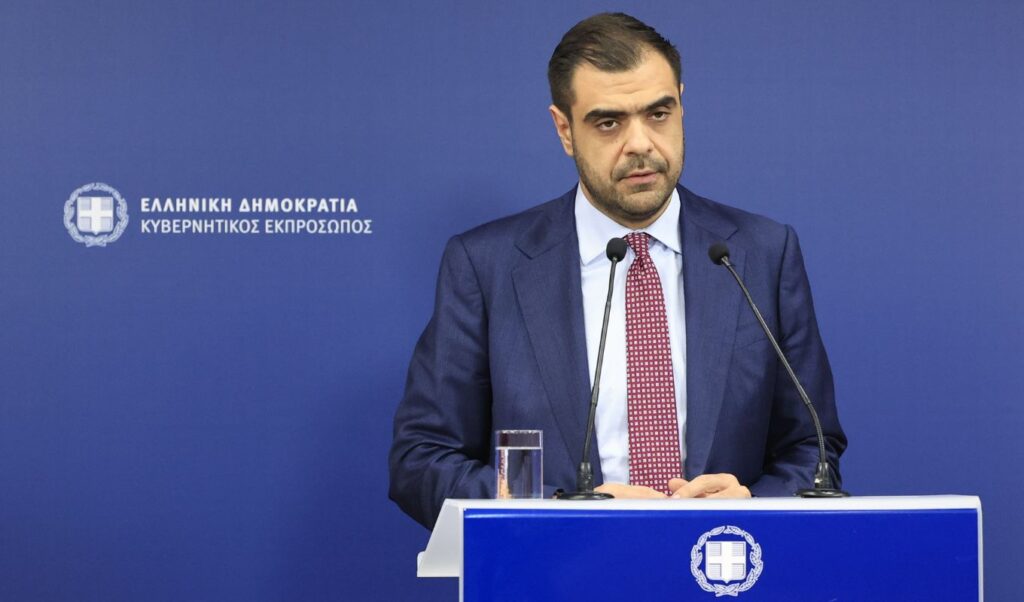
Pavlos Marinakis moved to put an end to speculation about a potential cooperation between New Democracy and a possible Samaras party — with the precondition that Kyriakos Mitsotakis not be appointed prime minister — during a briefing for political journalists. The government spokesperson, when asked about comments made by Adonis Georgiadis on Parapolitika radio regarding whether New Democracy would engage in coalition talks with Samaras, with the contentious issue being a potential change in the premiership, described the question as “hypothetical on multiple levels.” He urged everyone to “wait and see the election results first, and whether Samaras will actually form a party.”
“Respect for the people’s verdict is self-evident. The people choose the prime minister — no one else does. Prime ministers are not chosen behind closed doors,” he stated.
When asked more broadly about the possibility of a coalition government with a potential Samaras party, should New Democracy fail to secure an outright majority, Marinakis said: “Our goal is an outright majority. It’s achievable, though not easy. Our goal is to put forward a programme that will convince the people. An outright majority is our one and only objective.”
What Adonis Georgiadis said
It should be recalled that Adonis Georgiadis, speaking earlier in the morning on Parapolitika 90.1 during the programme “Apenanti Mikrofona” with Sotiris Xenakis and Vassilis Skouris, and referring to the possibility of Antonis Samaras forming a new party, said: “I believe he will form a party. That Samaras could hurt us in terms of our conservative vote is possible — he’ll obviously take some votes from us.”
Georgiadis left open the possibility of cooperation with Antonis Samaras, on the condition that Samaras would not demand a different prime minister in place of Kyriakos Mitsotakis. He said: “If Mr. Samaras did not set as a precondition that there be a different prime minister, I would tell you that — as long as the Greek people elected him to parliament — just as we would talk to other parties, we would naturally talk to Samaras too. But if the condition is ‘a different prime minister,’ then that obviously cannot happen.”
Pavlos Marinakis’ opening statement at the political journalists’ briefing
Good afternoon and good week,
Last Friday, authorities arrested the suspected perpetrators of the arson attack that led to the murder of Vagia Nestora in Thessaloniki, as well as those responsible for the deadly arson attack on Marfin bank 16 years ago, which claimed the lives of pregnant Angeliki Papathanasopoulou, Epaminondas Tsakalis, and Paraskevi Zoulia.
These crimes shook society to its core, exposing the utter contempt that some individuals hold for human life.
The State has fulfilled its commitment — first and foremost to the victims’ families and loved ones — to ensure that these cases do not remain in the shadows, thereby contributing to the delivery of justice and paying tribute to the memory of those who were lost.
Amid the grief and anguish caused by these tragic events, it is particularly meaningful that voices of unity and responsibility were heard. When it comes to terrorism, there can be and must be no room for excuses, tolerance, or divisive views. The memory of those who perished demands a common stance from all of us: to defend democracy and to isolate violence.
Yesterday, yet another organised attempt at intimidation took place. Cowardly individuals wrote threatening slogans on the home of the family of Deputy Minister of Migration and Asylum Sevi Voludaki, as well as on her political office.
Democracy is neither intimidated nor retreats in the face of threats, violence, or coercion.
Those who attempt to impose their views through practices that violate democratic principles and the rule of law will face the full consequences prescribed by law.
– – – –
Significant initiatives currently underway to strengthen higher education are making a tangible contribution to upgrading Greek universities.
First and foremost, with a clear plan and increased resources, the Ministry of Education, Religious Affairs and Sports is effectively addressing the need for student housing.
Alongside the creation of new infrastructure, financial support for students is also being actively bolstered. In 2026, approximately €90 million will be allocated for the student housing allowance, compared to €87.7 million in 2025 and around €42 million in 2019. The allowance has been increased to €1,500, rising to €2,000 and €2,500 in cases of shared accommodation near regional universities, providing meaningful support to tens of thousands of students and their families.
Through the Public Investment Programme, extensive improvement works are being funded at existing student residences, along with major university infrastructure projects across the country. Also part of this framework is the recent funding of €115 million allocated to all higher education institutions and ASPETE for maintenance, repair, and operational upgrade works at their facilities.
Through the National Development Programme, the Ministry of Education’s Sectoral Development Programme — with a total budget of €691 million, of which €581 million is directed towards university infrastructure projects, facility modernisation, digital transformation, and the upgrading of public universities — is being implemented.
At the same time, the largest student housing construction programme ever undertaken in the country is now underway. With a budget of €737.5 million, delivered through Public-Private Partnerships, approximately 8,600 new beds are being created in modern student residences. In addition, major renovation and modernisation works are progressing in Athens, Rethymno, and Heraklion, while similar interventions are being carried out in Western Macedonia, Epirus, and Thessaly. Furthermore, €224 million from the Social Climate Fund is being made available for the energy and operational upgrade of 17 student residence buildings belonging to INEDIVIM and various universities, while significant works are also underway in Komotini, Xanthi, Achaia, Koukouli, and Rio, alongside the procurement of new equipment for 12 student residences.
In total, from 2020 to the present, the resources mobilised for student housing and university infrastructure exceed €1 billion, combining national and European funding, PPP investments, and targeted financing. This represents the largest investment ever made in this country in the area of student welfare, with the goal of ensuring that every student has access to modern, safe, and affordable living conditions throughout their studies.
– – – –
One year has now passed since the launch of the nationwide campaign “Zero tolerance for not wearing a helmet” by the Ministry of Citizen Protection and the Hellenic Police.
During this period, police officers conducted targeted checks on motorcycle and scooter riders and passengers, professional delivery riders, and motorcycle rental businesses.
Over the course of one year, a total of 975,000 checks were carried out, resulting in 85,000 violations recorded against riders.
The Hellenic Police will continue, consistently, to carry out intensive checks and awareness campaigns across the entire country, with the aim of protecting human life and creating safer road conditions for all.
– – – –
As of 31 August, the national initiative to reduce prices on basic consumer goods sold in supermarkets comes into effect.
The decision was reached at a meeting between Development Minister Takis Theodorikakos and representatives from industry, multinationals, supermarkets, and suppliers, in the presence of the Director of the Independent Market Supervisory Authority and the Secretary General for Commerce. For the product categories agreed upon, price reductions of at least 5% will be applied. Participation by companies in this national initiative is voluntary, and the measure will remain in effect for a period of two to four months.
– – – –
The government responded swiftly to the new upward trends in petrol and diesel prices, which are once again due to external factors.
The country’s refineries agreed to contribute to efforts to contain prices, with the two groups — HELLENiQ Energy and Motor Oil — each committing to provide €20 million to the State, totalling €40 million combined.
This amount will be used to reduce the price of unleaded petrol by 10 cents per litre and diesel by 5 cents per litre by the end of August.
Details on the implementation of the measure will be announced within the week.
It is noted that, following the Gulf crisis, a number of refineries in the broader region were destroyed, creating new upward pressure on both petrol and diesel prices due to reduced production and increased seasonal demand.
– – – –
The overall picture across the country’s Courts of First Instance has improved significantly in terms of ruling delivery times and case clearance rates following the implementation of the Judicial Map reform.
According to statistics from the Justice Observatory, JustStat, the estimated time for a ruling to be issued at Courts of First Instance across the country has been reduced by approximately half. The average time for a first-instance ruling in Greece now stands at 309 days, compared to 307 days across the European Union — a target that had been set for 2027 but has already been achieved.
At the same time, the case clearance rate has improved markedly, rising from 86.2% prior to the implementation of the Judicial Map to over 105%. This means that all incoming cases for the judicial year are being resolved, with an additional 5% of pending cases from previous judicial years also being cleared.
– – – –
The joint Action Programme of the Ministry of Tourism and the Greek Tourism Confederation represents a significant initiative and a long-standing demand for further strengthening of institutional cooperation between the public and private sectors in the industry.
The strong performances of recent years confirm the sector’s dynamism, while naturally leaving no room for complacency. Maintaining competitiveness, upgrading the quality of the tourism product, ensuring the sustainable management of destinations, strengthening the workforce, and protecting the country’s international image all require consistent planning, coordination, and the harnessing of the knowledge and experience of all stakeholders involved.
I am happy to take your questions.