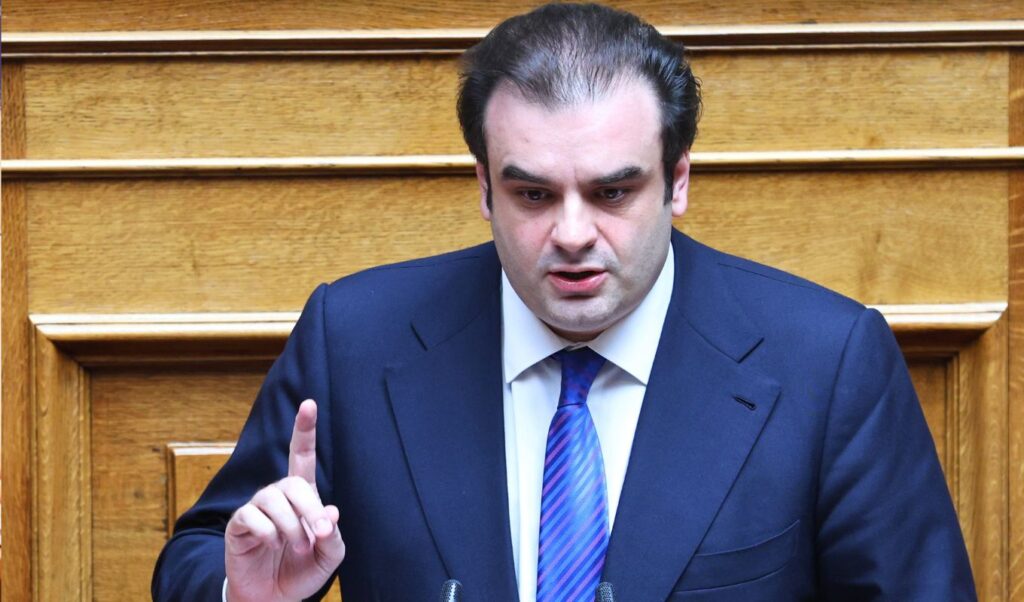
Kyriakos Pierrakakis used a radio interview to highlight the Greek economy’s outperformance and the distribution of fiscal space under the principles of budgetary discipline. Speaking on Status FM 107.7 in Thessaloniki, the Minister of National Economy and Finance and President of the Eurogroup placed the creation of new wealth through investment and reform at the heart of the government’s strategy for the period ahead.
Framing the core economic and political dilemma, Kyriakos Pierrakakis put it plainly: “Is money something that exists, or something that is created? I believe the latter — the opposition believes the former,” drawing a clear contrast between a handout-driven logic and one of productive growth. As he stressed, “growth doesn’t come from giveaways with no substance behind them, but from investments, reforms, and policies that generate new wealth and increase disposable income.”
Pierrakakis: “I’m glad Tsipras said it — the economy really is outperforming”
He placed particular emphasis on the economy’s trajectory, describing it as one of outperformance, and notably drew on a recent comment by A. Tsipras, leader of the EL.AS party: “I’m glad Mr. Tsipras said it — the economy really is outperforming.” In the same vein, he stressed that “every available fiscal margin is being returned to society,” while making clear this is done “always within European fiscal rules.”
Responding to criticism over the composition of investments, Mr. Pierrakakis argued that official data show a strengthening of productive investment, particularly in sectors such as “technology, logistics, and agri-food,” underlining that these are high-value-added, export-oriented industries. He also set out a key government objective of ensuring the economy’s positive results are felt across society, stating that the priority is “further wage increases and making sure growth reaches every household.”
On the political front, when asked to comment on the stance of former Prime Minister Antonis Samaras, he expressed respect for every politician who has served as the country’s prime minister, but noted that “politics is not the memory of the past, but the memory of the future” — redirecting the conversation toward the need to sustain the growth path and address the real concerns of citizens.