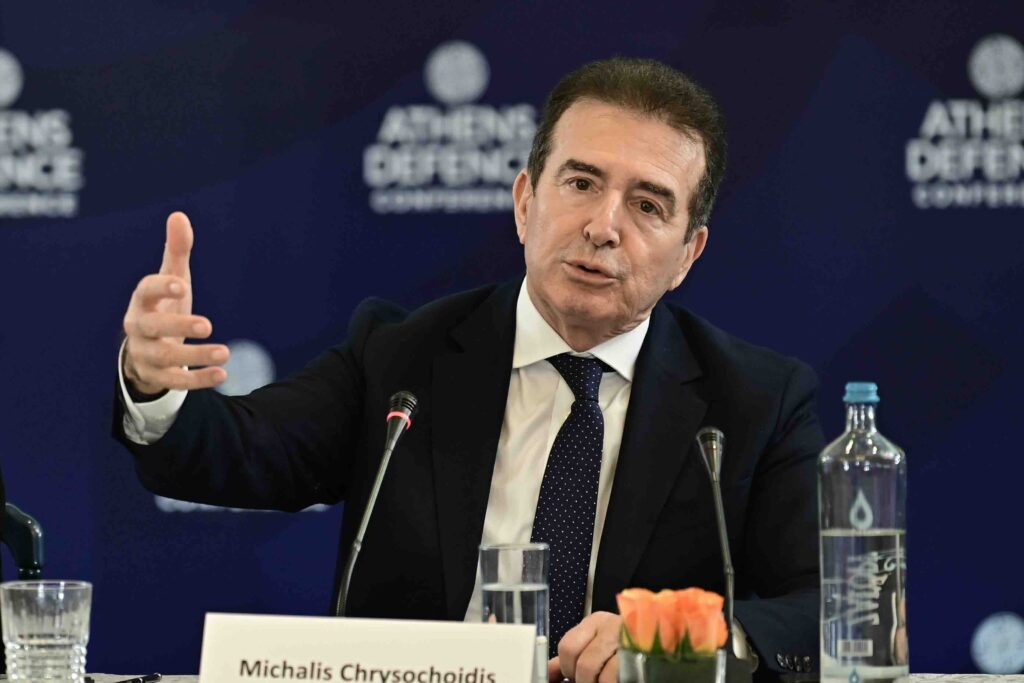
“Greece is one of the safest countries in Europe,” emphasized the Minister of Citizen Protection, Michalis Chrysochoidis, speaking at the Athens Defence Conference, organized by the Delphi Economic Forum in cooperation with the Hellenic Foundation for European and Foreign Policy (ELIAMEP).
Chrysochoidis: We are protecting Europe’s borders in an exceptionally effective way
According to the ministry’s official statement, Minister Chrysochoidis addressed the major challenges shaping the new security environment in Greece and Europe, against a backdrop of geopolitical developments, migration pressures, and hybrid threats that demand constant vigilance and preparedness. He noted that Greece stands on the front line of Europe’s borders, at the edge of the fire, “as there are many open fronts: the war in Ukraine to the north and ongoing conflicts in the Middle East. We are the natural and political boundary of the West. We monitor our borders with physical forces and all available technical means, ensuring that entries from this ring of fire into the interior are carried out according to the rules. In this new world, we are protecting Europe’s borders so effectively that we can proudly say that Greece, even under these conditions, remains safe,” he stressed. Describing the broader security framework, he added: “We control our borders. We have built approximately 80 kilometers of fence along the Evros river, which is primarily a defensive structure. We have deployed forces and are monitoring the flows of organized crime moving from all directions, both by land and sea.”
He also emphasized that cooperation with Turkey on managing migration flows — following the meeting between Prime Ministers Mitsotakis and Erdoğan approximately two years ago — has been outstanding. “Our position is clear. We are all working together — as members of the European Union and alongside all our European partners — to shape a secure environment. There is no other path. It is the only one,” he underlined. He further noted that current developments demand constant vigilance and a high level of readiness. “The permanent enemy of security is the lack of continuous alertness and sustained vigilance. This must be the cornerstone of any country’s security strategy,” he stressed. Finally, the minister highlighted that prevention and early preparedness are fundamental prerequisites for protecting the country and its citizens.
He also addressed the risks emerging from armed conflicts, noting that the most critical issue is what follows after wars end, focusing on the dangers of weapons trafficking and the proliferation of organized crime, with particular emphasis on drug and human trafficking. In this context, he noted that the Hellenic Police cooperates closely with international authorities such as the DEA, Europol, and Interpol, as well as with relevant agencies in Gulf states, in order to combat international criminal networks and strengthen intelligence-sharing frameworks. He stressed that security is not solely a matter of technology or operational capacity — it is a matter of continuous vigilance, political accountability, and strategic planning. “The most important aspect of security is vigilance — absolute operational readiness for whatever emerges. How we can manage even the last crisis, always in combination with strategy, planning, equipment, and technology,” he said, adding: “Every day, more and more, we must build the new European security policy — which represents a new achievement — on two foundations: first, a universal political commitment to this goal; and second, the allocation of all necessary means to implement it. Within this framework, a series of dimensions and policies must be explored that will lead to a comprehensive and integrated policy.”
Artificial intelligence and new technologies can significantly enhance the work of security services, but can never replace the judgment, responsibility, and decision-making of political leadership, Minister Chrysochoidis noted. He also remarked that “the application of artificial intelligence to security, research, and the adoption of measures addressing a range of security challenges that we must resolve is admirable — but with one critical distinction: politics shapes the climate in international relations, the relationships between states, and a range of other factors that lead either to the resolution of crises or, potentially, to conflicts. Let us retain all the technical capabilities that artificial intelligence offers and the wealth of armament programs, but let us keep the proper functioning of politics — in the interest of security and of peoples — as the paramount objective,” he concluded.