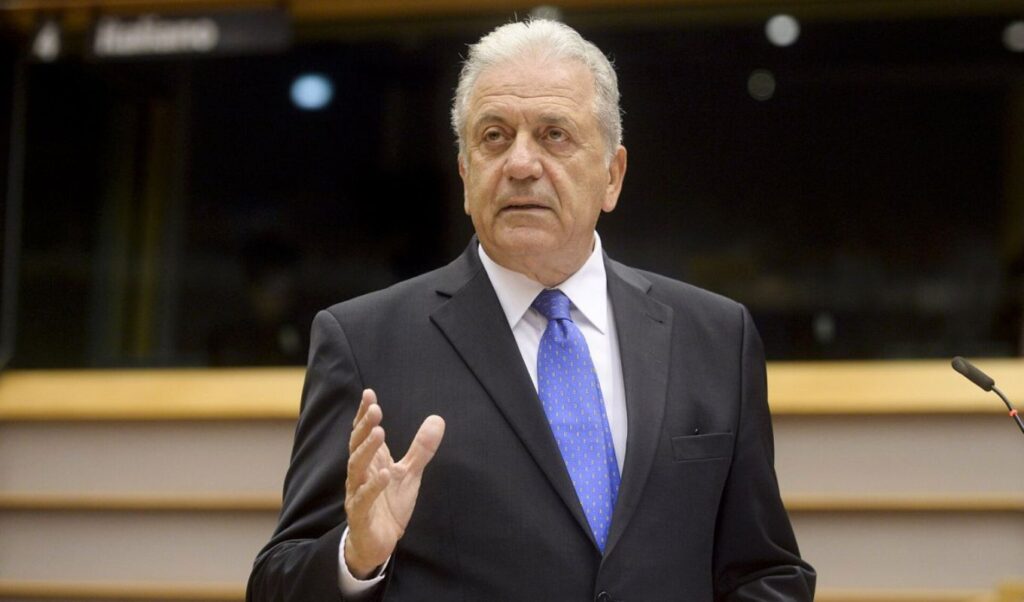
A European arrest warrant has been issued by Belgian authorities against New Democracy MP and former EU Commissioner Dimitris Avramopoulos in connection with the Qatargate scandal. According to reports, Greek judicial authorities have been notified of the warrant, however it has not yet been executed, as Avramopoulos’ status as a sitting MP requires the Greek Parliament to lift his parliamentary immunity before any arrest can be made. In a public statement, Dimitris Avramopoulos argued that “an attempt is being made, without any basis, to link my name to the Fight Impunity case.” He also announced his intention to pursue legal action, emphasizing that “any attempt to revive this matter by the Belgian authorities and to implicate my name in any issue relating to Fight Impunity — whether through unfounded references or through distortion of the facts — is arbitrary, unacceptable, suspicious, and will be met with every legal means available.”
Read also: Avramopoulos on the European arrest warrant in the Qatargate case: “There was no involvement on my part, direct or indirect, in anything improper — I will not invoke my parliamentary immunity”
Sources close to Dimitris Avramopoulos on Fight Impunity: “An institutionally disclosed and approved activity”
In recent hours, sources close to the former EU Commissioner have addressed his relationship with the NGO Fight Impunity, arguing among other things that it was an “institutionally disclosed and approved activity.” According to the same sources, Dimitris Avramopoulos submitted his participation in Fight Impunity for approval to the European Commission. “This approval is the central element of the case. D. Avramopoulos’ participation was known, declared, institutionally vetted and officially permitted,” they stressed. They also noted that his participation “was accompanied by a monthly honorary remuneration of €5,000 gross, for a period of one year, from February 2021 to February 2022. This remuneration was disclosed to the European Commission,” they stated, adding: “This was not an undeclared, informal or off-the-books financial arrangement.” “Dimitris Avramopoulos’ relationship with Fight Impunity can be summarized as follows: it was an institutionally approved, declared and limited participation in an honorary advisory body, with a monthly honorary remuneration of €5,000 gross for one year, which was properly declared and taxed in Greece. The substance of his participation consisted of public interventions on combating impunity. His relationship with Pier Antonio Panzeri was limited to two meetings, with no personal, political or operational continuity,” sources close to the former Commissioner also stated.
See below the EU documents cited by the Avramopoulos camp to demonstrate that he had received authorization from both the EU’s Independent Ethical Committee and the office of Ursula von der Leyen to participate in Panzeri’s Fight Impunity as a former Commissioner.
The document from Von der Leyen’s office
The documents from the EU’s Independent Ethical Committee
The Avramopoulos camp’s full non-paper
Dimitris Avramopoulos’ relationship with Fight Impunity was an institutionally disclosed and approved activity, conducted within the framework of the rules governing the post-mandate activities of former members of the European Commission.
At the time the invitation to participate was extended, Fight Impunity presented itself as a non-governmental organization dedicated to combating impunity for serious human rights violations, crimes against humanity and international injustices.
The organization’s public profile was associated with the promotion of international justice, accountability and the protection of fundamental rights.
It was within this context that the organization’s Honorary Board operated.
This honorary body included, or was said to include, international figures, former officials and prominent personalities in European and international public life. Among them were Federica Mogherini, former High Representative of the European Union for Foreign Affairs and Security Policy and former Vice-President of the European Commission; Bernard Cazeneuve, former Prime Minister of France; Emma Bonino, former Italian Foreign Minister and former European Commissioner; Denis Mukwege, Nobel Peace Prize laureate recognized for his fight against sexual violence in conflict zones; Cecilia Wikström, former Member of the European Parliament; Isabel Santos, a Member of the European Parliament active in foreign affairs and human rights issues; as well as other individuals with distinguished public careers in international justice and human rights.
This composition was significant for the organization’s image at the time. It created the impression of an honorary advisory body of international standing, with a European and humanitarian mandate. It was within this environment that the invitation was extended to Dimitris Avramopoulos to join the Honorary Board.
Dimitris Avramopoulos had completed his term as European Commissioner for Migration, Home Affairs and Citizenship on 30 November 2019. Under the European Commission’s Code of Conduct, every former Commissioner is required to notify the Commission of any professional, advisory or other activities undertaken after the end of their term, insofar as these may be related to their previous institutional role.
Following this procedure, Dimitris Avramopoulos submitted his participation in Fight Impunity for approval to the European Commission. His participation did not begin informally or without prior institutional scrutiny. It was examined by the competent bodies, assessed by the Independent Ethical Committee, and approved by decision of the President of the European Commission.
This approval is the central element of the case. D. Avramopoulos’ participation was known, declared, institutionally vetted and officially permitted. The same process also covered the monthly honorary remuneration provided for his participation.
His participation was accompanied by a monthly honorary remuneration of €5,000 gross, for a period of one year, from February 2021 to February 2022. This remuneration was disclosed to the European Commission as part of the approval process and formed part of the overall institutional assessment of his participation. This was not an undeclared, informal or off-the-books financial arrangement.
The amount was properly declared to the competent Greek tax authorities and taxed in Greece in accordance with applicable legislation. After applicable deductions and tax liabilities, the net amount received was €3,750 per month.
Dimitris Avramopoulos’ relationship with Pier Antonio Panzeri was limited. He had met him on two occasions. The first meeting took place in October 2019 in Strasbourg, one month before the end of his term as European Commissioner.
The European Commission was informed of this meeting. On that occasion, Mr. Panzeri asked him whether, upon completion of his mandate, he would be willing to participate in Fight Impunity. The second meeting took place at a Fight Impunity conference held at the Delphi Forum in Greece.
D. Avramopoulos’ participation was not linked to the management of the organization. He held no executive role, did not participate in its administration, had no responsibility over its finances, took no decisions regarding the NGO’s operations, and did not represent the organization before European institutions or governments.
His role was honorary and advisory in nature, limited to public interventions relating to the fight against impunity and the need to strengthen international accountability mechanisms.
His activities consisted primarily of articles, speeches, interviews and written contributions reflecting on institutional and political dimensions of human rights, international justice and the challenge of combating impunity.
These interventions were public in nature and consistent with his European and international experience.
The European Commission’s approval came with clear conditions. Dimitris Avramopoulos was not permitted to use confidential information from his time at the Commission. He was not permitted to intervene with the European Commission on behalf of the organization. He was not permitted to engage in lobbying in areas related to his previous portfolio. These conditions were accepted and respected.
During the period of his participation, Fight Impunity was not presented as a fringe or unknown initiative. On the contrary, it had a visible public presence in institutional European settings. It co-organized or participated in events with European institutions, including the European Parliament, while its activities were associated with conferences, public debates, report presentations and interventions on human rights and international justice.
For example, Fight Impunity had been linked to events and initiatives involving European and academic bodies. Its public materials from that period referenced conferences, thematic reports, research publications and discussions on the state of impunity worldwide, as well as presentations in institutional and academic venues such as the European Parliament and the College of Europe in Bruges.
This profile reinforced the impression at the time that this was an organization operating within a recognizable institutional and academic environment, focused on international accountability, the protection of human rights and the fight against impunity.
Regarding the organization’s funding, Dimitris Avramopoulos had no administrative, financial or managerial responsibility whatsoever. He was not involved in the sourcing, receipt or management of funds. The information provided to the European Commission as part of the approval process was that the organization’s sources of funding derived primarily from donations. Furthermore, based on available data, the organization had not received funding from the European Union budget.
It is important to state precisely that the organization referenced international mechanisms, the United Nations 2030 Agenda and institutions of international justice, such as the International Criminal Court, as areas of thematic relevance and action. However, this does not necessarily equate to funding from the United Nations.
The accurate formulation, therefore, is that the organization invoked and served themes aligned with the objectives and principles of international organizations, without this implying that D. Avramopoulos had any knowledge of or responsibility for its sources of funding.
The critical point is that D. Avramopoulos had no role in the NGO’s funding. His relationship with it related exclusively to his institutionally approved participation in an honorary advisory body and his public interventions on combating impunity.
This relationship did not continue indefinitely. On the contrary, it faded and was effectively terminated on the initiative of Dimitris Avramopoulos himself, when he concluded that there was no longer any substantive engagement, organized activity or meaningful purpose to his participation from the organization’s side.
From a certain point onwards, there were no texts, interventions, speeches or concrete initiatives in which he was called upon to participate. Under these circumstances, he determined that the relationship no longer had any reason to continue and requested that all related monthly honorary remuneration be discontinued.
This development demonstrates that the relationship never evolved into an active collaboration.
When there was no longer any substantive basis for participation, he distanced himself. The decision to discontinue the monthly remuneration reflects precisely this assessment: that an honorary relationship is only meaningful when accompanied by substantive activity and a clear purpose.
The subsequent involvement of Pier Antonio Panzeri in a criminal investigation does not alter the nature of Dimitris Avramopoulos’ relationship with the organization during the preceding period.
D. Avramopoulos participated in an honorary advisory body, with the knowledge and approval of the European Commission, in an organization that at the time presented itself as having an institutional and humanitarian purpose. He had no knowledge of or oversight over the organization’s internal financial or administrative operations.
The substance of the matter is clear: his participation was institutional, approved, declared and limited. There was no administrative, financial or operational role in the NGO’s functioning. There was no connection to funding, lobbying or the organization’s decision-making. His sole relationship with Fight Impunity was the one that had been officially disclosed and approved by the European Commission.
The broader conclusion that emerges concerns the need for stricter institutional oversight of organizations operating within the orbit of the European decision-making system. However, this is a matter of institutional governance and transparency. It does not change the factual circumstances of this particular case.
Dimitris Avramopoulos’ relationship with Fight Impunity can be summarized as follows: it was an institutionally approved, declared and limited participation in an honorary advisory body, with a monthly honorary remuneration of €5,000 gross for one year, which was properly declared and taxed in Greece.
The substance of his participation consisted of public interventions on combating impunity. His relationship with Pier Antonio Panzeri was limited to two meetings, with no personal, political or operational continuity. His relationship with Fight Impunity was terminated on his own initiative, when he concluded that there was no longer any interest, activity or meaningful basis for participation.
The only real relationship Dimitris Avramopoulos had with Fight Impunity was the one that was disclosed, officially approved by the European Commission, and declared to the competent Greek tax authorities.