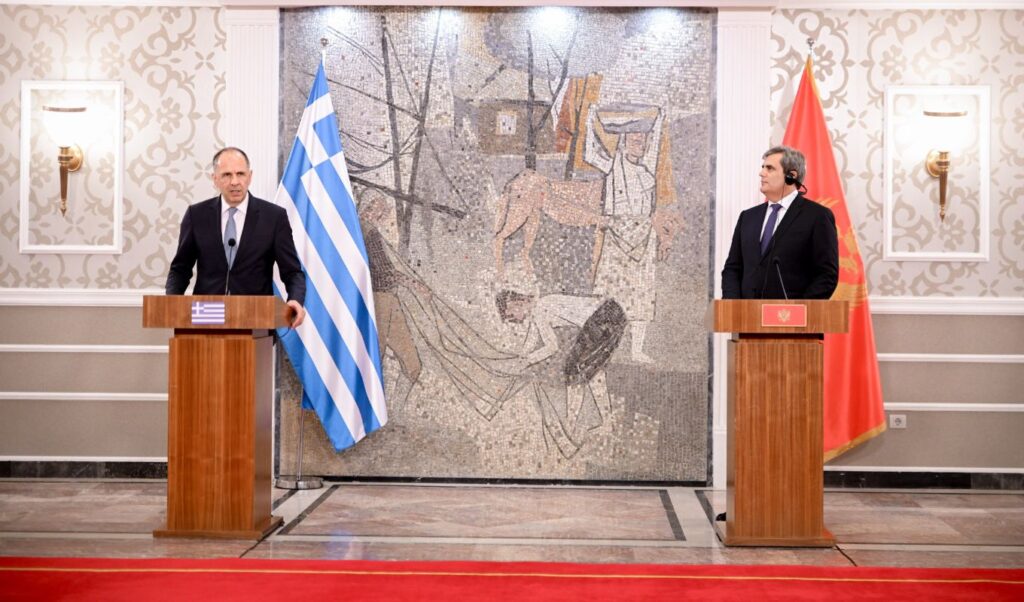
Greek Foreign Minister George Gerapetritis reiterated Greece’s “steadfast and unwavering support for Montenegro‘s accession path toward the European Union” following his meeting in Podgorica with Montenegro’s Deputy Prime Minister and Foreign Minister, Ervin Ibrahimović. Minister Gerapetritis noted that he had the honor of being received by Prime Minister Milojko Spajić and the Foreign Minister, and thanked Ibrahimović for his warm words toward Greece and himself personally. He emphasized that “Greece’s support for Montenegro is not an obligation, but a conscious political choice,” aimed at further developing bilateral relations and facilitating the country’s European integration. The Foreign Minister praised the efforts of the Montenegrin government, and of Ibrahimović personally, in advancing the necessary reforms, noting that Montenegro’s accession to the European Union would be mutually beneficial — both for the country itself and for the EU. Referring to the 20th anniversary of Montenegro’s independence, he described it as an important milestone for the country and its people, while highlighting that Greece and Montenegro are bound by traditional ties of friendship, mutual respect, and shared historical references.
📍Podgorica
FM George Gerapetritis’ meeting w/ #Montenegro DPM & FM Ervin Ibrahimović @ErvinIbrahimov1 pic.twitter.com/CbtGit38HA— Υπουργείο Εξωτερικών (@GreeceMFA) June 19, 2026
“Western Balkans’ EU accession is a strategic choice”
Minister Gerapetritis stressed that the day’s discussions confirmed the high level of bilateral relations and the significant room for further cooperation across many sectors. He also underlined that the two countries, as NATO allies and neighboring states, share a common interest in promoting peace, security, and prosperity in Southeastern Europe. He placed particular emphasis on Montenegro’s European perspective, noting that Greece conveys not only its own support but also a broader message of solidarity on behalf of the European Union. He also congratulated Montenegro on hosting the EU–Western Balkans Summit, at which Greece was represented by both the President of the Republic and the Prime Minister — a fact that, he said, underscores the importance Athens attaches to the region’s European future. The Foreign Minister stressed that Western Balkans’ integration into the EU is a strategic choice that will contribute to the stability, peace, and development of a region that has experienced serious upheaval and conflict in the past.
He also welcomed the progress Montenegro has made in meeting accession criteria, with particular reference to the country’s full alignment with the EU’s Common Foreign and Security Policy — describing it as a significant achievement that demonstrates convergence on international security matters. He noted that the launch of the drafting process for Montenegro’s Accession Treaty represents a meaningful recognition of the progress achieved and confirms the country’s position as a frontrunner in the Western Balkans accession process. He expressed hope that the transition from the negotiation stage to full membership would accelerate in the coming period. Gerapetritis reaffirmed that Greece will continue to provide expertise and support on reform issues and the incorporation of the EU acquis, recalling that since the Thessaloniki Agenda of 2003, Athens has consistently been one of the strongest advocates for the Western Balkans’ European perspective.
In this context, he also referred to the Delphi Declaration, noting that ahead of Greece’s presidency of the EU Council in the second half of 2027, Greece is committed to keeping Western Balkans enlargement high on the European agenda. He went so far as to describe it as a “major goal” for Greece to welcome Montenegro as a new EU member state during its presidency. A significant part of the talks was also devoted to bilateral relations. The Foreign Minister noted that both sides discussed the further development of economic cooperation in the areas of trade, tourism, environmental technology, academic collaboration, and culture.
📍Ποντγκόριτσα
Συνάντηση ΥΠΕΞ Γιώργου Γεραπετρίτη με Αντιπρόεδρο της Κυβέρνησης & ΥΠΕΞ Μαυροβουνίου Ervin Ibrahimović pic.twitter.com/z2jPuz1J19— Υπουργείο Εξωτερικών (@GreeceMFA) June 19, 2026
Regional connectivity
Gerapetritis made particular reference to cooperation on advancing regional connectivity in the areas of energy, infrastructure, ports, and transport, highlighting the strategic importance of the Adriatic–Ionian Highway in boosting trade, tourism, and business partnerships. He also announced that both sides agreed on an upcoming Greek business mission to Podgorica, aimed at exploring new investment opportunities and fostering business cooperation between companies from both countries. Gerapetritis also highlighted the growing mobility of visitors between Greece and Montenegro, noting that direct air links play a decisive role in strengthening people-to-people ties and mutual understanding. In closing, he thanked Ibrahimović for his hospitality and constructive cooperation, assuring him that Greece will continue to stand by Montenegro both bilaterally and on its path toward EU membership — a development that, he emphasized, will strengthen both Montenegro and the European Union as a whole.
🇬🇷🇲🇪| Δηλώσεις Υπουργού Εξωτερικών, Γιώργου Γεραπετρίτη, μετά το πέρας της συνάντησής του με τον Αντιπρόεδρο της Κυβέρνησης και Υπουργό Εξωτερικών του Μαυροβουνίου, Ervin Ibrahimović (Ποντγκόριτσα, 19.06.2026)
🔗https://t.co/FDfrAppez4 pic.twitter.com/RHbNRckyoi
— Υπουργείο Εξωτερικών (@GreeceMFA) June 19, 2026