A particularly significant turning point for Greek-American relations is marked by the upcoming Ministerial Conference of the 3+1 Format in Houston on Thursday (11/6), as it will deepen strategic cooperation between Greece, Cyprus, Israel and the United States. The meeting follows the Athens conference in November 2025 (P-TEC), and aims to establish the East Med Energy Center, a new institution that aspires to function as a hub for innovation, investment and energy security.
3+1 summit in Houston: New chapter in Greece-US relations
Through the institutionalization of this “Iron Triangle,” Washington confirms its trust in Athens as a leading regional partner. This initiative, which includes strategic infrastructure such as the Vertical Corridor and new LNG terminals, will enhance energy resilience against regional threats from Iran, Russia and China. Furthermore, the active presence of American energy giants like Chevron and ExxonMobil in Greece underscores the US commitment to ensuring stability in the Eastern Mediterranean region.
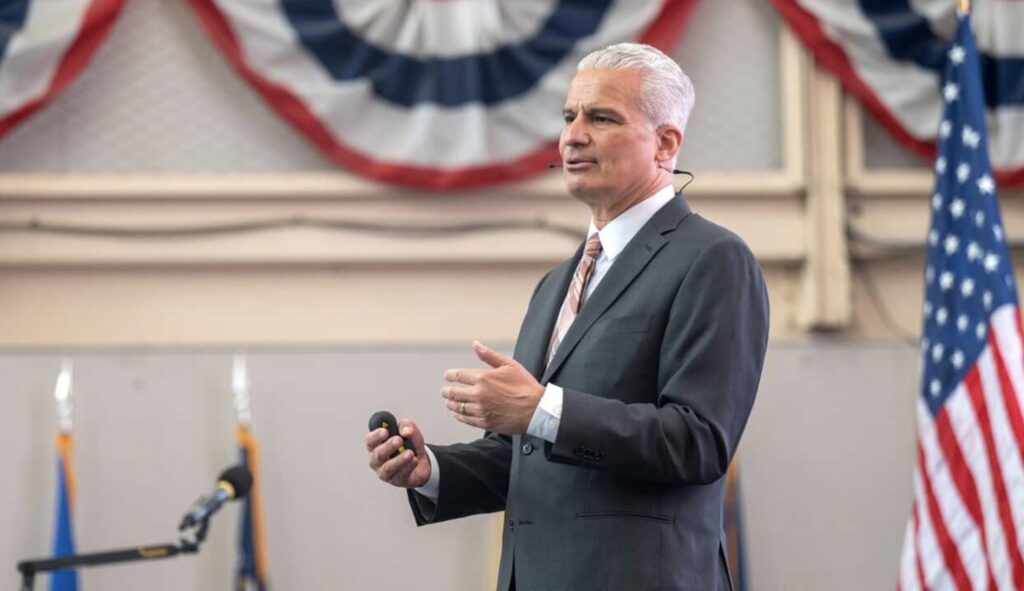
John Sitilides tells parapolitika.gr: The Trump administration institutionalizes Greece, Cyprus and Israel cooperation
John Sitilides, Greek-American geopolitical and strategic analyst and senior associate for Global Risks at the Center for the National Interest in Washington, D.C. (Diplomatic Advisor at the US State Department 2006-2023), analyzes for parapolitika.gr how these actions are reshaping Europe’s energy map for the coming decades and upgrading Greece’s geostrategic role. As he argues, “the Trump administration actively establishes and institutionalizes the ‘3+1’ of Greece, Israel and Cyprus in Texas, the geopolitical core of global energy dominance. This strategic partnership includes trilateral energy connectivity, but also critical logistics, transportation and up to 1,200 kilometers of submarine cable, underwater infrastructure and fiber optic telecommunications, extending across multiple regional East-West and North-South corridors throughout the Middle East, the Levant and Southern Europe to Central and Eastern Europe. This bold initiative dates back to the first Trump administration, which approved the bipartisan legislative act ‘Eastern Mediterranean Security and Energy Partnership Act of 2019,’ authored by then-Senator Marco Rubio. This historic legislation included a provision for creating this permanent transatlantic cooperation mechanism in energy security, cybersecurity, natural resources, emerging technologies, as well as coordination for regional early threat detection. All this within the broader geopolitical competition in the region between US allies and partners and direct challenges from Iran, Russia and China.”
Greece’s role in Eastern Mediterranean energy planning: LNG, Vertical Corridor and IGB at the center
At Thursday’s meeting, the energy ministers of the four countries are expected to outline the planning and next steps for Greece’s anticipated role. According to Mr. Sitilides, “it’s significant that US Energy Secretary Chris Wright, together with his Greek and Cypriot counterparts, will issue a joint statement after the Summit, detailing future planning among the four regional partners. The EastMed Energy Center represents the logical extension of deepening US-Greece relations, centered on Greece’s leading role in the Partnership for Transatlantic Cooperation on Energy and Climate (P-TEC). Additionally, the new LNG import terminals in Alexandroupolis and Revithoussa, the Trump administration’s significant investment in developing the strategic port of Eleusis, the Vertical Gas Corridor pipeline network from Greece through Bulgaria, Romania and Moldova to Ukraine, the Interconnector Greece-Bulgaria (IGB), the reconfigured Trans-Balkan Pipeline and the Southern Gas Corridor extending through Greece to Europe hold prominent positions in the new Washington-Athens strategic framework.”
Chevron, ExxonMobil and Venture Global: Vote of confidence in the Greek economy
Furthermore, the presence of major energy giants in the Mediterranean adds, according to Greek-American geopolitical analyst John Sitilides, additional geostrategic power to our country in an era of intense fluidity and despite strained Euro-Atlantic relations. As he argues, “American investments in Greece’s promising hydrocarbon sector, led by ExxonMobil in the northwestern Ionian Sea, Chevron in the Cretan Sea and Venture Global for exporting two billion cubic meters of LNG annually through Greece to broader European markets, add exceptional value to the relationship and embody Washington’s confidence in Athens as a strategic partner, even in the aftermath of disturbed relations with other European Union members. Because there is no utopian energy transition in global markets, as hydrocarbons will remain the dominant form of energy-dense baseload, essential for modern industrial production and civilization in Europe and globally, these realistic US-Greece initiatives will strengthen Athens’ energy resilience against regional geopolitical disruptions and solidify Washington-Athens relations for years and decades to come. The development of Eleusis port will become increasingly important, if Gaza can finally be administered and governed by a normal, non-terrorist government that recognizes Israel and opens doors to international investment for regional development, with strong focus on its exceptional prospect as a modern Beirut or a second Dubai on Mediterranean shores. A normal Palestinian government could accelerate the Saudi Arabia-Israel rapprochement, which would implement the much-publicized India-Middle East-Europe Corridor (IMEC), which can bypass the Chinese Communist Party-controlled Piraeus port for successful Greek integration. The Mitsotakis government can also look forward to deeper Greek integration into the current Three Seas Initiative among Central and Eastern European countries, connecting the Baltic, Black Sea and Adriatic. Greece’s official logistical integration would double the strategic reach of these axis countries to include the Aegean, Ionian and Mediterranean Seas, transforming the European mini-bloc into a Six Seas Initiative.”
The Rubio-Barak confrontation and the message to Ankara
Mr. Sitilides interprets as a vote of confidence in our country the statement by US Secretary of State Marco Rubio to Congress, who left no room for optimism for Ankara regarding F-35 acquisition, while simultaneously rejecting the way US Ambassador to Ankara Tom Barak defends Turkey’s interests. As Mr. Sitilides argues, “Secretary Rubio bluntly and accurately reiterated the Trump administration’s policy that Turkey cannot acquire F-35 fighter jets while possessing the Russian S-400 anti-aircraft missile system, which endangers advanced and privileged American aviation technology. This is a clear position and attempts by a US ambassador to usurp and actively undermine voted laws and official US government foreign policy constitute a dangerous precedent for broader American diplomacy and communications globally. An ambassador reports to the Secretary of State and does not make foreign policy. Secretary Rubio’s strategy on behalf of President Trump in the Eastern Mediterranean seeks to systematically integrate Greece, Cyprus and Israel into America’s core security architecture. The US has deepened its defense ties with Athens, prioritizing significant infrastructure expansions at Souda Naval Base and Alexandroupolis port. As a senator, Marco Rubio authored Congressional legislation that ended the decades-long US arms embargo on Cyprus — the country that was invaded in 1974 by a NATO ally who illegally used American weapons in aggressive military operations. Of course, Ankara will continue seeking every opportunity to return to the F-35 program, seven years after Turkey’s expulsion by President Trump due to S-400 purchase. Ambassador Barak’s unfortunate statement that current US policy is ‘crazy’ should more accurately be directed toward Ankara, whose ‘crazy’ foreign policy led it to acquire advanced Russian technology, despite repeated warnings from Turkey’s strongest supporters in the US Senate and House of Representatives that this reddest of red lines must never be crossed.”
S-400, Hamas and Cyprus: Turkey’s open fronts with the US
“Between Ankara’s long-term embrace of terrorist organizations Hamas and Hezbollah, its adoption of the radical anti-Western Muslim Brotherhood, its refusal to satisfy any Kurdish aspirations for autonomy in the Middle East, its ridiculous EEZ agreement with Libya against every interpretation of international maritime law and UNCLOS, Ankara’s position on S-400s simply widens the growing list of deteriorating US-Turkey relations. And this happens even as the country prepares to host President Trump at the NATO Summit in Ankara in July, just two weeks before the world condemns once again Turkey’s invasion and fifty-two years of military occupation of European Union territory in Cyprus,” he concludes.