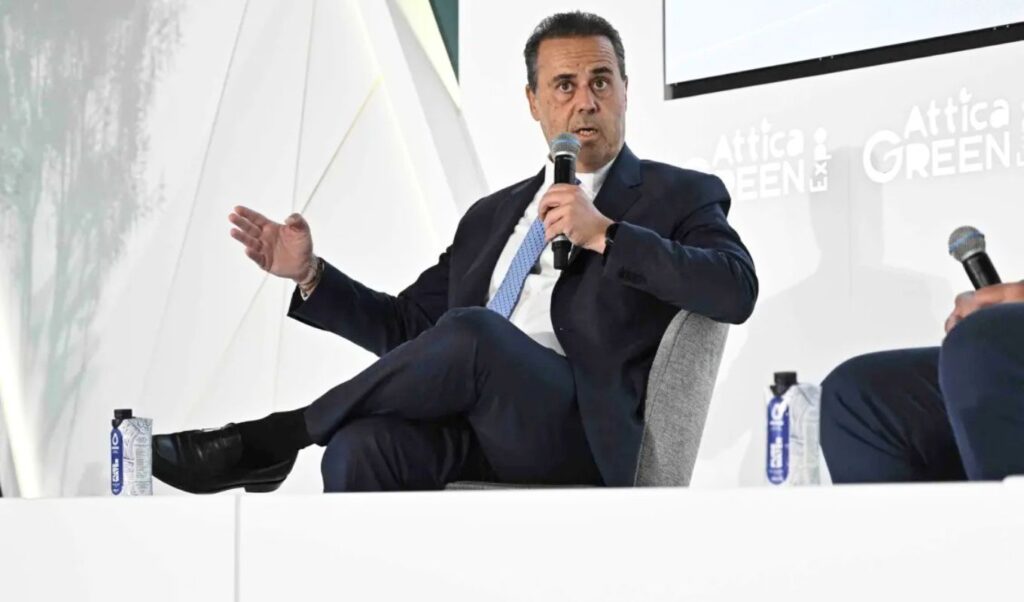
The strategic importance of energy infrastructure, hydrocarbons, renewable energy sources and the vertical energy corridor for the country’s geopolitical and economic strengthening was emphasized by Environment and Energy Minister Stavros Papastavrou in an interview at the Attica Green Expo 2026. Additionally, he highlighted the ministry’s holistic approach regarding spatial planning frameworks for tourism, renewable energy and industry, calling for the establishment of a clear landscape with rules. For his part, in a relevant panel he participated in, General Secretary for Waste Management Coordination Manolis Grafakos announced that the proposal for waste management planning in Attica has already been submitted to the European Commission.
Specifically, the Environment and Energy Minister characterized hydrocarbon sector development as a “national issue,” emphasizing that it requires “seriousness, consistency and continuity,” while underlining that the country is now entering a new phase of energy strategy and geopolitical upgrading.
As he characteristically stated: “Hydrocarbon development is a national issue and that’s why we must approach it with great seriousness, consistency and continuity.”
Papastavrou: Hydrocarbon sector development is a “marathon”
Mr. Papastavrou emphasized that Greece is proceeding with the first deep-water exploratory drilling in February 2027, noting that this is a complex and multi-year process requiring strategic persistence and stability. “Hydrocarbon sector development is a marathon,” he noted, explaining that major energy companies operate with international portfolio management terms and continuously evaluate investment priorities and returns.
Simultaneously, he highlighted the importance of energy policy continuity, noting that Greece managed to accelerate critical processes and gain the credibility of major international investors. “Being able to reach exploratory drilling is not something that happens on autopilot,” he emphasized, noting that the country “positively surprised” major energy companies with the speed of implementing critical decisions.
The minister made particular reference to the Vertical Corridor, which he characterized as a project “much larger than the narrowly energy component,” as it creates a new economic and geopolitical reality in the broader Balkans and Eastern Mediterranean region. “Greece is evolving into an entry and management point for new energy routes,” he stated, adding that the country leverages its geographical position, infrastructure, as well as the political and economic stability it possesses.
What he said about Greece, Cyprus, Israel and United States cooperation in energy
Mr. Papastavrou, when asked about his upcoming trip to the US, also referred to the cooperation between Greece, Cyprus, Israel and the United States in the energy sector, noting that the “3+1” initiative is now gaining greater depth and more substantial content. “This initiative for us is an element of highlighting the region’s wealth and creating a cooperation framework,” he declared, simultaneously emphasizing that Greece plays a leading role in shaping a new cooperation framework in the Eastern Mediterranean.
Regarding energy infrastructure, the minister emphasized that the government has been systematically investing in networks and interconnections since 2019, noting that this strategy is not the result of circumstantial developments, but of long-term planning. As he mentioned, critical projects have already advanced, such as the Alexandroupolis FSRU, new natural gas compressors, Crete’s electrical interconnection, as well as planned Dodecanese interconnections. “Networks and infrastructure are our homeland’s backbone and an investment for our children,” he characteristically stated.
He also gave particular emphasis to the increased energy needs created by artificial intelligence and data center development, noting that developments in this sector confirm the importance of timely energy network strengthening.
Referring to renewable energy sources, the Minister noted that installed renewable capacity increased from 6.3 GW in 2019 to nearly 18 GW today, while in the last 12 months alone, an additional 3 GW was added to the system. Simultaneously, he emphasized the need for a new holistic approach to spatial planning and energy, focusing on new spatial planning frameworks for tourism, renewable energy and industry.
“A holistic approach needs to be created,” he characteristically stated, explaining that the goal is coordination between spatial planning, energy, tourism and industry, with clear and modern development rules.
Mr. Papastavrou emphasized that the goal is to complete new spatial planning frameworks by the end of summer, which will set clear rules for permitted uses and environmental protection. “When you’ve reached 18 GW, you now need clearer and stricter rules,” he stated, noting that the country must organize public space with greater transparency and effectiveness. Referring to civil protection and restoration of areas affected by natural disasters, he noted that within the Antinero framework, anti-erosion and flood protection works were completed on time for the first time in areas affected by major fires in 2025. “If you follow the fire trauma the first winter, then nature has much greater chances to recover,” he characteristically mentioned.
In closing, the minister expressed optimism about the country’s energy sector prospects, noting that if geological estimates for regional deposits are confirmed, significant opportunities are created for new investments and further strengthening of Greece’s geopolitical position.
“The Eastern Mediterranean is now at the center of major energy companies’ interest,” he emphasized, noting that Greece is proceeding “in an organized way and with seriousness” into this new energy era.
Manolis Grafakos: Planning for Attica waste management will be completed in the coming months
Planning for waste management in Attica is being completed within the coming months, “so Attica is also closing in the best possible way,” noted General Secretary for Waste Management Coordination Manolis Grafakos in a relevant panel he participated in. As he announced, the relevant proposal has already been submitted to the European Commission.
As he stated, “for seven years we have worked hard. We put in order a difficult and very complex component, with conflicts and local reactions. Some were shouting when facilities closed and it was proven afterwards that these were installations with zero staff and no financial statements for ten years.”
He added: “We have made a huge change, a huge reform and we are really very happy because we succeeded together with local government.”