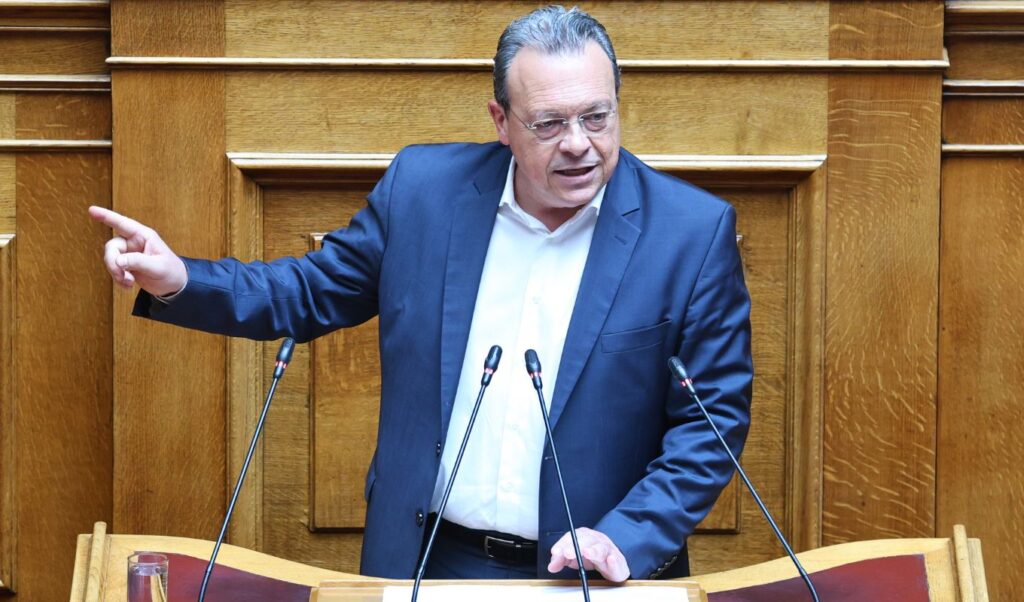
SYRIZA president Socrates Famellos addressed his decision to expel Pavlos Polakis from the party’s parliamentary group, as well as the party’s electoral prospects and the role of Alexis Tsipras.
Famellos: Polakis attack was offensive, Tsipras role crucial
The SYRIZA president spoke Tuesday morning (19/5) on ERTnews, saying about the Chania MP: “Polakis’s public statement was offensive and unethical, containing no element of truth. SYRIZA is a left-wing party whose primary characteristic is credibility. There was an issue of political dignity and violation of political ethics incompatible with a SYRIZA MP. His expulsion was a justified and expected choice.”
He then expressed complete disapproval of Dimitris Chatzisokratis’s proposal, which triggered Pavlos Polakis’s post before his expulsion. As he stated: “I categorically reject it; it’s unacceptable. There’s no discussion about dissolution, suspension of operations, or resignation in SYRIZA, which has turned a new page and seeks to intervene in the public arena. Any discussion about SYRIZA’s assets is unacceptable and unrelated to our political identity. We don’t do politics for the seats.”
“SYRIZA in next elections within a unifying scheme”
When asked how SYRIZA will participate in the next elections, Socrates Famellos responded that “SYRIZA is doing everything possible for a candidate scheme, a ballot that will be unifying. SYRIZA will be in the next elections within a unifying scheme, expressed through a unifying progressive formation.”
Regarding Alexis Tsipras, he noted that “in the last Central Committee, we decided his role is crucial. I said – even after Tsipras’s event in Chalandri – that we must converge, and I emphasized the urgency of a unifying solution.” In this context, he characterized “Tsipras’s initiative as important; there’s interest in what he will propose. Everyone’s stance must converge for unified progressive expression. Yes to collaborations, Alexis Tsipras’s role is crucial, creation of new formations and a broad invitation for all democratic citizens, schemes and unities to fit.”
Finally, he observed that “since political will for unity hasn’t been expressed in public discourse, the next discussion about candidacies should be delayed.”