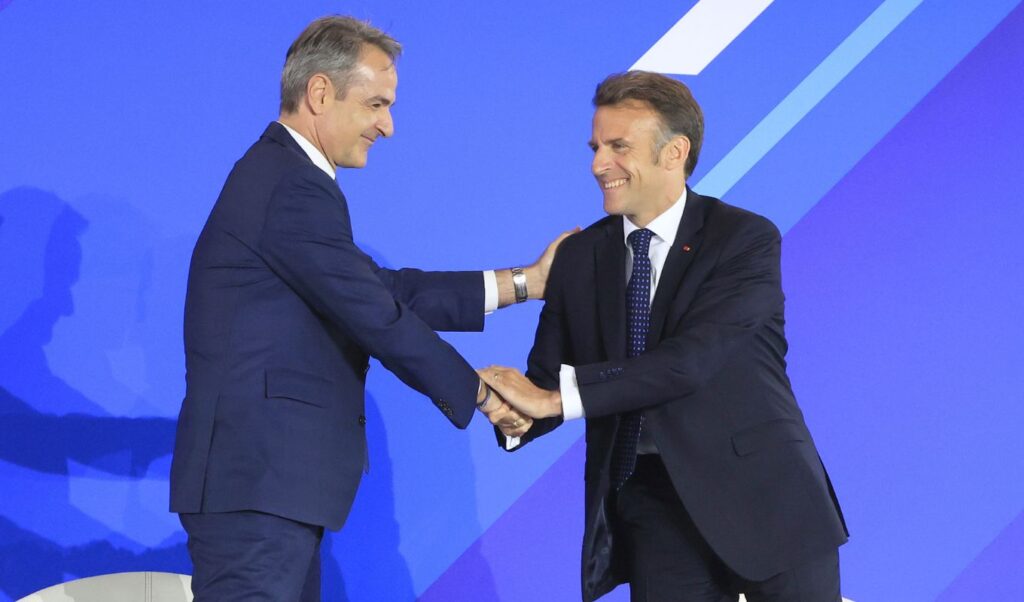
Turkey is weighing the impact of Macron’s visit to Athens, gradually raising tensions and provoking confrontation across all fronts in recent times. References to Macron’s visit recorded in Turkish mass media express concern about the strengthening of the strategic partnership between Greece and France in the Aegean, Eastern Mediterranean, Cyprus, and cooperation in Europe’s defense framework. In Ankara, which uses the Blue Homeland doctrine as leverage for claims in the Eastern Mediterranean, most publications “read” the Greek-French defense cooperation as the most powerful deterrent force. Characteristic is Hurriyet’s publication, emphasizing that “the agreement essentially provides French forces permanent deployment, rights and privileges similar to those of NATO on Greek-Cypriot territory.” It also refers to the support France provided to Greece in 2021, when it deployed an aircraft carrier and Rafale fighter jets after the incident between the Turkish ship Kemal Reis and the frigate Limnos.
Other media, such as Ahaber, speak of “targeting Turkey” by the French President with his statement that France will stand by Greece’s side in case of conflict with Turkey, emphasizing that “Macron lit the fuse immediately upon arriving in Athens.” Cumhuriyet also argues in its publication that Emmanuel Macron’s statements “could increase tensions” in Greek-Turkish relations, while the newspaper Sozcu translates Macron’s statements as “provocation in the Aegean.”
Associate Professor of International Politics, Antonis Klapsis, estimates that strengthening the Greek-French alliance will not bring about any change in Turkish stance, except for the reappearance of violations and infringements in the Aegean. This is because, as he argues to parapolitika.gr, the Greek-French alliance did not emerge now – it is a continuation of a policy known to Turkey. As he characteristically states: “Strengthening Greek-French cooperation is not enough to change Turkey’s course toward Greece. It certainly creates an additional safety valve for Greece, but Turkish policy aims to change correlations in the Eastern Mediterranean, revise Treaties, establish Turkish zones of influence far beyond what International Law provides, and implement the Blue Homeland. All these will remain on the table. I believe Turkey will not step back from all this.”
Furthermore, Mr. Klapsis, while considering the French President’s statement very positive, interprets Macron’s declaration as “you do what you must, we are here to help you.” This means French support is not one-dimensional because, as he says, “any other country takes you seriously into account if you yourself have the ability to exercise some influence, to be strong, and if you have the will to act. Diplomatic reinforcement comes to complement your own defensive, economic, political enhancement, so they are two communicating vessels. The stronger you are yourself, the more likely you are to find external help, and external help to strengthen your own power. Of course, Greece has been doing this for many years, it doesn’t change anything in the essence of the matter. But the current government has perhaps become more systematic than what was happening some years ago.”
It’s worth noting that France’s defense cooperation is not limited only to Greece but extends to Cyprus as well. As announced yesterday by the President of the Republic of Cyprus, Nikos Christodoulides, an agreement will be signed in June providing for the presence of French forces in Cyprus within the framework of enhanced cooperation between Cyprus and the French government.
Additionally, today’s visit by Foreign Minister Giorgos Gerapetritis to Tripoli, Libya, is expected to add fuel to Turkey’s irritation toward Greece, as Greece aims to withdraw the invalid and unsubstantiated Turkish-Libyan memorandum. Mr. Gerapetritis will meet with Libyan Prime Minister Abdul Dbeibah, with whom they will discuss the issue of EEZ delimitation between the two countries.