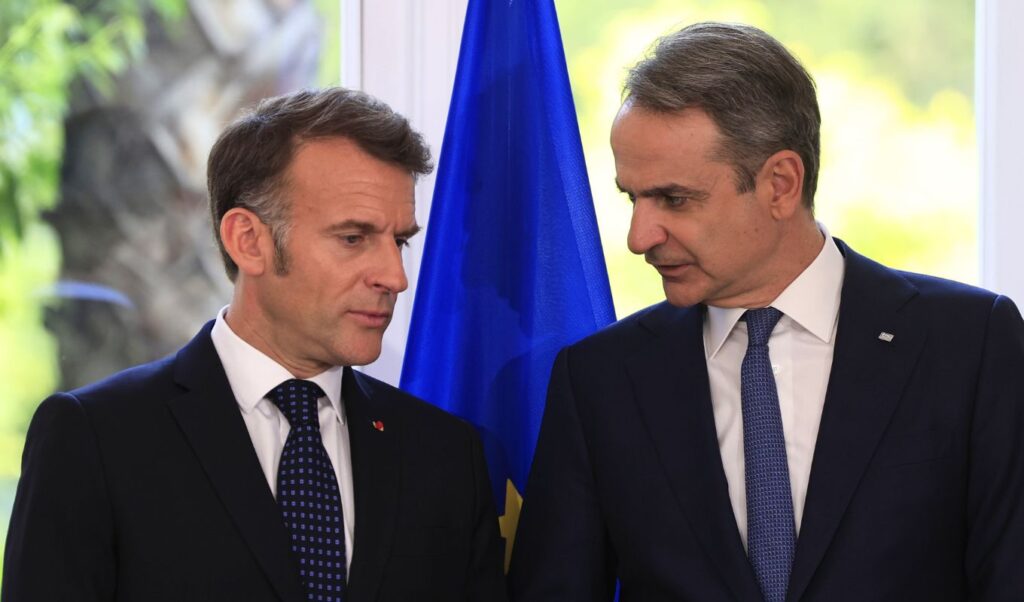
Greece and France have sealed the renewal of their strategic partnership agreement for cooperation in security and defense, signed an enhanced comprehensive strategic partnership, and effectively marked the expansion and deepening of cooperation that now operates on multiple levels. “The Enhanced Comprehensive Strategic Partnership between France and Greece signals the alignment and cooperation of the two countries not only in defense, but also in the economy, civil protection, migration, technology, environment, education and culture, as well as cooperation within the EU and international organizations”, government sources noted.
Greece – France: New era in defense after Mitsotakis-Macron agreement
As Kyriakos Mitsotakis wrote on Facebook, “this is an agreement that makes Greece safer, strengthens its geopolitical position and creates new opportunities and prospects for synergies, from artificial intelligence to cybersecurity.” The symbolism of Emmanuel Macron’s two-day presence in Athens was significant, as was his resounding response to what France would do if Turkey threatens our country: “If sovereignty (of Greece) is threatened, know that we will be here.”
Greek-French relations have gone through several waves in recent years before reaching the strong point where they stand today. In the 2020-2022 period, they reached perhaps the highest level in their modern history. France stood practically by our country’s side during the crisis with Turkey in August 2020 with the Oruc Reis. The two countries signed an agreement in 2021 “for establishing a strategic partnership for cooperation in defense and security,” which among other things provides for “assistance and support” even “with the use of armed force, if they jointly determine that an armed attack is taking place against the territory of one of the two.” The government’s decision then to strengthen the Armed Forces included the acquisition of 24 Rafale fighter aircraft for the Air Force and three Belharra frigates for the Navy.
After the re-election of Macron and Mitsotakis for a second term in office, in 2022 and 2023 respectively, relations warmed up again. The two leaders met three times within just a few months: In Vilnius, Lithuania, on the sidelines of the NATO Summit, in Malta, on the sidelines of the nine Euro-Mediterranean states meeting (EU-MED9), and in Paris.
In 2024, some clouds began to appear in bilateral relations, when for example neither Emmanuel Macron nor the then French Foreign Minister attended Ancient Olympia for the lighting of the Olympic Flame for the Paris Olympics that summer. Many scenarios were heard then: About French displeasure over the cancellation of the intention to procure corvettes by the Greek Navy, while Paris was pressing for Naval Group’s Gowind corvettes. About the Greek Prime Minister’s disagreement (and other European counterparts of course) with the prospect of sending Western ground forces to Ukraine, which the French President supported. About disagreements between the European People’s Party and Renew Europe (Macron’s party) in the period before the European elections.
This was followed by a series of visits by Kyriakos Mitsotakis to France: To Normandy for the 80th anniversary of the Allied Landing, to Lorient and Naval Group’s shipyards, where the three “Greek” frigates were being built, and to Paris, for the Olympic Games opening ceremony. Subsequently came, shortly after the launch of the second Greek Belharra, the announcement of activating the 3+1 option and acquiring a fourth frigate (with increased Greek participation in construction), with the Prime Minister noting that it was “deemed necessary, as securing the homeland is a non-negotiable priority.”
The war in the Middle East also triggered the upgrade of Greek-French relations. Mitsotakis and Macron traveled to Paphos and personally declared their support and solidarity with Cyprus. “We ensure close coordination with our allies and our European partners, primarily with our Greek friends, so that this effort in the Eastern Mediterranean is strengthened by willing nations,” Macron had said a few days earlier in his television address, showing with this rhetoric the level of communication that now exists between Athens and Paris.
It is no coincidence that Mitsotakis eventually attended the second Nuclear Energy Summit, which was recently held in Paris, hosted by Macron, and declared his support for the French President’s energy planning – as well as Greece’s inclusion in it. “I am here because I recognize a basic reality that President Macron and other colleagues have pointed out: we cannot achieve everything we care about in Europe – strategic autonomy, economic competitiveness, decarbonization – without nuclear energy,” Mitsotakis emphasized. “I came to Paris today to announce that Greece is also turning the page. The time has come to explore whether nuclear energy, and specifically small modular reactors, can have a role in the Greek energy system,” he announced subsequently, rhetoric which he repeated in their meeting the day before yesterday.
“I welcome the initiative you have undertaken to give a new boost to Europe’s nuclear industry, in which France leads,” the Prime Minister said among other things, while one of the nine agreements signed in Athens concerned the “Joint Declaration of Intent for establishing cooperation in the field of nuclear technology.”
The agreements that were signed
Greece and France proceeded to sign nine strategic cooperation agreements during Emmanuel Macron’s visit to the Maximos Mansion. These were preceded by a private meeting between Kyriakos Mitsotakis and the French President and the two leaders’ visit to the frigate “Kimon” which was anchored in Piraeus.
The first agreement concerns the general framework of expanded Greek-French cooperation under the title “Enhanced Comprehensive Strategic Partnership.” The agreement strengthens the country’s security, upgrades its geopolitical position and creates new economic opportunities and synergies in critical sectors, such as artificial intelligence and cybersecurity. At the same time, Greece and France are forming a common axis in the Mediterranean, with steadfast commitment to International Law, the Convention on the Law of the Sea (UNCLOS) given that Turkey has not signed UNCLOS.
The second concerns the renewal of the 2021 Greek-French strategic partnership agreement. The renewal is valid for five years and was signed by the Defense and Foreign Ministers of both countries. Earlier, Nikos Dendias and France’s Minister of Armed Forces, Catherine Vautrin, had met aboard the frigate “Kimon.”
The third agreement concerns the Joint Declaration of Intent for establishing cooperation in the field of nuclear technology between the Ministry of Development of the Hellenic Republic and the Ministry of Economy, Finance and Industrial, Energy and Digital Sovereignty of the French Republic. And as Takis Theodorikakos declared after signing, “Greece actively participates in the European dialogue for strengthening energy autonomy, on terms that serve security, innovation and the public interest.” The Development Minister clarified that cooperation with France focuses on peaceful uses of nuclear technology and emphasizes research, development and innovation.
The fourth agreement concerns an Action Plan for enhancing cooperation in the fields of Higher Education and scientific research with a time horizon of 2030.
Additionally, the following agreements were signed:
- Convention for the Establishment of an Intergovernmental Organization for the Development and Operation of Digital Ocean Systems and Information Services.
- Declaration of Intent for Cooperation in Defense Research and Development and Innovation of Defense and Military Technologies and Systems.
- Framework Agreement for continued support of MICA IR/RF missiles and 1st Executive Contract of 2026 between the Ministry of Defense – these are air-to-air missiles that equip Greek Mirage 2000-5 and Rafale aircraft. The IR version is infrared-guided and the RF version is radar-guided for longer ranges.
- Roadmap for strengthening cooperation between the Greek Ministry of Foreign Affairs and the Ministry of Europe and Foreign Affairs of the French Republic.
- Joint Declaration of Intent between the Ministry of Education of the Hellenic Republic and the Ministry of Education of the French Republic for further strengthening bilateral cooperation in vocational education, training and lifelong learning.