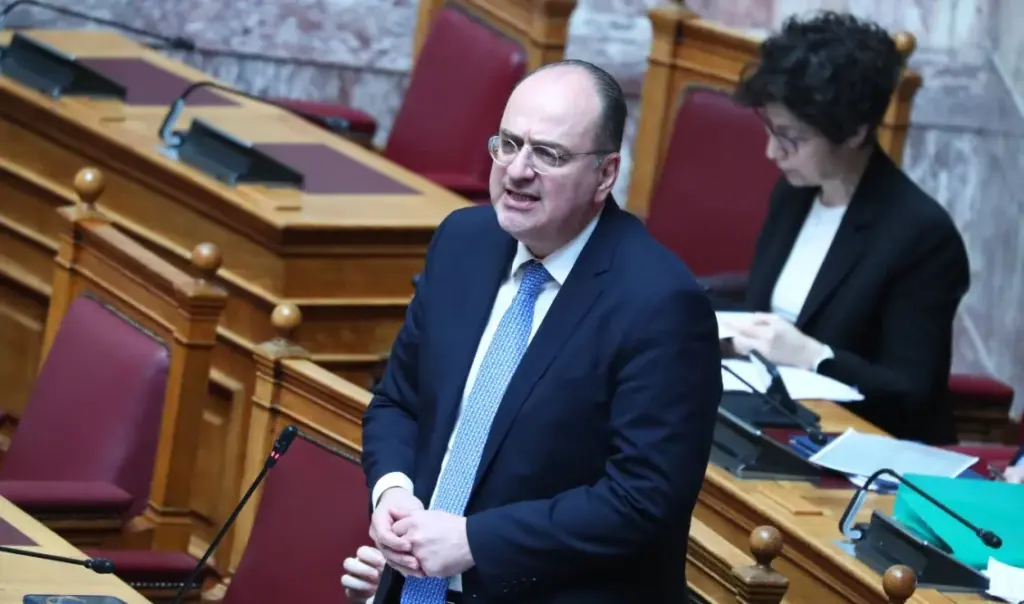
In a particularly sensitive political climate, with the government facing multiple fronts, the case of Makarios Lazaridis evolved into an issue with intense negative political impact. His resignation from the position of Deputy Minister of Agricultural Development, just two weeks after assuming his duties, brought an end to a case that had begun to burden the government’s work, with the public intervention of Dora Bakoyannis acting as a catalyst for the final developments.
New Democracy MPs describe Makarios Lazaridis’s resignation as essentially inevitable. Some even believe that the decision was delayed, worsening the climate and causing unnecessary introspection during an already demanding period for the government.
In the previous ten days, both Makarios Lazaridis himself and government officials emphasized that, despite the intense speculation and political pressure that had developed around his appointment as a special scientist in 2007, there was no issue of his departure from the government scheme.
Makarios Lazaridis: Dora Bakoyannis’s intervention that changed everything
However, the margins began to narrow suffocatingly after former minister Dora Bakoyannis’s public statement on Saturday morning on Mega TV. She noted that, based on how the case had developed, Mr. Lazaridis should facilitate the prime minister and the party, while responding directly to a relevant question, she supported his resignation, pointing out that such a move would work protectively for him as well.
At the same time, she emphasized that this is a case dating back approximately two decades, but stressed that “it is clear that this is something irregular.”
As it turned out, Ms. Bakoyannis’s intervention functioned as a catalyst, accelerating developments and signaling the end of the Kavala MP’s brief tenure in the government scheme.
Within New Democracy, it was estimated that after this public statement, other sharp interventions would follow, as several MPs believed that his staying created an additional field of pressure from the opposition.
The behind-the-scenes and final decision
In the final hours before the resignation, Mr. Lazaridis was in constant communication with the Maximos Mansion, focusing on managing the crisis that had emerged. On Saturday morning, and following consultation with the prime ministerial staff, he finally submitted his resignation.
The case had from the beginning created a difficult dilemma for the government. Mr. Lazaridis had assumed duties on April 4 and just a few days later, on the 9th of the month, the issue with his academic credentials and his 2007 appointment came to the forefront. At the Maximos Mansion, it was initially estimated that an immediate departure, just a few days after assuming duties, would cause greater political damage, which is why such a possibility was ruled out at the time.
However, the case did not de-escalate. On the contrary, pressure intensified, with the opposition constantly returning to the issue, while within the Parliamentary Group, evident discomfort was recorded. In this context, resignation began to be treated as a one-way street, in order to lower the tone both in public debate and within the party.
Criticism and internal reactions
Sources from New Democracy noted that, based on the turn the case had taken, Mr. Lazaridis’s departure was imperative, as it had become difficult for him to remain in the ministry’s political leadership.
At the same time, there was no shortage of criticism regarding how he handled the crisis communication-wise, with many focusing particularly on his appearance on OPEN TV, which triggered a new cycle of confrontation. Although he subsequently attempted to lower the tone with a public statement, the climate was not reversed.
New Democracy MPs, both publicly and in private discussions, kept their distance, speaking of a “murky” landscape that made defending the case difficult. Stelios Petsas had even pointed out the need for clear answers regarding the 2007 appointment procedure.
At the same time, many pointed out that different measures and standards cannot be applied when other MPs have resigned for less serious cases, a fact that strengthened pressure for a clean solution.
Resignation as the only way out
Despite Mr. Lazaridis’s own moves to defuse the situation – such as his statement that he wished for the interest-bearing recovery of any unduly paid amounts – the case continued to cause political cost. In fact, some estimated that the issue could develop into a bigger problem than other open cases, such as that of OPEKEPE. Thus, the image gradually formed that resignation was the only way out, with Dora Bakoyannis’s intervention accelerating the final developments and leading to the definitive solution of the issue.