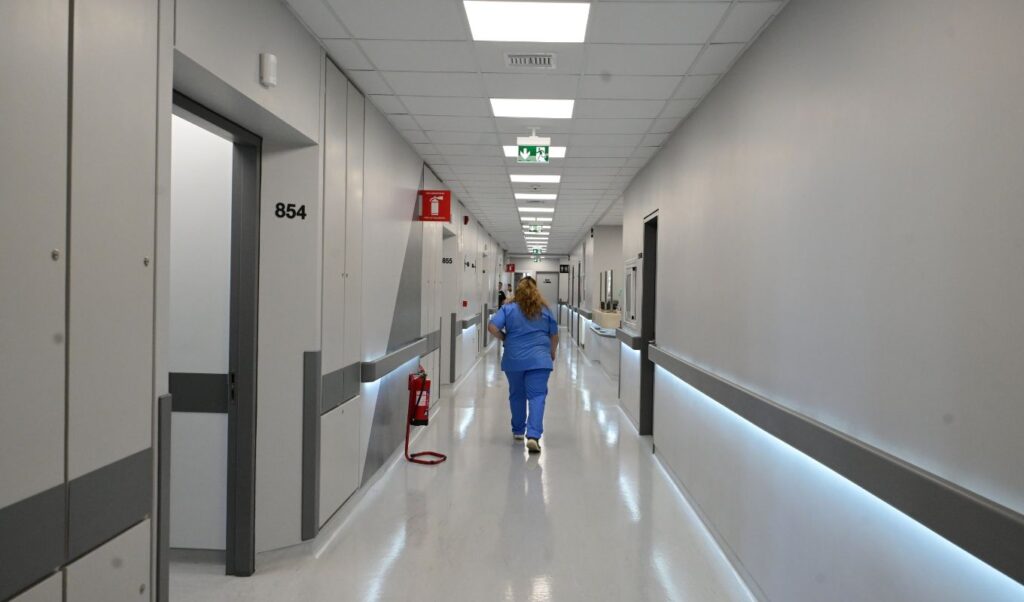
By midday today, approximately 8,500 private primary healthcare units — as well as non-medical wellness facilities such as beauty institutes, spas, and similar establishments — had already been thoroughly scanned and inspected since last Monday by the new digital application MedWatch. The platform is currently available to the Ministry of Health and the Athens Medical Association (AMА), while the Piraeus Medical Association (PMA) is expected to join the system within the coming days.
MedWatch has scanned 8,500 health and wellness facilities
MedWatch contains comprehensive licensing data for all private medical clinics registered with the Athens Medical Association (AMA), and within one month the application will be rolled out to all Medical Associations across the country. The platform scans every advertising practice by private physicians, as well as by professionals operating across 1,600 non-medical wellness centers — including activity on social media — and identifies potential violators of existing legislation and valid operating certifications. Flagged cases are referred to the Boards of Directors of the relevant Medical Associations for immediate on-site inspections.
Notably, out of the 8,500 private primary healthcare units and non-medical centers already inspected through MedWatch, 231 potential violations of current legislation and operating certification requirements have been identified. Of these, 160 are non-medical wellness centers, 50 are private medical clinics, 7 are private multi-specialty clinics, 1 is a day-care medical unit, and 12 are private hospitals.
The new digital application was presented to the public today at an emergency press conference by Health Minister Adonis Georgiadis, with the participation of Matina Pagoni, President of the Governing Committee of the Panhellenic Medical Association (PMA); Giorgos Patoulis, President of the Athens Medical Association (AMA); and Nikolaos Platanisiotis, President of the Piraeus Medical Association.
How a private medical clinic is licensed and inspected by its Medical Association
Given the growing public interest in how private healthcare facilities are licensed and monitored, it is useful to clarify the existing regulatory framework and the role of Greece’s Medical Associations.
Parapolitika.gr put the question to Nikolaos Platanisiotis, President of the Piraeus Medical Association and First Vice-President of the Governing Committee of the Panhellenic Medical Association, who provided a detailed account of the licensing framework, the required documentation, and the inspection procedures applied to private medical clinics and diagnostic laboratories by the inspection teams of the relevant Medical Associations.
According to Nikolaos Platanisiotis, in order to operate a private medical clinic, multi-specialty clinic, or diagnostic laboratory, an application must be submitted to the relevant Medical Association, accompanied by a specific set of supporting documents. These include a floor plan of the premises, drawn up and signed by a qualified engineer. The dimensions and suitability of the spaces are verified against established regulatory standards.
In parallel, the physician’s personal details, medical specialty, and legal eligibility to practice medicine are also reviewed.
In cases where the facility is equipped with medical devices or specialized scientific equipment, these must be described in precise detail within the application file. The required legal proof of acquisition must also be provided, along with applicable documentation such as CE European certification markings, where required.

Additional requirements
According to the President of the Piraeus Medical Association and First Vice-President of the Panhellenic Medical Association, additional requirements apply to specific categories of equipment and activities. A prime example is radiological equipment, for which the relevant certifications and approvals from the competent authorities are mandatory. Similarly, where applicable, a valid fire safety certificate must also be submitted.
Furthermore, the facility is physically inspected by an engineer and members of the relevant Medical Association to verify that all required conditions are met.
For new licensing applications, the inspection is carried out by scheduled appointment. At the same time, unannounced spot checks are also conducted — covering approximately 10% of facilities — to verify compliance with operating requirements in practice.
Depending on the nature and scope of the facility, the Medical Association may request additional documentation, certificates, or certifications when deemed necessary to complete the inspection process.
The overarching goal of this process is to ensure that private healthcare facilities operate in full compliance with the current institutional and scientific framework, and that they meet all prescribed standards for the safety and service of the public.
Athens Medical Association has been calling for a new inspectorate since 2020
The Athens Medical Association (AMA) has itself been calling for a new, specialized healthcare inspectorate since 2020. The AMA oversees approximately 16,500 private medical clinics, multi-specialty clinics, and private diagnostic laboratories.
According to the AMA, a significant regulatory gap has existed since the abolition of the Health Inspectors Corps in 2019 — the body that previously conducted inspections of both public and private healthcare facilities using specialized staff. At its peak, the Corps employed more than 130 subject-matter inspectors. By contrast, as AMA President Giorgos Patoulis has noted, the Association currently has only around 20 administrative staff members, none of whom are specialized in conducting this type of technical inspection.
In a statement issued last week, the AMA made its position clear: “The AMA, on the one hand, lacks the necessary staffing and expertise, and on the other, it is a structural distortion for a single body to bear simultaneous responsibility for both licensing and inspection. The reinstatement or establishment of an independent regulatory and inspection mechanism by the state is imperative.”

To put the sheer scale of the AMA’s workload into perspective, it is worth noting that even a mid-sized Medical Association — such as that of Patras — oversees approximately 650 private medical clinics, multi-specialty clinics, and diagnostic laboratories, according to Anna Mastorakou, President of the Patras Medical Association, speaking to parapolitika.gr.

Finally, the Piraeus Medical Association currently oversees 1,505 private primary healthcare units — including private medical clinics, multi-specialty clinics, and diagnostic laboratories. Of these, the operating licenses for 181 facilities are already under review for various reasons, and a significant number of those licenses are expected to be revoked in the near future, according to Piraeus Medical Association President Nikolaos Platanisiotis, speaking to parapolitika.gr.