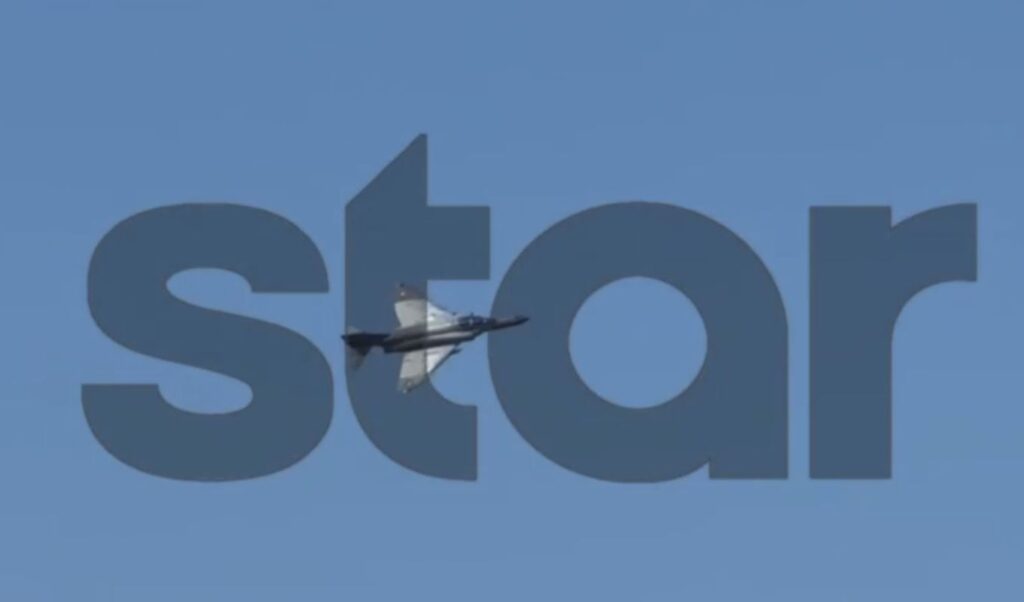
A video of the Phantom jet’s test flight, taken just 24 hours before the tragic crash during the Athens Flying Week at Tanagra, was aired on Star’s evening news bulletin. According to the report, the footage captures Friday’s rehearsal flights at Tanagra, which included clockwise turns and maneuvers — all executed flawlessly. These exercises are routine for our pilots and are considered standard practice. However, when they attempted to repeat the same sequence 24 hours later, the well-known tragedy unfolded. The video was posted on Twitter by Stamatis Pittas.
Watch the video from Star’s evening news bulletin:
Tanagra crash: The probable causes of the Phantom jet’s catastrophic failure
Journalist Marinos Gassiamis outlined the possible scenarios being investigated in connection with the Phantom’s crash, while also highlighting the heroic decision made by the two pilots, who chose to remain aboard the aircraft and saved dozens of lives at Tanagra during the airshow.
“This is an investigation that will take at least a month before we can be absolutely certain about what went wrong. Several scenarios are being examined. The pilots stayed with the aircraft, saving far more lives in the process. Looking at the footage, the aircraft appears to be banking into a turn to come back over the runway. To execute that turn — and bearing in mind that we’ve been hearing in recent hours that it was an old aircraft — ‘old’ refers to the technology it carries. It’s not modern by current warfare standards; that’s why we call it old, for no other reason. It’s a rugged, hard-wearing fighter jet that can forgive a great many errors. So it goes into the turn, and at that point we can see what appears to be a loss of lift, and it begins to descend. What could have gone wrong? We can only speculate at this stage. The most plausible explanation right now is that a downdraft pushed it off course, precisely because it was attempting a marginal turn and was already pulling significant G-forces,” he initially said, speaking on Live News.
He went on to add: “In this case, the aircraft — which was already pulling considerable G-forces and was operating at its limits — may have been struck from above or from the side by a downdraft or a crosswind gust, pushing it out of controlled flight and sending it into the ground. The other scenario, which is also quite strong, is that just as the aircraft climbed to execute the turn, it flew through a bird strike. Even a single bird ingested into the engine could have destroyed one of the two engines, immediately causing the aircraft to lose the thrust it needed to complete the maneuver. Even a modern fighter jet equipped with collision avoidance systems would have had extreme difficulty recovering at such a low altitude with that kind of probability — namely having ingested a bird. Another cause being examined is spatial disorientation, or vertigo. However, in my personal view, that scenario is very unlikely, as is pilot error, because we must remember that since the Phantoms were upgraded in the Hellenic Air Force, they have taken on — beyond interception missions — capabilities that are unique. I believe they are the only Phantoms capable of firing AMRAAM missiles, which are beyond-visual-range air-to-air missiles.”