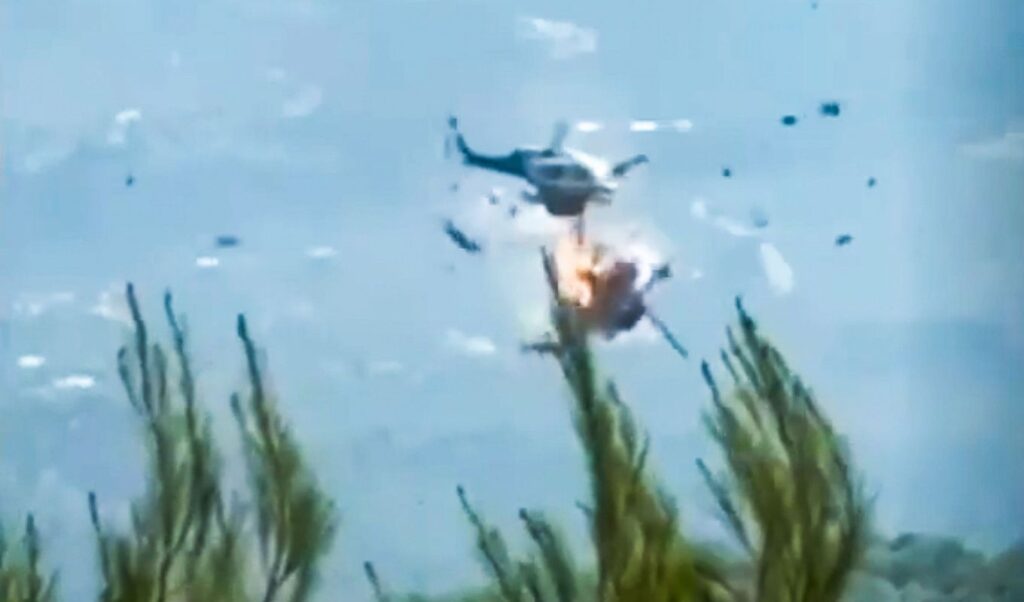
Details about the progress of the preliminary investigation are emerging regarding the tragic accident at Psatha on August 2nd, when two Bell-type helicopters collided, resulting in the tragic deaths of the Danish pilot of one aircraft and the co-pilot, a translator of Greek origin.
The Psatha tragedy: the critical 15 minutes before the helicopter collision
The investigation is now focused on the testimonies of the two survivors, the coordination of aerial assets, and the radio communications recorded shortly before the accident. The preliminary inquiry has been taken over by the Greek Police’s Organized Crime Division, and more than 15 witness statements have been collected so far. At the same time, forensic experts and specialists are being called upon to reconstruct, minute by minute, everything that unfolded above the Psatha fire front.
“We had no visual contact”
Particular weight is being given to the testimonies of the two survivors — the British pilot and the Greek translator who were aboard the helicopter that managed to survive the collision. According to information that has come to light, the two men stated that they had no visual contact with the helicopter they ultimately collided with. They reportedly indicated that at the moment of impact, they initially believed they had struck overhead power lines. Their helicopter is said to have been flying second in formation, following a lead aircraft that served as the “flight leader.” According to the same sources, the instructions they had received were to carry out their water drop only after the lead helicopter had completed its own run. However, a third helicopter — the ill-fated Bell — reportedly appeared within the formation.
The third helicopter and the critical question
A pivotal element of the investigation is the presence of the third helicopter in the area. According to one account attributed to the survivors’ testimonies, the two men reportedly stated they were unaware that a third helicopter was also participating in the firefighting operation. Other sources, however, indicate that at some point they heard via radio a third helicopter crew announcing their approach to the position. It remains unclear exactly when the presence of the third helicopter became known. When the crews were informed about the other aerial assets — and precisely what each crew knew — is one of the key questions the investigation must resolve.
The critical 15 minutes under the microscope
Particular interest surrounds events that reportedly unfolded approximately 15 minutes before the collision. Coordination of aerial assets in the Psatha area is said to have been handled on the ground by a senior Fire Service officer. According to reports, roughly a quarter of an hour before the accident, this officer left the position to travel to another area where a flare-up had occurred.
Following his departure, and in accordance with standard operational protocol, coordination is said to have passed to the airborne coordinator — the officer directing aerial assets from the Fire Service’s coordination helicopter.
However, sources indicate that at that moment the airborne coordinator was located at a different section of the fire front, in the Vilia area, and had no visual contact with what was happening at Psatha. This specific time window is now under intense scrutiny, in order to determine who held the operational picture of the helicopters, what instructions were issued, and whether all crews had been informed of the movements of the other aircraft.
The audio recordings may hold the answers
The recorded communications between crews and coordinators are considered of decisive importance. Police investigators already have the relevant material from the Operations Centre, which will be cross-referenced with witness statements. Evaluation of the communications is expected to be carried out by specialists, as the exchanges involve highly specialized codes and require expertise in aviation procedures. Forensic experts have been appointed to the case, and technical advisors representing the parties involved are also participating in the process. Meanwhile, the wreckage is expected to be transferred to Tatoi, where technical examination will continue.
Coordinators to testify last
According to information available so far, those who held the coordinator role at the time of the incident are expected to give their statements at a later stage of the investigation. In the meantime, authorities are working to gather and cross-reference witness testimonies, crew communications, and technical findings in order to build the most complete possible picture of the sequence of events.
The fundamental question the investigation must now answer is what exactly happened in the final minutes before the collision: who knew the position of each helicopter, what information had been transmitted to the crews, and whether adequate coordination of aerial assets was in place above the Psatha fire front.