The toll left by major forest wildfires across Attica over the past decade has been devastating. A total of 15 large fires have destroyed more than 800,000 stremma (approximately 200,000 acres) of land. The successive fires that struck the Athens Basin have dramatically reshaped the region’s forest map, with available data showing that even before the 2026 fire season had begun, 38% of Attica’s forested areas had already been lost. Among the hardest-hit areas is Kalamos in Attica, where the destruction caused by the catastrophic 2017 fire remains strikingly visible to this day.
The situation in Kalamos, nearly 10 years after the devastating fire
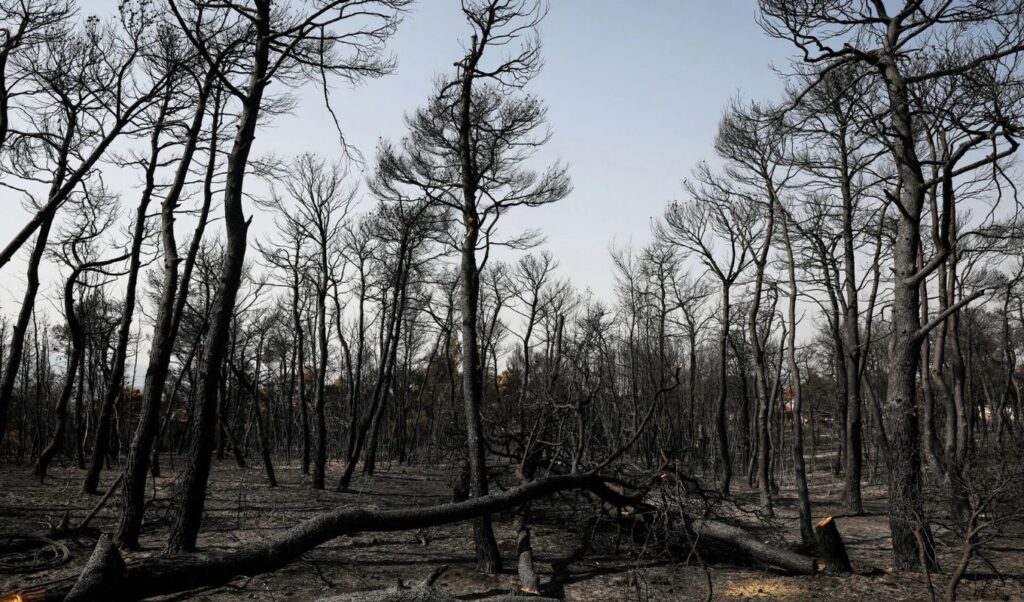
Particular attention is being drawn to Kalamos, where 30,000 stremma (roughly 7,400 acres) burned in 2017. The area has become a defining case study illustrating just how slow natural recovery can be in the wake of a catastrophic wildfire. Nearly a decade later, the situation remains dire — a clear indication that the destruction was so severe that nature has not yet managed to regenerate. The picture emerging from Kalamos shows that, despite the passage of years, landscape renewal remains extremely limited. This is precisely why the area sits at the center of ongoing discussions about the long-term consequences of wildfires across Attica.
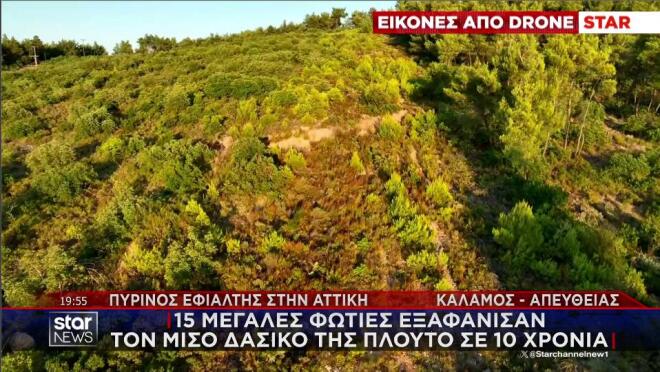
How many years does a forest need to turn green again?
As reported in the prime-time news bulletin on Star TV, in Kalamos — nine years after the devastating 2017 fire — one can now see only the faintest “hint” of green. This image powerfully illustrates just how slowly the natural landscape is regenerating.
Copernicus data on wildfires in Attica and the scale of burned land
According to the data, 15 major wildfires broke out across Attica within a single decade. As mapped using data from the Copernicus Earth Observation Service, these fires scorched more than 800,000 stremma (approximately 200,000 acres) of land.
Regarding the most recent fire that struck Porto Germeno, the burned areas in the Megara municipality have not yet been factored into the total count — meaning the full scale of destruction could be even greater than the figures currently on record. To put the 800,000 stremma figure into perspective, it is equivalent to the entire land area of the city of Singapore. Reports also reference “one-third of Attica’s trees burned,” a statistic that underscores the severe blow dealt to the region’s forest resources.
The same report also presents data on how long it takes the area’s main vegetation species to recover. Pine trees, kermes oaks, mastic trees, and phrygana scrubland — which together make up the ecosystem of Kalamos and large parts of Attica more broadly — require between 10 and 15 years just to reach a meaningful height.
For a mature, self-sustaining forest to fully establish itself, however, the timeline stretches to approximately 20 years. This estimate helps explain why the wounds left by wildfires remain visible for so long — even when early signs of regrowth create the impression that recovery is well underway.