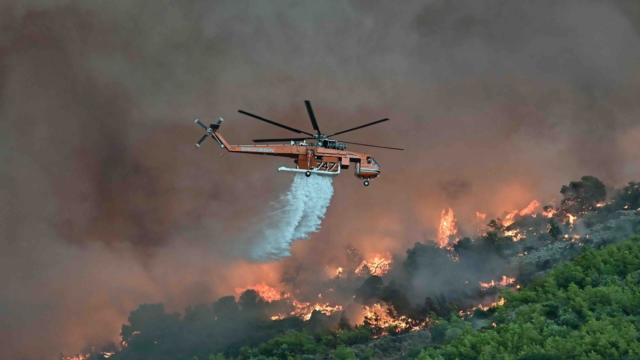
The images from Porto Germeno speak volumes about the extraordinary difficulty posed by today’s large-scale wildfires. The fire front continues to push firefighting forces to their limits, as gale-force winds, relentless reignitions, emergency evacuations via the 112 alert system, and widespread destruction of homes and properties combine to make this one of the most challenging operations of this year’s fire season.
This is far from an isolated incident. Within just a few days, Greece found itself battling successive major fire fronts. In Rethymno, extreme weather conditions severely hampered firefighting efforts and grounded aerial resources, while two firefighters lost their lives in the line of duty — as did another who was operating at the fire front in Gytheio. In Boeotia, specifically in Agios Vasileios, residents and vacationers were evacuated by sea after flames encircled the settlement. Meanwhile, new fire fronts erupting across Aigialeia, Phocis, and Phthiotis served as a stark reminder that operational pressure remains critically high, with firefighting forces stretched thin across multiple simultaneous crises.
Wildfires: What is a “mega fire” and how does it differ from a typical wildfire?
These developments have brought the term mega fire back into sharp focus. This is not simply a large wildfire. A mega fire is an extreme event that combines an exceptionally vast burned area, extraordinarily high fire intensity, rapid or unpredictable spread, prolonged duration, and severe impacts on settlements, infrastructure, and natural ecosystems.
In many cases, such fires develop a dynamic of their own. They generate their own microclimate, produce massive smoke columns, trigger powerful fire whirls and continuous reignitions, and can carry burning embers over long distances — sparking new ignition points far from the main fire front. Their behavior becomes increasingly unpredictable, and conditions can shift dramatically within minutes.
Greece has already faced devastating large-scale wildfires in recent years. However, scientists warn that climate change, prolonged drought periods, extreme heat, and increasingly frequent strong winds are creating conditions that favor the emergence of such extreme fire events with growing regularity.
The challenge, therefore, is not simply how to respond to the next major wildfire. It is about continuously adapting the way Greece organizes its prevention strategies and operational readiness. Harnessing scientific knowledge, improving fuel management, deploying modern technologies for fire behavior forecasting, continuously revising operational plans, and strengthening the resilience of high-risk areas are all central pillars of this effort.
Porto Germeno will be remembered as one of the largest wildfires of this summer. But beyond the scale of the destruction, it highlights something even more fundamental: that large-scale wildfires are evolving — and Greece’s approach to preparing for and combating them must evolve alongside them.