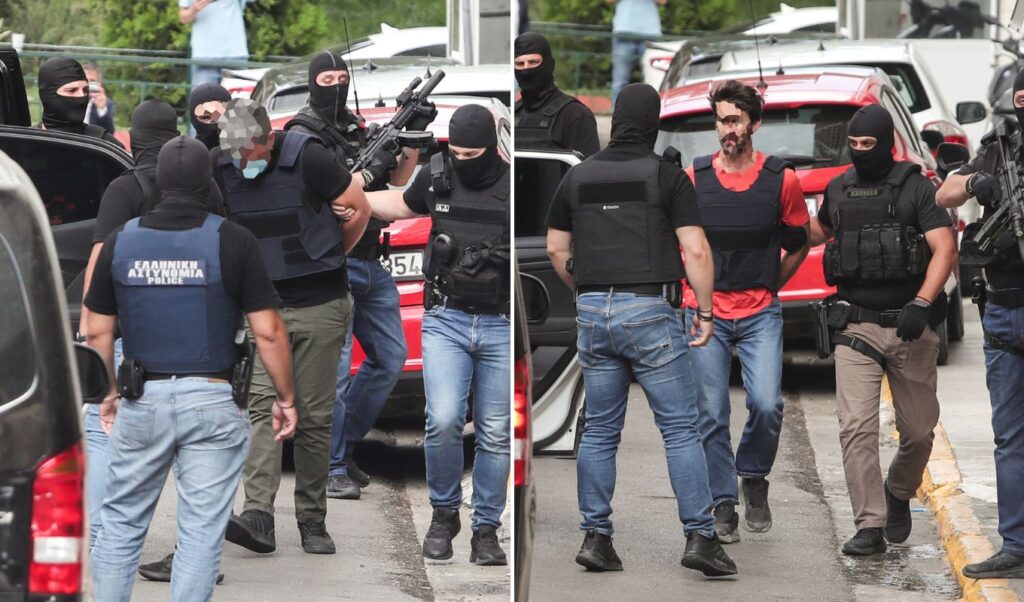
Police are moving to close the Marfin Bank case, having arrested two men while still searching for a woman believed to be living in the United Kingdom. The suspects are accused of setting the bank on fire in May 2010, in an attack that claimed the lives of three employees, including a pregnant woman. The two men were brought before the court at the former Evelpidon School building under heavy security. Armed officers wearing full-face balaclavas were present inside, while riot police units were stationed outside the courthouse gates. The suspects were transported in separate vehicles and entered the building wearing bulletproof vests, visibly composed. Although the offenses related to Molotov cocktail attacks have reached the statute of limitations, they face charges of premeditated murder on multiple counts, as three people died in the Marfin fire.
Read more: Marfin: “I couldn’t breathe — for a week our bodies expelled ash…” — The harrowing account of Maria Karagianni, the woman who became a symbol of the tragedy (Video)
Marfin: Who are the three suspects accused of carrying out the attack
What has caused widespread shock, however, is how these individuals have been living their lives today. According to Star, one of the two men who were handcuffed is the son of a wealthy family. The second man works as a rigger on the roof of the Olympic Stadium. The 46-year-old woman evading arrest lives in England, is now a mother of two children, and is struggling to make ends meet doing odd jobs. She reportedly claims to be in such dire financial straits that she cannot even afford to buy a plane ticket to return to Greece.
The investigation, the anonymous email and the photograph that “unlocked” the case after 16 years
The investigation conducted by the Homicide Division lasted an entire year. The key catalyst that brought this high-profile case back to the surface was an anonymous email received at the department’s offices, in which the unknown sender directly named all three individuals. The tip was assessed as critical, and authorities began re-examining the existing evidence. They then undertook a highly complex task: searching for these individuals across other, entirely unrelated case files. Through meticulous comparison of photographs and video footage, investigators confirmed with certainty that three individuals appearing in a separate case shared the exact same clothing, build, and distinctive physical features as the Marfin arsonists. Armed with this new evidence, the examining magistrate gave the green light for arrest warrants to be issued. According to Star, the case files now clearly show that one of the two arrested men was the person who smashed the bank’s glass front. He then, along with another suspect still being sought, threw Molotov cocktails into the interior of the building.
The chronicle of the Marfin tragedy
Unknown attackers stormed the Marfin Bank branch on 23 Stadiou Street. They smashed the glass facade and hurled Molotov cocktails and flammable material into the interior of the building while employees were inside. Most managed to escape or were rescued, but three employees became trapped and died from asphyxiation due to dense smoke and toxic fumes. The victims were Angeliki Papathanasopoulou, aged 32 (who was pregnant), Paraskevi Zoulia, aged 35, and Epameinondas Tsakalis, aged 36. The tragedy sent shockwaves through Greek society and became one of the darkest symbols of the country’s economic crisis era. The attack left an indelible mark on the collective memory, while the perpetrators were never convicted.
The case also had a judicial dimension concerning the operating conditions and safety standards at the bank branch. In 2013, bank executives faced charges of involuntary manslaughter, with fire safety measures, emergency exits, and staff training placed under scrutiny. In 2024, a ruling by the Greek Supreme Court (Areios Pagos) brought the case back into the spotlight, attributing responsibility to the bank that was leasing the premises at the time for failing to implement adequate safety measures, and referring the case for a new hearing.