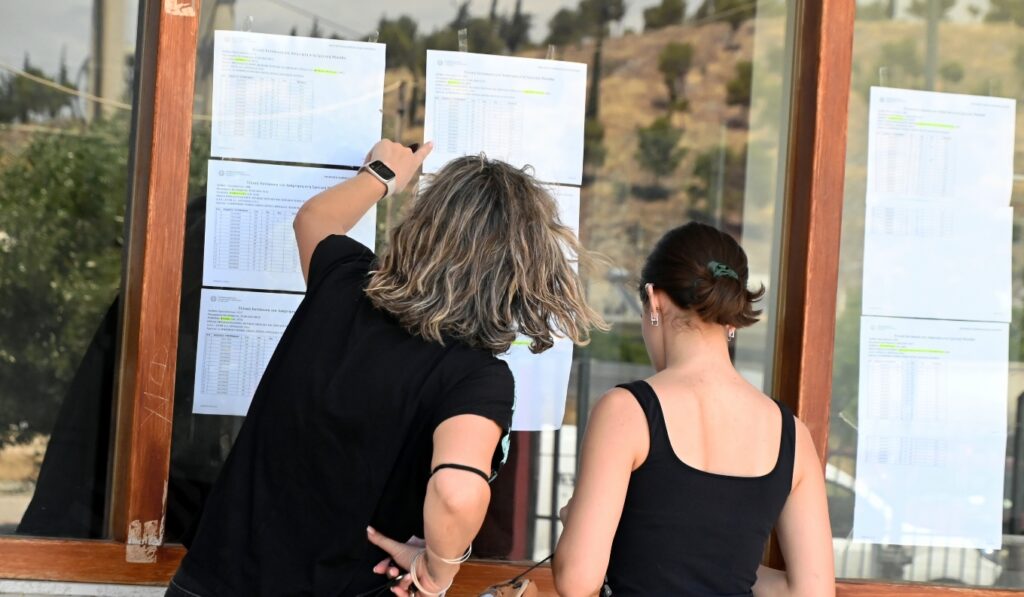
The 2026 Greek national university entrance exams once again produced students who stood out for their exceptional performance, proving that success is not simply the result of endless hours of studying, but of proper organization, composure, perseverance, and balance. Four graduates from high schools in Patras, who scored between 19,440 and 19,800 points, speak about the journey they took to reach their goals, describe the challenges they faced, explain how they managed exam anxiety, and reveal what they believe truly matters for a student preparing for these high-stakes exams. Despite their different personalities and career aspirations, all four top scorers agree on one fundamental point: success should never be equated with a person’s worth, and free time is an essential part of any effective exam preparation strategy.
Greece’s 2026 national exams: Andreas Oikonomopoulos and his path to 19,800 points
Andreas Oikonomopoulos, who achieved a score of 19,800 points, has set his sights on the Mechanical and Aeronautical Engineering School at the University of Patras. As he explains, his passion for physics began in his first year of high school, and he gradually realized that this particular program best matched his interests. He also reveals that a significant source of inspiration was his grandmother’s brother, who was an aeronautical engineer and remains a role model for him to this day.

He describes his final school year as “the best of my life,” despite the pressure and demanding schedule. As he explains, the continuous effort gave him the opportunity to grow every day and test his own limits. He does admit, however, that he experienced significant anxiety over both the essay-writing paper and Chemistry — a subject in which he needed to invest extra time to fill in gaps in his knowledge.
He places particular importance on free time, which he considers essential for every student. As he points out, many candidates spend endless hours studying while neglecting their mental well-being. He, on the other hand, made sure to rest — especially before each exam — so that he could sit his papers with a clear head. He also sends a powerful message to future candidates, stressing that “a child’s worth is not measured by their performance in a single subject” and that even failures are part of the journey toward success.
What Greece’s other top scorers have in common
Iliana Gogka, who scored 19,600 points, is aiming for the Medical School at Aristotle University of Thessaloniki, with a particular interest in Psychiatry. As she states, “Medicine is a profession that fascinates me, and Psychiatry in particular, because I want to give back to others — that has always been my dream.” She explains that the final year was not as stressful as many believe, provided there is composure, proper preparation, and trust in oneself and one’s teachers. She admits that the greatest pressure came after Easter, when the countdown to exam day truly began. She advises future students to believe in their own abilities and to avoid comparing themselves to others.

Themistoklis Vantarakis, with 19,500 points, is considering a degree in Electrical Engineering, Chemistry, or Chemical Engineering. He describes himself as an anxious person by nature, but emphasizes that the support of his family and teachers was absolutely decisive. He also mentions that there was a period during which his performance fell short of his own expectations, and that a conversation with one of his teachers helped him get back on track. What stands out is his candid admission that “I didn’t study for endless hours” — as he explains, he typically dedicated around three hours per day to studying.

Finally, Maria-Panagiota Babali, with 19,440 points, is also targeting a place at medical school. As she explains, from a young age she had decided to pursue a career in healthcare, believing that helping others is a true vocation. She describes her final year as demanding yet fulfilling, noting: “There was pressure, but there was also joy, because I was working toward a higher goal.” Although she felt exhausted during the exam period, she never gave up. She also reveals that she had plenty of free time, which she spent with friends, listening to music, and resting — despite the guilt she sometimes felt when she saw classmates studying for longer hours.
The shared message from all four top scorers is clear: success requires consistency, structure, composure, a strong support system, and self-belief. At the same time, all four emphasize that the national university entrance exams are an important milestone — but by no means the only measure of a young person’s worth.