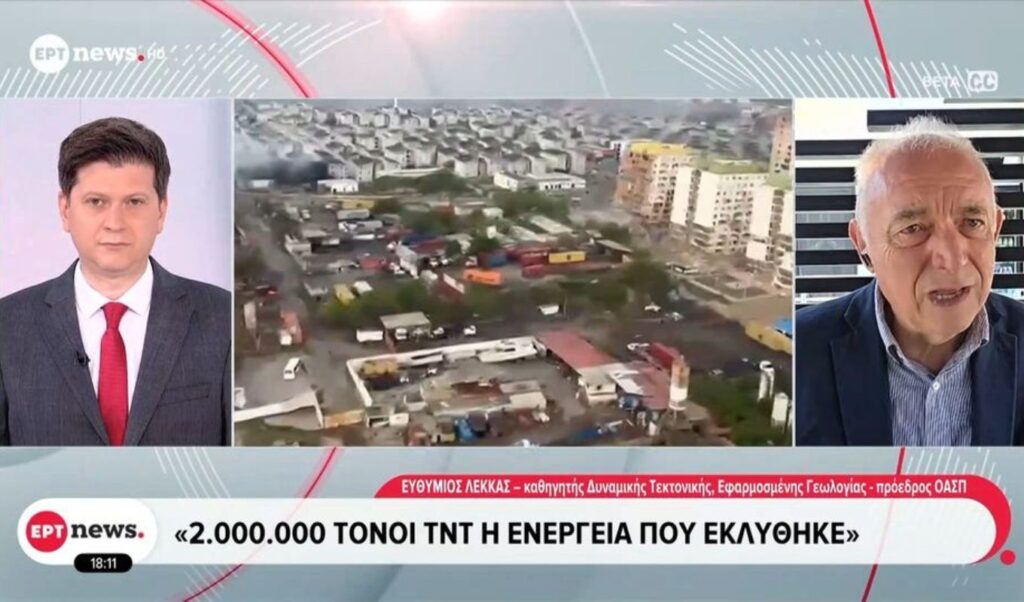
The powerful double earthquake that struck Venezuela on the night of Wednesday, June 24, 2026, caused tragic losses, with dozens of people killed and thousands still missing. Fears of a rising death toll are mounting as devastating images of the destruction spread widely across social media. Disaster management professor and president of the Greek Earthquake Planning and Protection Organization (OASP), Efthymios Lekkas, weighed in on the phenomenon, describing the sheer scale of the energy released and the catastrophic consequences of the two powerful tremors that struck Venezuela.
Lekkas on Venezuela’s double earthquake: The energy released was equal to 180 Hiroshima atomic bombs
Speaking to ERT, Efthymios Lekkas explained in practical terms what it means for a magnitude 7.0+ earthquake — like those that struck Venezuela — to hit a region. As he stated: “The 7.5-magnitude quake, which was the second one, is equivalent to 2 million tons of dynamite, or 180 Hiroshima atomic bombs. You can understand, therefore, that the energy released was enormous, which is why we have been witnessing everything we’ve seen over the past 24 hours.” He was then asked whether he anticipates aftershocks following the 7.2 and 7.5-magnitude quakes, to which the professor responded: “Based on the available data, we expect an aftershock in the range of magnitude 6.5. However, this is an approximation, because every region has its own seismic potential and its own characteristics — so this is simply an average figure we are working with.“
“These two earthquakes — these massive earthquakes — complemented each other in terms of the destruction they caused to buildings. The first earthquake damaged smaller-volume structures in the surrounding area, while the second earthquake caused damage to large-volume buildings, tall buildings — and so together, they produced an extremely wide spectrum of destruction from both seismic events,” he said, referring to the double earthquake in Venezuela that has already left dozens dead, with the death toll tragically expected to rise further. “We are dealing with the collision of two major tectonic plates — the South American and the North American plates. The tectonic faults involved are an order of magnitude larger than anything found in the Greek territory,” he noted when asked whether there is anything comparable in Greece, adding that earthquakes in Greece typically reach a maximum of magnitude 7.0 on the Richter scale.