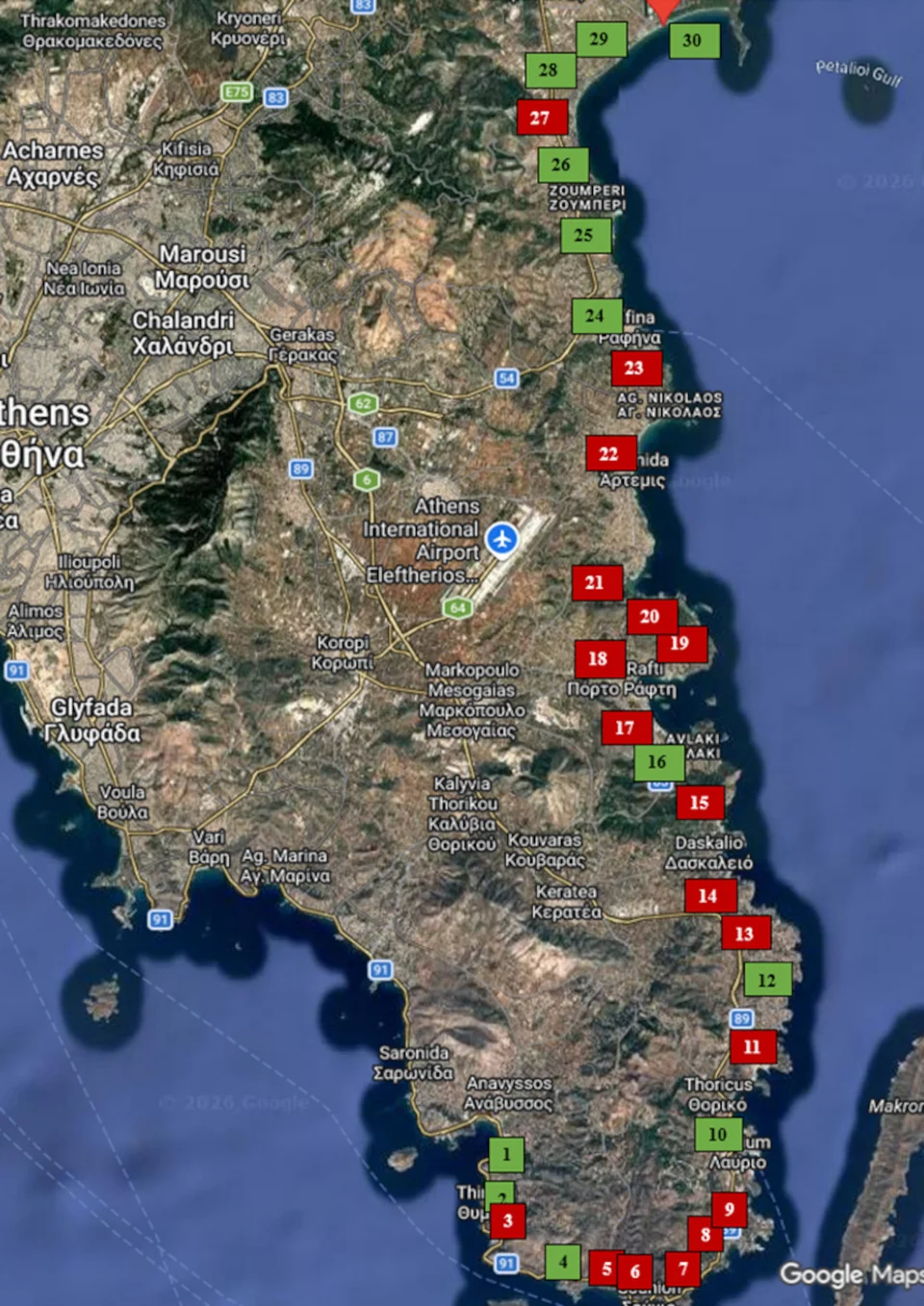
Recent water sampling checks conducted by PAKOE across the beaches of East Attica paint a detailed picture of current coastal water quality, identifying both areas with satisfactory water conditions and locations where elevated microbial contamination has been detected. According to the data, PAKOE carried out repeat inspections along the region’s coastline on 15/06/2026, covering a total of 30 different sampling points. “Of these, 12 points (40.0%) were deemed safe (suitable) for swimming, while the remaining 18 points (60.0%) were classified as unsafe (unsuitable), based on the thresholds set by Directive 2006/7/EC for microbiological indicators (E. coli and enterococci).
Read also: Dogs on the beach: when are they allowed and when are they banned?
Compared to May’s measurements, the overall picture has worsened, with unsafe locations now outnumbering safe ones.
East Attica beaches classified as unsafe for swimming
“In the area stretching from Thymari to Lavrio, a striking variation is observed between neighbouring beaches. Both sampling points at Thymari remain suitable for swimming, and the beach at Charakas also shows positive results. In contrast, the beach at Palaia Fokaia in Ormos Katafygi, Legraina, and Sounio beach were all classified as unsafe. In Lavrio, significant microbial contamination was recorded at the beaches of Asimaki, Pountazeza, and Mavri Petra, all of which were deemed unsuitable. The exception is the ‘Oxygen’ beach, which showed low concentrations of microbial indicators and was classified as safe,” PAKOE states.
“In the Keratea area, the situation remains problematic. Of the four sampling points checked at Daskaleio, only the 2nd Limanaki was deemed suitable for swimming, while the 1st and 3rd Limanaki, as well as the central Daskaleio beach, were classified as unsafe due to elevated microbial loads.
Porto Rafti records the highest concentration of unsafe samples in the region. Of the six sampling points, only one location at Akti Avlachiou was deemed suitable, while all other beaches exceeded the permitted limits, with particularly high E. coli concentrations. This pattern suggests widespread microbial contamination within the area’s enclosed bay.
Further along the coastline, Vravrona, Artemida (Loutsa), and Rafina also returned unsafe results, with measurements recording high microbial loads.
On a more positive note, Mati, Zoumberi, and several beaches in Nea Makri showed improved conditions, with most samples remaining within permissible limits.
In Nea Makri specifically, two of the three sampling points were classified as suitable, while one point exceeded the limits and was marked as unsafe.
Positive results were also recorded at Marathon beach and Schinias, where samples remained within legally defined limits.
Overall, the June measurements confirm that East Attica continues to face significant localised microbial contamination, particularly in enclosed bays, harbour areas, and densely populated coastal zones. The safest swimming options are found primarily at more open beaches, including Thymari, Charakas, Oxygen beach in Lavrio, Mati, Zoumberi, parts of Nea Makri, Marathon, and Schinias, where water quality remained within the required standards.”
Summary table of sampling and microbial load assessment for East Attica bathing waters (HERE)