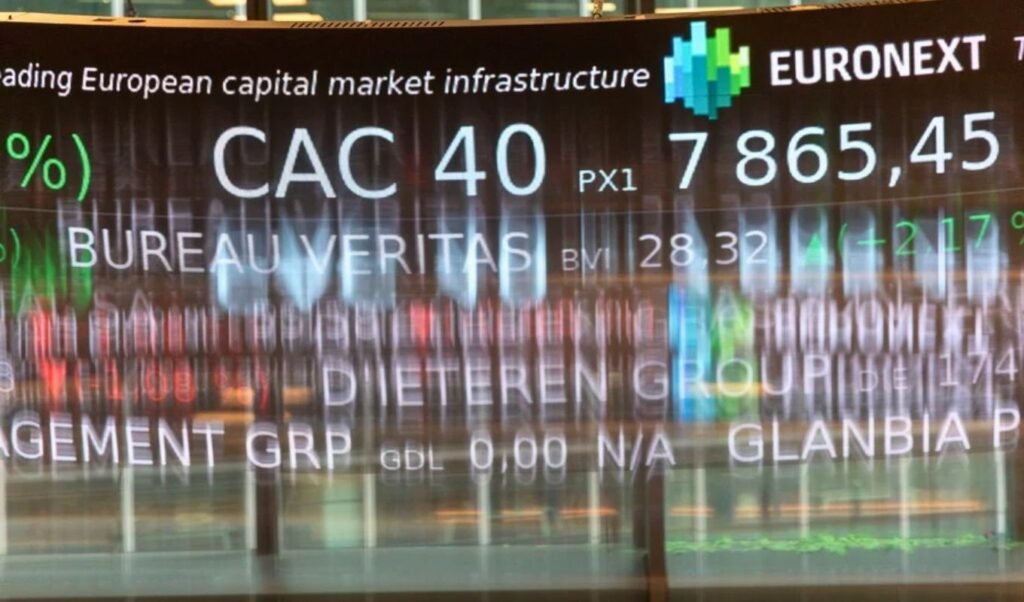
The French economy is facing mounting pressure as the country’s borrowing costs surpassed the psychological threshold of 5% for the first time in 24 years. The development reflects growing concern among international investors about Paris’s ability to bring its public finances under control. France’s 10-year government bond yield reached 5.01% on Wednesday — a level not seen since 2002 — before easing slightly to 4.99%. The previous day, the yield had hovered near 4.94%, confirming the intensifying pressure on the eurozone’s second-largest economy.
The French-German spread reaches levels not seen since 2011
A telling sign of the shift in investor sentiment is the widening gap between French and German bond yields. The French-German spread reached 159 basis points intraday — equivalent to 1.59 percentage points — approaching levels last seen in 2011, when the eurozone was grappling with its sovereign debt crisis.
The development carries even greater significance given that France is now borrowing at higher rates than countries like Italy and Spain, which for years were viewed by markets as far more fiscally vulnerable. Italy’s 10-year bond yield stood at around 4.57%, while Spain’s was at 4.07%.
Behind the surge in yields lies a combination of political instability, fiscal imbalances, and deteriorating global economic conditions. The difficulty in forming stable parliamentary majorities, combined with ongoing disputes over the state budget, has deepened doubts about whether the French government can implement a credible deficit reduction plan.
At the same time, recent social protests and violent unrest add another layer of uncertainty, as the government is forced to strike a balance between the need for fiscal consolidation and rising social pressures. “There is a fairly clear sense of distrust” toward France, Andrea Tueni, head of market activities at Saxo Banque France, told AFP.
According to his analysis, rising energy prices are also playing a significant role by fueling inflationary pressures and raising expectations of tighter monetary policy from central banks.
Yet the particularly sharp rise in French yields, compared to those of other European countries, suggests that investors are concerned not only about the broader interest rate environment, but also about France-specific risks.
Public debt and the risk of a growing fiscal burden
At the heart of investor concerns is the trajectory of public debt and the difficulty of reining in deficits. According to a Reuters analysis, if no political agreement is reached on fiscal measures, the deficit could climb as high as 6.4% of GDP. Even if a €54 billion savings package were implemented, the deficit is estimated to potentially remain at 5% or higher, with public debt exceeding 120% of GDP.
The core problem is that rising interest rates could place an even greater strain on an already difficult fiscal situation. The higher the rate at which the French government borrows, the greater the debt servicing cost when issuing new bonds or refinancing existing obligations.
This limits the funds available for public investment, social spending, and tax relief, while simultaneously making it harder to meet fiscal targets.
Illustrating the scale of the challenge, Reuters estimates suggest that France’s annual debt servicing costs could approach 4% of GDP by 2030 — up from approximately 2.2% the previous year — if elevated yields persist.
This creates the risk of a vicious cycle: high interest rates increase fiscal strain, the need for additional austerity measures risks curbing economic activity, and weaker growth makes debt stabilization even harder to achieve.
An additional factor weighing on markets is France’s political outlook ahead of the presidential election in April 2027.
The absence of a stable parliamentary majority hampers the implementation of reforms, while sharp disagreements among political forces over taxation, public spending, and the pension system narrow the scope for consensus.
Investors are closely monitoring party proposals on debt management, looking for signals about the future direction of fiscal policy.
In this environment, passing a budget and crafting a credible plan for the gradual reduction of deficits has become critical to restoring confidence.
What the French crisis means for the eurozone
The turmoil in the French bond market is not purely a domestic French affair. As one of the European Union’s largest economies and a key pillar of the eurozone, France plays a vital role in the stability of the European financial system.
A prolonged period of elevated yields could create additional pressure on European banks holding French government bonds, as rising yields are accompanied by falling prices on already-issued securities.
At the same time, a deteriorating investment climate could affect the financing conditions for businesses and households, while any broader spread of uncertainty could push up borrowing costs for other eurozone member states as well.
The stance of the European Central Bank is also drawing considerable attention. Although the ECB has tools available to address serious disruptions in sovereign debt markets, their existence does not imply automatic intervention whenever a country’s yields rise.
Moreover, pressure stemming from fiscal and political uncertainty cannot be addressed through monetary policy alone — which makes the decisions of the French government itself all the more critical.
Breaching the 5% threshold carries strong symbolic weight, as it reflects a significant reassessment by markets of the risk associated with French debt.
It does not, however, mean that France is already in a crisis of debt servicing inability. The country still has access to international capital markets, and higher interest rates affect the cost of existing debt gradually — not immediately and in full. The real concern is how long these pressures will persist and whether a significantly more expensive financing environment could become entrenched.
In the weeks ahead, investor attention will be focused on budget negotiations, French credit rating reviews, and ECB decisions, with political developments remaining another critical variable.
The market’s message to Paris is clear: fiscal sustainability and the political capacity to implement necessary measures are now being judged far more harshly than before. And for as long as uncertainty persists, the premium investors may demand to fund the French state is likely to keep rising.