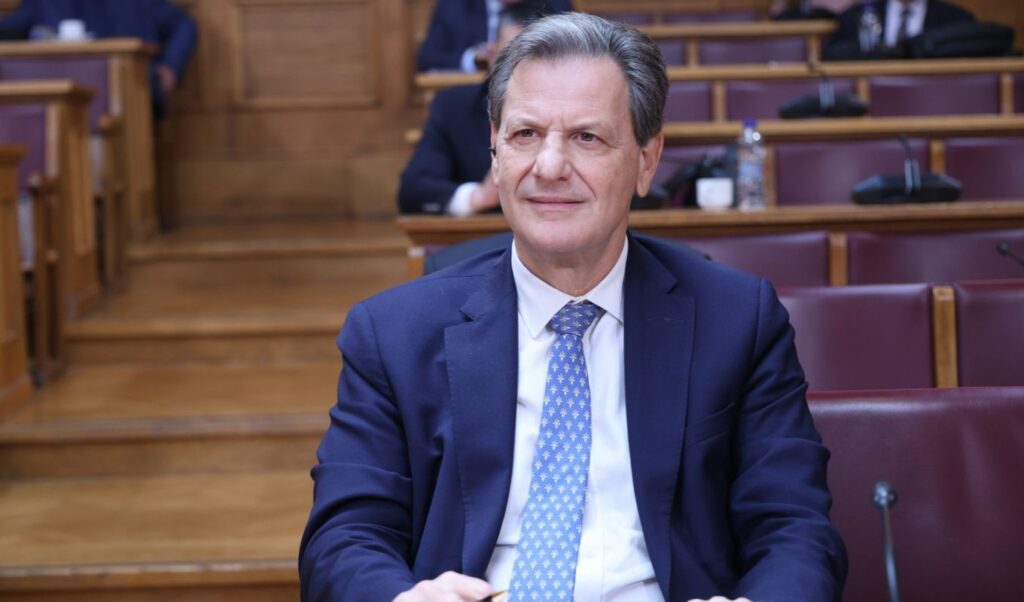
Theodoros Skylakakis addressed parliament during the debate on the 2027 Budget Draft. The New Democracy general rapporteur spoke of a Greek economy that has regained its credibility while grappling with mounting international challenges. According to Skylakakis, the world — and Europe in particular — is being battered by a series of trials that could escalate throughout 2027. For this very reason, he argued, Greece must pursue fiscal stability and economic credibility, as these remain its only real weapons.
Skylakakis: Investment outlook after the Recovery and Resilience Facility
“The period ahead is critical for Greece and for Europe. Politics as routine management no longer exists. Understanding the new world, discussing it, and reaching consensus on it is a national imperative. The 2027 budget gives us the foundation to begin that conversation. Sound public finances, falling debt, credibility that was hard-won. In this spirit, I call on you to vote in favour of the 2027 Budget Draft,” said New Democracy’s general rapporteur, Theodoros Skylakakis.
A significant portion of the rapporteur’s speech focused on the risks and challenges facing Greece in 2027. “The greatest challenge,” he said, “is sustaining investment after the end of the Recovery and Resilience Facility (RRF). However, the RRF’s track record has proven that we can mobilise private capital with public sector participation — not at rates of 40%, 50%, or 60%, but at far lower levels, around 4%. It is also critical to examine how the Greek economy can generate ‘new money’ through reforms — reforms that boost productivity.” The New Democracy general rapporteur further stressed that “the Fiscal Council has noted in its opinion that any slowdown in reforms, particularly ahead of elections, would limit productivity and undermine the economy’s credibility.”
The “perfect storm”
“But the greatest risk of 2027 is political risk — and it is not uniquely Greek. Imagine the perfect storm: successive elections in Greece, a political crisis in Europe, and a fiscal crisis in France — since the danger has now migrated from the periphery to the core. A regime in Russia that may seek an escape through escalating aggression. A clash between Congress and the executive branch in the United States, and the bursting of the artificial intelligence stock market bubble — a bubble entirely disconnected from the genuine, enormous potential of AI. Each of these, taken alone, is manageable. Together, however, they constitute the perfect storm — and faced with such a storm, political stability and fiscal credibility are not a luxury but the only refuge a country like Greece has,” said the New Democracy general rapporteur.
Turning to the debt reduction strategy, Skylakakis noted that “while a sequence of international crises unfolded — the pandemic, the energy crisis, the war in Ukraine, inflation at its highest in decades, the war in the Middle East — Greece did not resort to any extraordinary fiscal management. This is a major achievement of the government, and it has been rewarded: today, Greece borrows at lower rates than the United Kingdom.” “The fiscal space was found,” he said, “through the fight against tax evasion, which has been pursued consistently since 2019.” “But we must be honest about this. That space, this year and next, is being used in full. The European expenditure rule compliance account is closing at zero. From 2028 onwards, every new permanent measure will need to be financed by a new reform, new reductions in tax evasion, or new efficiencies in the state — otherwise it simply cannot be done,” he noted.
This year’s inflation is largely imported
Earlier in his speech, commenting on the execution of the 2026 budget, Skylakakis said that this year net primary expenditure of the General Government has increased because in 2024 and 2025 spending remained approximately €4 billion below the ceiling set by European rules. “The opposition at the time spoke of excessive surpluses. But had we spent that money then, we would not have it now — in the year it was most needed. And we could not have given more, because the new European rules would not have allowed it. We needed those resources because this year’s inflation is largely imported — it climbed from 2.7% in February to 5.4% in April, following the outbreak of the war. Oil prices rose, food prices rose, natural gas prices rose. Let us not forget who put Europe in this position. Russia, through its invasion of Ukraine and its energy blackmail, forced Europe into dependence on liquefied natural gas from the global market,” said Skylakakis.
The New Democracy general rapporteur also addressed the loan component of the RRF, which mobilised €29 billion in private investment. “The largest private investment programme ever seen in Greece,” he said, adding that these €29 billion will not simply disappear at the end of the year — a large share of them will flow through the economy in the years ahead, in 2027, 2028, and 2029, serving as an anchor to help sustain the Greek economy in the interim period before flows from other European instruments accelerate. These investment funds, he emphasised, were mobilised with the smallest public contribution ever provided by the Greek state for an investment programme of this scale — just over €4 of public spending for every €100 of private investment. The loans will be repaid, he noted, and that repayment will generate resources for public coffers, reducing the need for borrowing, with a fiscal benefit exceeding €1 billion.