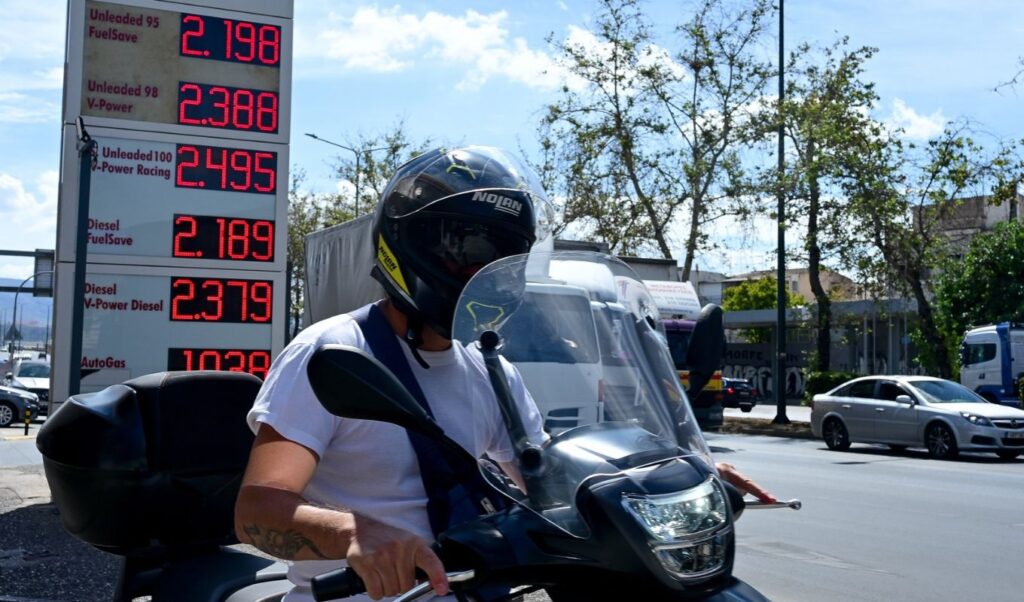
Consumers are bracing for new pressure on fuel prices, as Tuesday’s (September 29) refinery pricing is expected to trigger a fresh wave of increases at the pump. In recent days, prices at fuel stations have edged slightly higher, without moving far from the levels recorded on Friday, September 25. The national average price currently stands at €2.20 per litre for unleaded petrol and €2.22 per litre for diesel. However, fuel market insiders are warning that the new refinery pricing could bring increases of up to 2% within a single day. If these estimates are confirmed, the average price of unleaded petrol is expected to exceed €2.24 per litre, while diesel could climb above €2.26 per litre.
Heading towards €2.30 per litre
The pressures, however, do not appear to be temporary. Market insiders estimate that if the upward trend continues, prices could soon approach €2.30 per litre. In several island regions, these levels have already been surpassed. In the Cyclades, the average fuel price has risen above €2.40 per litre, while in the Dodecanese it exceeds €2.30 per litre.
This picture reflects the intensity of the pressures that have built up in the market over the past seven months. On February 28, unleaded petrol was selling at an average of €1.75 per litre and diesel at €1.57 per litre. Since then, the price of petrol has risen by approximately 25%, while the corresponding increase for diesel has reached 41%.
Uncertainty over the duration of the energy crisis
The biggest challenge remains the uncertainty surrounding the severity and, above all, the duration of the energy crisis. No one can reliably predict when international prices will begin to ease and, consequently, when pressure on the domestic market will start to subside.
It is telling that, without the existing subsidies in place, unleaded petrol would have already reached around €2.30 per litre, while diesel would be approaching €2.37 per litre.
Against this backdrop, the government’s economic team is advancing a four-pillar plan to keep prices in check — one that can remain active for as long as the exceptional conditions in the energy market persist.
The four interventions
The first pillar is an extension of the direct pump subsidy on diesel. The level of the new support measure is expected to be announced on Wednesday (October 1), with the possibility of increasing it beyond current levels still on the table.
In parallel, the government is seeking an agreement with refineries for them to contribute to the price containment effort through discounts on both diesel and unleaded petrol.
The third pillar concerns heating oil, for which a dual subsidy from both the state and refineries is under consideration. The total discount could reach as much as 30 cents per litre — an amount roughly equivalent to a reduction in the special consumption tax.
Finally, the plan provides for a review of the subsidy framework every 15 days. This mechanism would allow both the level of state support and the fiscal cost to be adjusted in line with movements in international prices.
The overarching goal is to establish a continuous consumer support mechanism that will remain in force for as long as necessary, until meaningful signs of relief from the energy crisis begin to emerge.
Oil hits $108 per barrel
Meanwhile, developments in the Middle East are leaving little room for optimism about an imminent easing of the energy crisis. International oil prices moved higher once again, with a barrel reaching $108 — a 4% rise in another highly volatile trading session.
Uncertainty over the price outlook has intensified globally, with the United States examining measures to boost domestic supply and Donald Trump seeking to reassure consumers.
“We’re going to win the war very soon, and once we win it, oil prices will come down — they’ll come down a lot, to where they were before the war,” the US president stated.