At a particularly sensitive political juncture, with the clock ticking toward the next election, the Greek government finds itself confronting a powerful cocktail of challenges that could test New Democracy’s political dominance in the months ahead. With an outright parliamentary majority as its declared goal, maintaining the trajectory toward that outcome inevitably runs through three simultaneous hotspots — ones that could largely define the entire pre-election battle through the spring of 2027: the cost-of-living crisis sweeping through households, rising energy costs that threaten to further test society’s resilience and signal a difficult winter ahead, and the escalation of Turkish provocations as they unfold across the Aegean and Eastern Mediterranean.
While the balance of power has largely been set — with New Democracy holding its lead and being threatened primarily by its own internal contradictions — the findings of the latest polls, which record a strong majority current calling for “political change,” are not going unnoticed. On the contrary, they are generating serious concern within the Prime Minister’s Office. This is all the more pronounced given that the rift within the ruling party between its parliamentary group and ministerial officials appears not only unresolved but persistently visible.
Cost of living: The government’s top priority
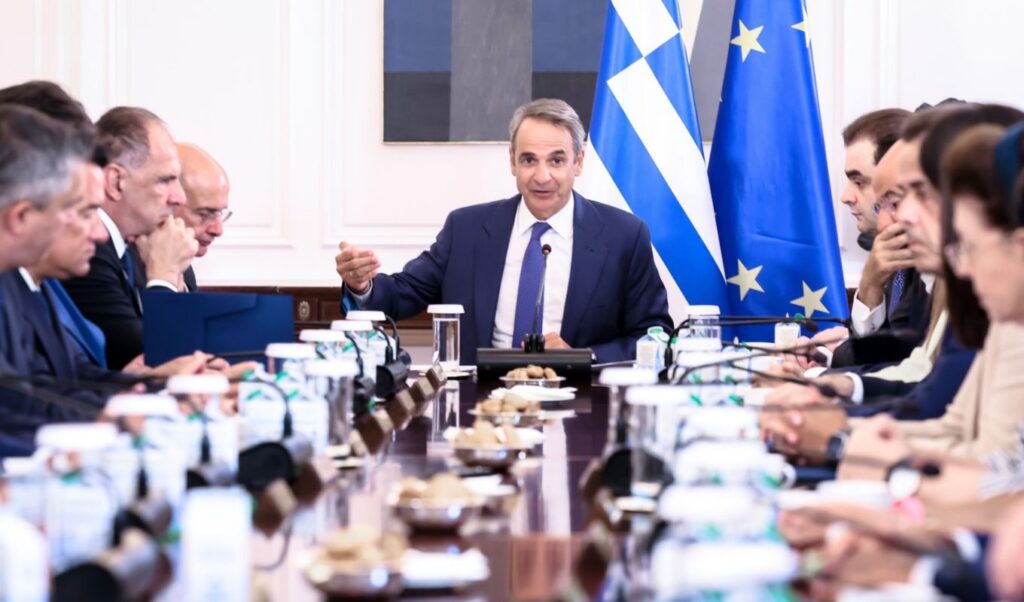
The cost of living has been officially designated by Kyriakos Mitsotakis himself as the government’s number one priority. It has long been the ruling party’s Achilles’ heel, as persistent inflation — particularly in food and essential goods — erodes disposable income and fuels voter discontent. “The most significant immediate government priority, in a climate of great international uncertainty and turbulence, is addressing the cost of living — primarily by curbing energy costs with a focus on heating oil, and in the medium term by increasing disposable income through further tax relief and higher average nominal wages,” the Prime Minister stressed in his Sunday review.
In this context, the energy crisis only compounds an already difficult picture, with Athens and Mr. Mitsotakis preparing to go head-to-head with northern European countries at the upcoming October EU Summit. Greece is entering European negotiations pushing for a collective, pan-European solution to fuel and energy prices, emphasizing that domestic fiscal capacity is insufficient to sustain support measures without jeopardizing fiscal stability.
The high-stakes battle over fuel prices
Stabilizing energy prices therefore remains the critical challenge of this autumn, as any new wave of increases threatens to blow apart the budgets of households and businesses — and along with them, the government’s plans to recapture the momentum needed for a third term in office. At the same time, the government’s standing is being tested internally within the party, as the visible gap between regional MPs — who are on the receiving end of citizens’ frustration — and ministerial officials is generating unwelcome turbulence at this stage. Dora Bakoyannis has publicly denounced arrogance and a sense of entitlement among some officials, with a number of New Democracy MPs quietly voicing their agreement.
The Prime Minister, having been briefed during his stay in the United States about these internal discord signals, moved swiftly to prevent further escalation on the intra-party front. Speaking from Washington, he issued a firm call for “humility,” seeking to head off any missteps and, above all, to avoid giving the impression that the government is disconnected from society and its problems. His message was directed primarily at government officials, calling for effectiveness, careful and measured public communication, and direct engagement with the everyday concerns of the party’s social base.
Mitsotakis sends a clear message to Ankara
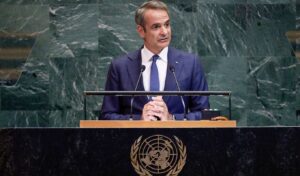
Greek-Turkish relations have now entered this complex equation, with Kyriakos Mitsotakis using the podium of the UN General Assembly and his meetings in the United States to send an unambiguous message to Ankara, clearly delineating Greece’s red lines: “The Greek-Turkish dialogue cannot coexist with unilateral actions that violate international law.”
“Greece wants to be a country that builds bridges, not one that stirs up trouble,” he stressed, ahead of Greece’s assumption of the UN Security Council presidency in October — reiterating the red lines of Greek diplomacy as he had also articulated them from the UN floor, at the eleventh hour before the resumption of the electricity interconnection project. Within government circles, it is clear that maintaining calm waters in the Aegean is desirable, but not at the cost of any concessions on sovereign rights. On the other hand, Turkey’s conduct on the ground remains the ultimate crash test as to whether diplomacy can remain viable, or whether Ankara’s continued provocations will trigger a new crisis with unpredictable consequences for the domestic political landscape.
Published in Apogevmatini