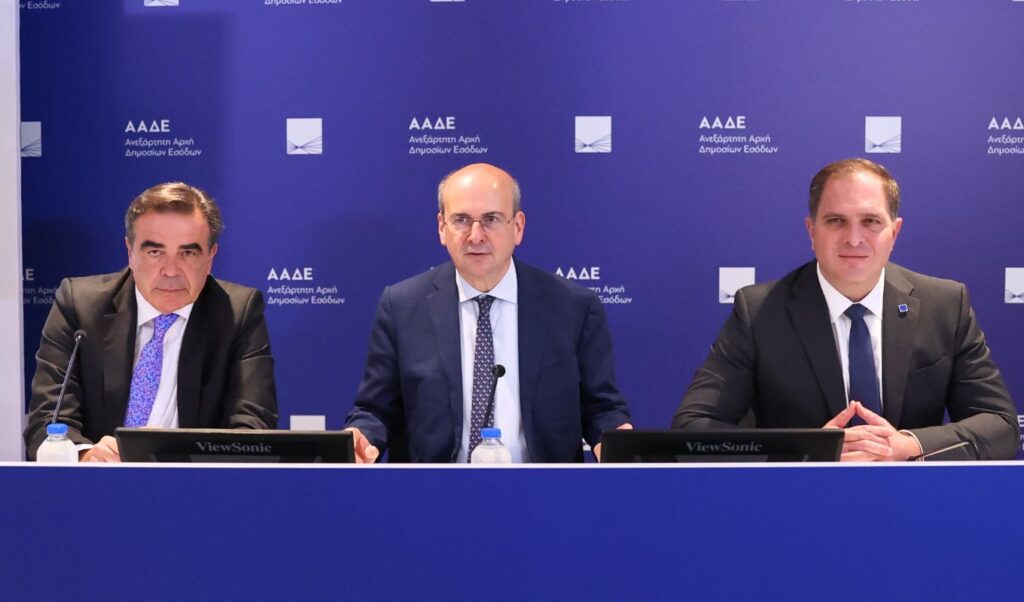
A joint press conference has concluded, held by Deputy Prime Minister Kostis Hatzidakis, Minister of Rural Development and Food Margaritis Schinas, and the Governor of the Independent Authority for Public Revenue (AADE), Giorgos Pitsilidis, focusing on the progress of agricultural payments. “We have fully honored our commitments to support livestock farmers, cotton producers, and wheat growers. Real producers are receiving significantly more money,” said Kostis Hatzidakis.
Farm payments: key highlights from the press conference
At the center of the discussion was the transition of OPEKEPE (the Greek Payment Authority for Common Agricultural Policy Aid) to AADE, described as a political decision that is proving its worth. Also highlighted were the latest agricultural payments, which exceeded expectations — with more funds being credited to “real producers” as a result of stricter controls — as well as upcoming changes to the new subsidy application process.
“This press conference is taking place at AADE’s offices, and since our last meeting, a significant reform has taken place: the absorption of OPEKEPE by AADE. Serious work is being done with the farmers’ interests and the country’s reputation in mind. At a time when we are managing this transition and must remain compliant with the European Commission, we must also ensure our farmers are paid on time. A major coordination effort is underway between the Ministry of Rural Development and AADE,” Kostis Hatzidakis said at the outset.
“Excellent work was done in record time, and on behalf of the Prime Minister, I want to congratulate both sides. The absence of any backlash since the payments were made reflects the scale of the effort and the positive outcome. More money is being paid out compared to last year.”
“We have fully honored our commitments to support livestock farmers, cotton producers, and wheat growers. Real producers are receiving significantly more money. This is the added value of this reform. Controls were carried out, people who should not have been receiving funds were excluded, and unit prices were also increased,” he emphasized.
“As we speak, there are 1,151 cases deemed suspicious, five criminal organizations have been identified, and the estimated damage has been assessed at €69 million.” “Our country will assume the EU Presidency on July 1, 2027. By then, we must not be carrying the burdens and unresolved issues of the past. What we are doing with the transition of OPEKEPE to AADE is precisely addressing one part of those outstanding issues,” said Margaritis Schinas, who then took the floor.
“On July 1 last year, Action Plan 1 was agreed upon, which has brought us to where we are today. The goal is not just another successful payment, but ensuring we never return to yesterday’s system — one that did not work in favor of the real beneficiaries,” he added. “To the best of my ability, I will contribute to restoring this relationship of trust with the farming community of our country.”
He also highlighted the implementation of the government’s commitment to allocate €80 million for livestock farmers and €80 million for wheat and cotton producers.
“The new system is beginning to deliver results. I am talking about a decision that has been vindicated — one that was supported in the European Parliament exclusively by the parliamentary group of New Democracy,” Margaritis Schinas stressed.
For his part, AADE Governor Giorgos Pitsilidis praised the work of the ministry, AADE, and their staff, who worked intensively — particularly during the past week — to ensure the payments were completed.
What’s changing in the subsidy application process
Regarding the upcoming changes to the subsidy application, Mr. Pitsilidis highlighted the following:
• Fields will be pre-filled using data from tax ID numbers, IBANs, business activity codes, and official registries
• Data will be drawn from the Ministry of Rural Development, myDATA, MIDA, and the Land Registry
• Invoices, farm operations, land parcels, and authorizations will all be subject to verification
• An updated geospatial framework for 2024–2025 will be utilized
“If all goes well, we will open the application process in the first two weeks of July,” said Giorgos Pitsilidis.