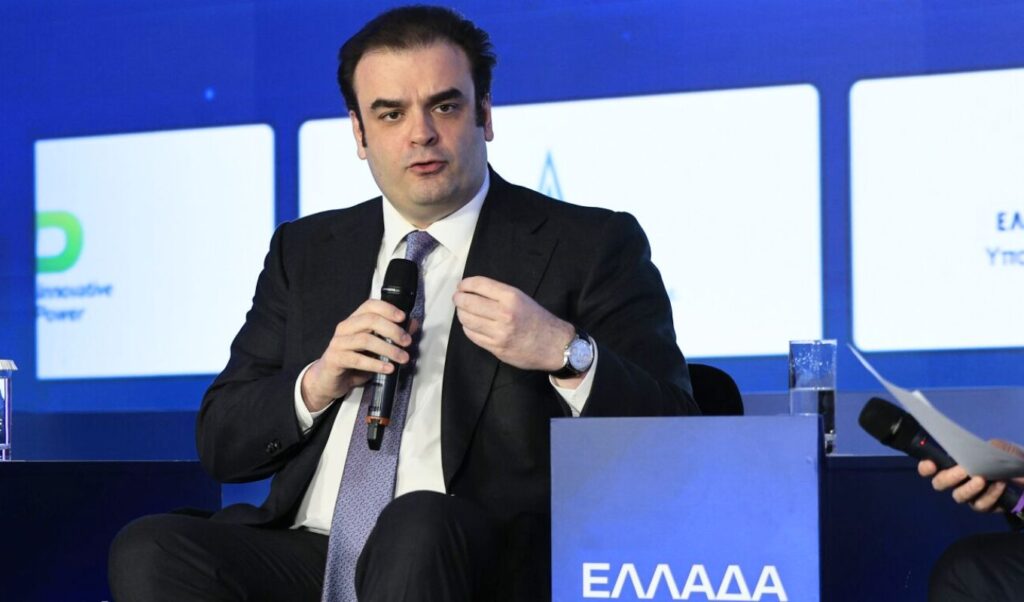
The Minister of National Economy and Finance and President of the Eurogroup, Kyriakos Pierrakakis, expressed the view that “Greece stands at the threshold of a period of significant opportunities, having now achieved political and economic stability.” His remarks came during a visit to the city of Patras. In an interview on the “Metropolis” program on Ionian TV, Mr. Pierrakakis emphasized that the country, together with its regions, must continue investing in sustainable growth, outward-looking policies, and the creation of new prospects. He also underscored the importance of safeguarding political stability, stressing that this hard-won achievement must not be put at risk.
Watch the video:
Full interview with the Minister of National Economy and Finance, Kyriakos Pierrakakis
Journalist: We have the pleasure and honor of welcoming today the Minister of National Economy and Finance and President of the Eurogroup, Mr. Kyriakos Pierrakakis, on the occasion of his visit to Patras. Mr. Pierrakakis, good evening and thank you warmly for being here.
Kyriakos Pierrakakis: Good evening. It is truly a pleasure to be speaking with you.
Journalist: You have already had meetings here in Patras since this morning with various organizations. Your first stop was at the Port of Patras. We heard and saw reports covering your statements there earlier. Based on everything you discussed — with the Governor of Western Greece and in your meeting with members of the Achaia Chamber of Commerce — Western Greece has not been growing at the same pace as other regions, yet we are beginning to see something change. I imagine you noticed this yourself through the meetings you had today, which is also a response to all those who say “we don’t pay enough attention to the regions.”
Kyriakos Pierrakakis: I can confirm that something is changing. I felt it clearly in my meetings with local organizations, and also walking around the city — in the eyes of the people. But what I want to say is that there are even more things that can change in the future. The key question is what I sensed — and said this morning after our meeting at the port: do we want a city and a country that looks inward or outward? A city, a Patras, that opens itself up to the world, or a Patras that is closed and turned in on itself? I just had a meeting at the Chamber of Commerce where they showed me the history of the Chamber going back to the 19th century.
There are many great stories in this city’s past — stories of how it served as a gateway for commerce and entrepreneurship. You don’t need to know the history of the “Stafidika” or of “Gustav Clauss” to understand in depth what happened here. But I believe we have even greater prospects ahead — around the University of Patras, around investments that can be made with the port as a central hub, and more broadly through making the most of everything this city and the wider region have to offer. I can sum it all up in one word: optimism.
Journalist: I want to talk a lot about this, because citizens are asking us — you know, we see our viewers on the street here as a regional broadcaster, we have that direct contact — and they want to know more about the new measures addressing citizens’ debts. How quickly will those who are struggling to meet their financial obligations actually feel relief under the new measures you have announced?
Kyriakos Pierrakakis: Immediately — right now, this summer — because the legislation in which we are incorporating all of these measures will, all going well, have been passed in Parliament next week. And let me remind everyone that we have a whole package of measures here. This is the largest package of measures for private debt since the financial crisis. Whether we’re talking about the 72-installment repayment plan, or about the expansion of the out-of-court settlement process — where we’ve lowered the eligibility threshold from €10,000 to €5,000 — or about how we’re reforming the out-of-court process itself. What has the public been asking for over many years? Effective protection of their primary residence. In my view, the Katseli Law did not achieve that — because there are still people running to the courts, both those who need to and those who don’t. We are transforming the out-of-court mechanism into a tool for protecting people’s primary residences. More and more of our fellow citizens are discovering what a powerful instrument this can be in their hands.
And even arrangements like the Swiss franc loan settlement — how long were we hearing about that? Around 50% of Swiss franc borrowers have already entered the settlement scheme, and even more had asked to study it more carefully before joining — so we extended the deadline to the end of September. All of these together are tools. And I saw this firsthand, among other things, on the day I announced the increase in the protected income threshold from €1,250 to €1,600 in Parliament, in response to a question from Stratos Simopoulos, our MP from Thessaloniki — in the sheer number of messages I received on my phone and the number of citizens who came up to speak to me about exactly that in the days that followed, when I was in Athens and in contact with people in my own constituency.
There are many people out there who need a state that extends a helping hand rather than wags a finger at them. And we’re talking about people who want to pay their debts — debts that accumulated during the difficult years of the crisis — people who tell me simply, in one phrase, when they meet me on the street: “we want to keep our heads above water.”
Journalist: These people feel trapped. So things are genuinely changing for them.
Kyriakos Pierrakakis: Exactly. These are tools in their hands. And there are many tools we are providing. Even the new Agency — which will acquire properties and lease them back to their former owners — will be operational this autumn. This is something we had been discussing for quite a few years. We already have a contractor in place. The Acquisition and Re-letting Agency is yet another tool for protecting people’s primary residences: you will be able to stay in your property for up to 12 years, with a state-subsidized, low monthly rent, and at the end you can reacquire your property. In the time we’ve been talking, I’ve outlined a whole range of measures.
There are many measures. And — to get ahead of the next question — private debt is actually a smaller problem in Greece than it is in other European countries. I tend to start from the data, inevitably given my role: private debt in the rest of Europe averages 121% of GDP. In Greece it stands at 94.5% — it is lower. But you might say, “does that mean it’s not a problem?” Of course it is — it’s just not systemic, as it is in other countries. But you have a social problem the moment even a single person needs your help. And so you must help them. And for as long as this problem persists, we will keep providing more tools to address it.
Their problem is our problem. That is how we approach it, and that is how I approach it personally.
Journalist: Since you mentioned “even a single person facing a problem” — we had a complaint from a mother of a hearing-impaired child that reached you. You contacted her, the exemption for the hearing aid subsidy was ultimately processed. Is this an example of how an everyday problem can reach the Ministry and be resolved? Because you know very well that citizens have the impression that the doors of Ministries are closed — that Ministers don’t see the realities of everyday life.
Kyriakos Pierrakakis: That was an absurdity that needed to be corrected. I won’t hide the fact that when I saw the report about that child, I was genuinely moved. The state generates many injustices. Back in 2019, what were people saying to Kyriakos Mitsotakis? They were saying “fix the state.” Through digitalization, we have managed to resolve a great many problems. We now have 2,257 services on gov.gr — that was the count yesterday, and the number keeps growing. We have digitalized a great deal. But at the same time, there are still so many injustices embedded in our state — injustices that accumulated over decades. And we have to solve them one by one, learn about them one by one. They sometimes produce problems as extreme as the one you mentioned. I am very glad we were able to provide a solution, even if it took the time it did.
And every other such problem that reaches any of us — me or my team — I assure you we will be on it and we will resolve it. Because at the end of the day, that is our job. That is why we are there. There are the statistics, the macroeconomic indicators — all the things this country was criticized for in recent years, a decade ago. We were nearly staring into the abyss as a nation. We addressed all of that. But at the end of the day, opportunity and growth must translate meaningfully into the everyday lives of each citizen. The bare minimum is not having a state that is a Leviathan — a state that generates pointless bureaucracy, puts people through needless hardship, and lacks all compassion. The state must extend a hand, not wag a finger. That is what we are trying to do. We are also using technology to do it better. We certainly still need to resolve a whole series of injustices of this kind.
Journalist: Staying on the topic of everyday life — I want to ask whether extending installment repayments helps households that are under daily financial pressure enough, or whether bolder interventions are needed.
Kyriakos Pierrakakis: As you can see, we are not stopping — every week we announce more measures. The 72-installment scheme affects 1.5 million citizens. The out-of-court mechanism affects one million citizens. If you look at how many people are potentially benefiting from each individual measure, the scope is very wide. And as I said, what is the goal? To put it simply: anyone who wants to pay their debts should be able to. Anyone who wants to keep their head above water and genuinely intends to honor what they agree to — why wouldn’t you help them do that? That is the obligation of the state, of the government, and that is precisely what we are trying to do with these measures. I think we will see that they are genuinely beneficial.
I heard criticism from the opposition about the Swiss franc settlement scheme. Yet 50% of affected citizens have already enrolled, and we are now extending it. I don’t need to defend the quality of the scheme as Finance Minister — the citizens who are signing up to it speak for themselves.
So step by step, we learn, we improve, we build policies and we move forward. And what I can assure you — given all the intense discussion about elections, when they might be held, which is the number one topic in political conversations — is that both the Prime Minister and I care far more about governing than about getting elected.
And I can tell you that as each day, each week, each month passes, you will continually see changes of this kind on the ground. Changes that affect people’s lives. Not old-fashioned political rhetoric, not old-fashioned political rivalry — we have moved beyond that. Politics is about the future. Politics is about what’s here and now. It’s about the problem that person over there is facing in real life. That is why, just as I am in Patras today, we will travel across all of Greece, city by city, street by street, to see what we can do — to resolve the obvious things that need resolving, but also to unlock the potential of each place and address the everyday social problems that people face.
Journalist: Of course, some people interpret these tours as a sign of early elections. 2027?
Kyriakos Pierrakakis: 2027, as the Prime Minister has stated. That is not what this work is about. When you are out in the field, you learn. And when you see a problem right in front of you, you pick up the phone and solve it. We have solved many such problems this way. Because when there are thousands of issues, many small ones among them, a small problem can be decisive in the life of a person or a family. If you can fix it right then and there, you have an obligation to do so. And being out there — being with people — makes an enormous difference.
Journalist: Energy. A very large issue — a very serious problem we face every day. Energy remains expensive.
Kyriakos Pierrakakis: I agree with you, and I will actually point out that this is a pan-European problem, not just a national one. In my other capacity, as President of the Eurogroup, I worked to put the issue of energy costs on the Eurogroup agenda even before the Strait of Hormuz was threatened and before the Middle East crisis escalated. Why? Because there is an inherent imbalance.
The best social policy you can pursue, among other things — especially in times of crisis — is to reduce energy costs for households. At the same time, Europe cannot talk about competitiveness without solving this equation. We need to achieve far more competitive energy prices. We don’t have a single unified European energy market. Some countries have much lower energy costs than others. We, as a country, need to make further investments. We know what needs to be done: you need investment in networks, investment in storage, and investment in interconnections with other countries.
If you do all three together, and combine them with the innovations taking place in the energy sector, you have the real capacity to lower energy costs — and that reduction will benefit every household and every business. I assure you that over the coming years, Europe will prioritize this — and I assure you in both of my roles. It is on the table at the level of both leaders and Finance Ministers. We know what needs to be done. We know what investments are required. And the energy escape clause that is now being introduced at the Commission’s initiative — which has already been discussed at the Eurogroup — reflects precisely this. What does it say for Greece, for example? It says we will have a window, over two years, of €1.5 billion, to make exactly these kinds of investments. I believe these investments are far more productive, and here’s why:
Let me cite one study. I don’t want to overwhelm you with statistics, but here is one worth noting: the IMF recently reported that the impact of the Middle East crisis on Europe is 12% smaller than it would otherwise have been — precisely because of the investments we made in energy infrastructure after 2022, after Russia’s invasion of Ukraine. What does that tell us? It is far more effective to make permanent changes to infrastructure and investments in order to help each citizen and