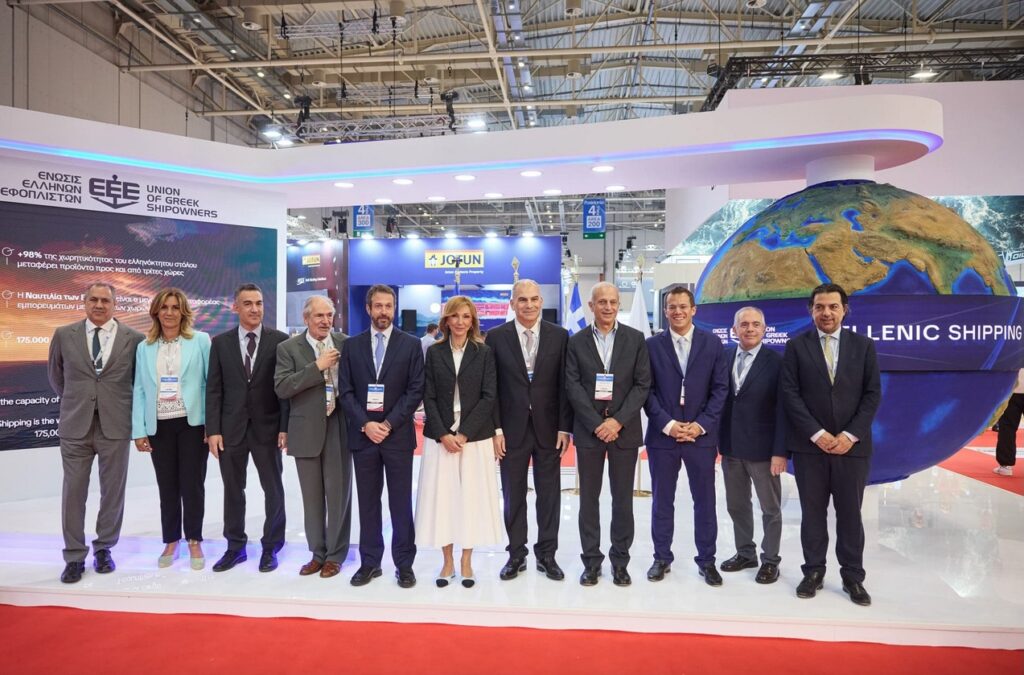
The president of the Union of Greek Shipowners, Melina Travlou, during a press conference at the Posidonia 2026 event, expressed optimism for the future of Greek shipping despite geopolitical and regulatory challenges. Specifically, Ms. Travlou, referring to the historically high Greek order book approaching 931 vessels, emphasized that this development reflects Greek shipowners’ confidence in shipping prospects and the continuous renewal of the Greek-owned fleet.
As Ms. Travlou noted, Greek shipping remains pioneering in adopting new technologies and reducing its environmental footprint, confirming its commitment to a sustainable transition.
Travlou: “Strengthening the Greek flag is directly linked to manning ships with Greek seafarers”
The president of the Union of Greek Shipowners addressed the issue of Greek registry competitiveness and attracting newcomers to the maritime profession. She emphasized that despite progress made in recent years, significant room for improvement remains. As she mentioned, the Greek registry must continue modernizing and adapting to contemporary international shipping needs to remain competitive in a constantly changing environment.
Ms. Travlou highlighted that strengthening the Greek flag is directly linked to manning ships with Greek seafarers, emphasizing that attracting young people to the maritime profession has become a strategic priority for the sector. As she pointed out, the shipping community is called to convince the new generation about the prospects the sea offers, otherwise discussions about changes in crew composition must begin. Additionally, she emphasized the need for coordinated action from all stakeholders. As she mentioned, cooperation with the Ministry of Maritime Affairs is ongoing and continuous, however broader participation from the educational community, trade unions, and maritime organizations is required to formulate a common action plan.
“We must all sit at the same table and leave behind stereotypes and perceptions of the past so we can move forward,” was the message sent by the president of the Union of Greek Shipowners.
Seeking balance in shipping’s green transition
She made particular reference to discussions conducted at the International Maritime Organization (IMO) regarding the Net Zero Framework. The president of the Union of Greek Shipowners argued that shipping was swept along by overly ambitious decarbonization targets, estimating that some proposed regulations do not correspond to the sector’s actual capabilities. As she mentioned, international shipping was swept along in previous years by the particularly ambitious decarbonization targets set by the European Union, resulting in adoption of goals which, in her opinion, are extremely difficult to impossible to achieve. She characterized the goal of complete decarbonization by 2050 as unattainable, while emphasizing that shipping is responsible for only 1.6% of global greenhouse gas emissions.
Ms. Travlou argued that during discussions at the 83rd session of the Marine Environment Protection Committee (MEPC 83) of the IMO, a proposal that had broader acceptance from the shipping community was replaced by the Net Zero Framework, which – as she said – moves in the wrong direction. According to the president of the Union of Greek Shipowners, the proposed framework would essentially transform the IMO into a mechanism for collecting significant financial resources, without clarity on how and where the collected revenues would be allocated. As she mentioned, related discussions even focused on financing developing countries and island states, a position the Greek shipping community disagrees with, considering it not shipping’s responsibility to shoulder this burden.
She praised the Greek government’s stance in negotiations, noting that Greece, in cooperation with the shipping community, highlighted the weaknesses of the proposed regulation and chose not to support it during the critical vote last October. Additionally, she expressed the assessment that the climate within IMO and European Union circles has begun to change, as recognition of the problems presented by the existing plan increases. As she emphasized, new proposals now on the negotiation table create conditions for seeking a more balanced solution that serves both environmental goals and the sustainability of global shipping and the international economy.
Commercial vessels must not become tools of geopolitical confrontations
The president of the Union of Greek Shipowners reiterated that ensuring freedom of navigation remains a top priority for the shipping community, emphasizing that commercial vessels must not become tools of geopolitical confrontations and conflicts.
The president of the Union of Greek Shipowners made separate reference to the issue of so-called “shadow fleets,” which she characterized not simply as a problem but as “a threat to shipping.” As she noted, the phenomenon’s development is directly linked to the existence of fragmented and non-universal sanctions, which create market distortions and favor the development of parallel cargo transport networks outside established rules.
Ms. Travlou rejected accusations attempting to unilaterally connect Greek-owned shipping with shadow fleet development, emphasizing that Greek ownership holds the largest share in the global tanker fleet and therefore it is natural that a significant number of vessels changing hands originate from Greek shipowners. As she explained, when a vessel is sold and subsequently resold to third parties, the original owners cannot control its subsequent course and use. “The targeting of Greek shipping is unfair,” she characteristically emphasized, pointing out that the issue concerns the entire international shipping community.
Additionally, she called on the international community, international organizations, and governments to seek more effective and globally applicable mechanisms to address the phenomenon, warning that unilateral sanctions and different regulations per region lead to competition distortions and undermine the proper functioning of the shipping market.