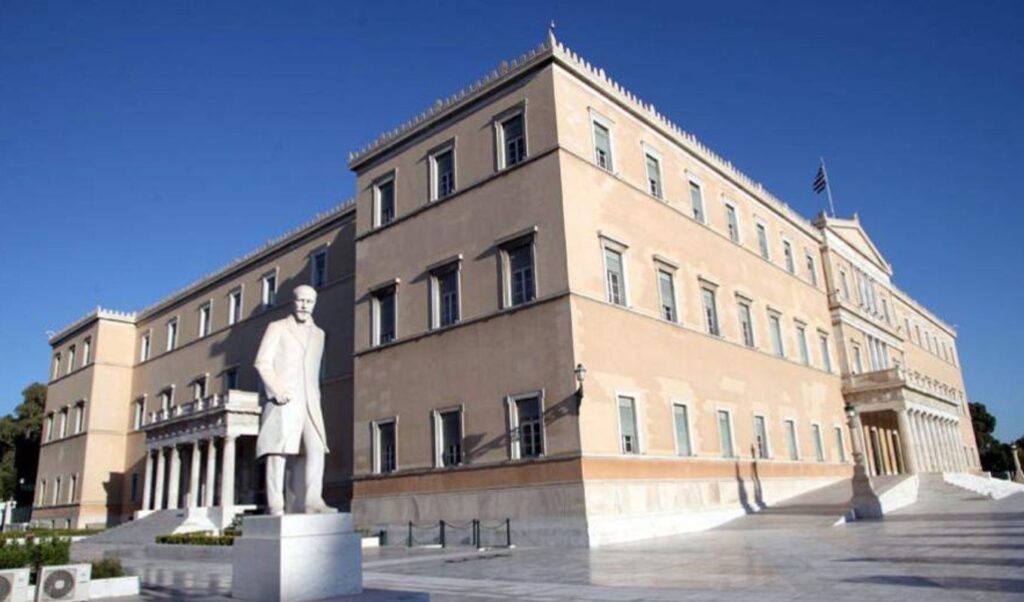
The European Union‘s new fiscal rules and their implementation in Greece are analyzed by the State Budget Office in an extensive report. The framework centers on net primary expenditures, which serve as the main compliance indicator, while emphasizing that additional fiscal space for benefits or tax relief can only emerge through permanent revenue-increasing measures and not from surpluses in primary balances.
The new fiscal rules, namely the common rules that determine how much EU member states can spend and borrow and how they can manage their public debt, came into effect in 2024. They are simpler than previous ones and aim to combine stability with room for investment and growth.
Specifically, they aim to keep public debt under control based on “simple, transparent, country-specific medium-term expenditure paths that protect investments, support reform implementation and strengthen implementation credibility,” as noted in the report.
State Budget Office to Parliament: The three fundamental changes included in the new framework
– It focuses on examining one main indicator: net primary expenditures financed by national resources. The Maastricht Treaty limits for deficit levels (3% of GDP) and debt (60% of GDP) remain in effect, while new safeguards contribute to steady debt reduction and the creation of safety margins for deficits.
Specifically, it provides that if public debt exceeds 90% of GDP, an average reduction of at least 1 percentage point annually must be ensured, while the structural balance is required to be at least 1.5 percentage points of GDP better than the maximum deficit limit of 3% and until this target is achieved, the structural primary balance must improve by at least 0.4 percentage points of GDP annually in a 4-year plan or 0.25 percentage points of GDP annually in a 7-year plan.
– Each EU member state prepares a 4-year (extendable to 7-year) fiscal-structural plan that determines the path of net primary expenditures. The plan describes how public debt will be reduced or remain at safe levels. It includes commitments for reforms (e.g., pensions, labor market, public administration) and investments.
– The European Commission checks whether the plan maintains debt on a reasonable downward path and deficits under control, negotiates and agrees on the plan with the member state. Once the path of net primary expenditures is agreed upon, it becomes binding.
The concept of net primary expenditures
Net primary expenditures, which constitute the “key” term of the new fiscal rules, include the largest part of primary public expenditures (for salaries, goods and services, investments, social transfers), but exclude:
(a) interest payments on debt,
(b) expenditures funded exclusively by the EU (e.g., Recovery and Resilience Fund grants),
(c) expenditures co-financed by community and national resources (e.g., Cohesion or Regional Development Funds),
(d) one-off, temporary measures and expenditures for cyclical unemployment.
Net primary expenditures are adjusted according to active tax measures: tax reductions are treated as additional expenditures and tax increases as savings.
The “Control Account”
A new tool called the “Control Account” compares actual net primary expenditures with the agreed path on an annual basis. If deviations exceeding a certain threshold are detected (approximately 0.3% of GDP in any year or 0.6% of GDP cumulatively) and are not justified by exceptional circumstances (e.g., serious crisis), the European Commission may initiate a corrective procedure.
Additional fiscal space from permanent measures, not from primary surplus overruns
Unlike the previous fiscal framework, in the new framework exceeding the target for primary surpluses does not open the way for additional expenditures (e.g., tax cuts or spending increases), as this would constitute a violation of the fiscal path agreed with the European Commission. This specific overperformance can be utilized for reducing public debt and creating fiscal “cushions” that will help support public expenditures during periods of economic slowdown, as emphasized in the detailed report by the State Budget Office to Parliament.
Additional fiscal space can be created through permanent measures on the revenue side. Specifically, implementing active revenue-side policy measures (DRMs) that ensure revenue increases on a permanent basis (e.g., broadening the tax base, changing tax rates, etc.) allows for revising the path of net expenditures to legislate permanent tax relief or additional public expenditures.
The “ticket” for permanent tax relief announced at the Thessaloniki International Fair
A characteristic example of applying this rule are the higher permanent tax revenues that created the required fiscal space to revise our country’s net expenditure path and legislate the permanent tax relief announced at the Thessaloniki International Fair last September.
For Greece, the growth rate of net expenditures was -0.2% in 2024. According to the Explanatory Report of the State Budget 2026, this total amount is expected to increase by 4.4% in 2025 and 5.7% in 2026.
Therefore, the cumulative increase during 2024-2026 aligns with the Council’s recommendation for a cumulative increase of 9.9%. Although the forecast for this year exceeds the annual ceiling, the cumulative development for the three-year period 2024-2026 remains compatible because 2024 recorded a decrease in net expenditures by 0.2% and the Control Account, after activating the national escape clause for defense expenditures, shows a negative cumulative balance of approximately -0.3% of GDP in 2026, i.e., below the maximum limit.
“A large part of the permanent tax relief announced at the 2025 Thessaloniki International Fair is financed by the 2024 active revenue-side policy measures (DRMs) and the initial under-execution of net expenditures, to maintain the agreed net expenditure path and safeguards for debt sustainability,” notes the detailed report by the State Budget Office to Parliament.