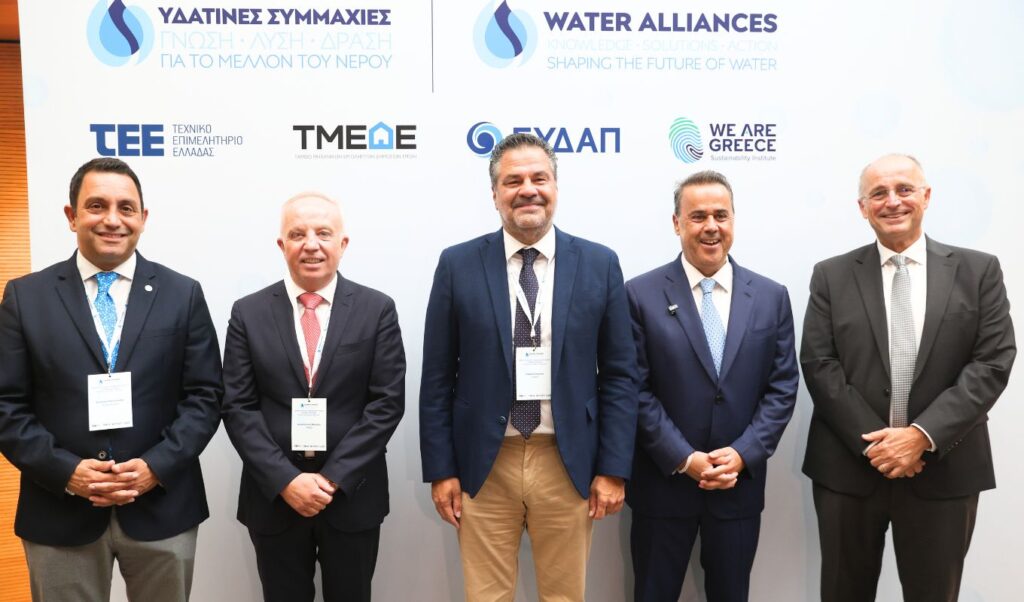
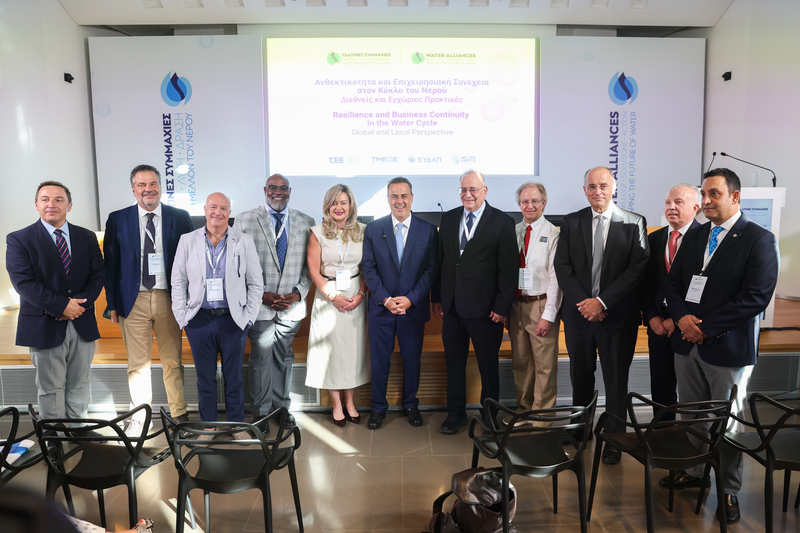
For the second consecutive year, the event “Water Alliances: Resilience and Operational Continuity in the Water Cycle — International and Domestic Practices” was organized by TEE, TMEDE, EYDAP, and We Are Greece. During the event, speakers highlighted, among other things, the urgent need to safeguard the water cycle against modern challenges, and underscored resilience and operational continuity as fundamental prerequisites for water security.
Water security as a critical resilience issue
The presentations made clear that, in an environment increasingly shaped by climate change, natural disasters, cyber threats, and growing demands on critical infrastructure, ensuring the uninterrupted delivery of water and sewage services has become a national priority. In this context, synergies between public and private stakeholders, the use of artificial intelligence and digital technologies, and the strengthening of crisis preparedness and response were identified as decisive factors in protecting and sustainably managing water resources.
The event demonstrated that water security is no longer merely an environmental or technical challenge, but a critical issue of infrastructure resilience, operational continuity, and social well-being — one that demands coordinated action, innovation, and long-term planning.
Papastaurou: Inaction is not an option in the face of the climate crisis and water scarcity
Addressing the conference, Minister of Environment and Energy Stavros Papastaurou stressed: “In the face of the climate crisis and water scarcity, inaction is not an option. Our country ranks 19th globally in terms of water scarcity risk. Yet this is a challenge that does not concern Greece alone, nor just the Mediterranean or Europe — it is now a global challenge. Tackling water scarcity and managing water resources effectively requires cooperation and collective effort. This is what we are doing in Greece: joining forces. Government, municipalities, regions, chambers, civil society, and competent authorities are all working together. Because water is a public good, a source of life, and a strategic national resource. And the resilience and operational continuity at the heart of today’s conference are a critical dimension of that effort. Water security is a matter of national security, social cohesion, and quality of life.”
“TMEDE stands ready, with a meaningful institutional role”
For his part, the President of the Engineers’ and Public Works Contractors’ Fund (TMEDE), Konstantinos Makedos, noted that the resilience of water infrastructure lies at the very core of how modern society and the economy function, emphasizing: “We are called upon to invest not only in new infrastructure, but also in upgrading, digitizing, and extending the operational life of the infrastructure we already have — turning resilience into a measurable investment characteristic. In this national and European challenge, TMEDE stands ready with a meaningful institutional role: not only as a guarantor and financing body for the engineering community, but as a catalyst for building a stronger financial and guarantee ecosystem for next-generation infrastructure. By actively contributing to closer cooperation between the state, engineers, critical infrastructure managers, and the financial sector, we can transform resilience from an aspiration into a concrete investment and operational outcome — effectively future-proofing our infrastructure.”
Dimitris Psychogyios, Vice President for the Water Sector at RAAEY, addressed the Authority’s role in managing crisis incidents. He emphasized that the Authority advocates for providers to be prepared with documented planning and risk-proportionate investments at a reasonable cost to consumers. This objective is also served by the evaluation of General Water Service Plans. He further noted that synergies and cooperation among providers are essential when preparing for a crisis. Referring to EYDAP, he observed that its scale and experience can be transformed into best practices for the entire sector.
EYDAP: Water security is a national priority
Giorgos Stergiou, Chairman of the Board of EYDAP, focused on the interconnected and ever-growing risks that water utilities face today. As he pointed out, phenomena such as droughts, storms, and wildfires are occurring with increasing frequency, while new threats related to cybersecurity and artificial intelligence are emerging alongside the physical aging of networks. “The risks we face are multiplying, not diminishing,” he stressed, calling for greater effort and enhanced operational readiness in anticipation of potential crises.
Haris Sachinis, CEO of EYDAP, described water security and the protection of critical infrastructure across the entire water cycle as a “national priority.” Referring to the company’s expansion into new areas beyond the Attica basin, he stated: “The knowledge accumulated within EYDAP can be valuable to the entire country. We aspire to be a point of reference for the water sector in Greece, and a reliable operational and technical partner of the state in the major transformation currently underway. Together with the relevant ministries, the Technical Chamber of Greece, TMEDE, RAAEY, We Are Greece, and all participating bodies, we are connecting policy, scientific knowledge, and operational experience.” He also noted that EYDAP’s immediate plans include its evolution into an “intelligent water utility” through the use of data, artificial intelligence, and digital technologies to improve performance and citizen services.
Along the same lines, Antonis Giannikouris, President of We Are Greece and Secretary General of TEE, put forward a concrete proposal for the creation of a permanent national water authority to serve as the scientific arm of the state — bringing together government, local authorities, municipal water utilities (DEYA), universities, and civil protection, with the aim of enabling data-driven decision-making and early identification of risks before they escalate into crises. The draft proposal for the new authority was submitted to the Minister of Environment and Energy and to the management of EYDAP.
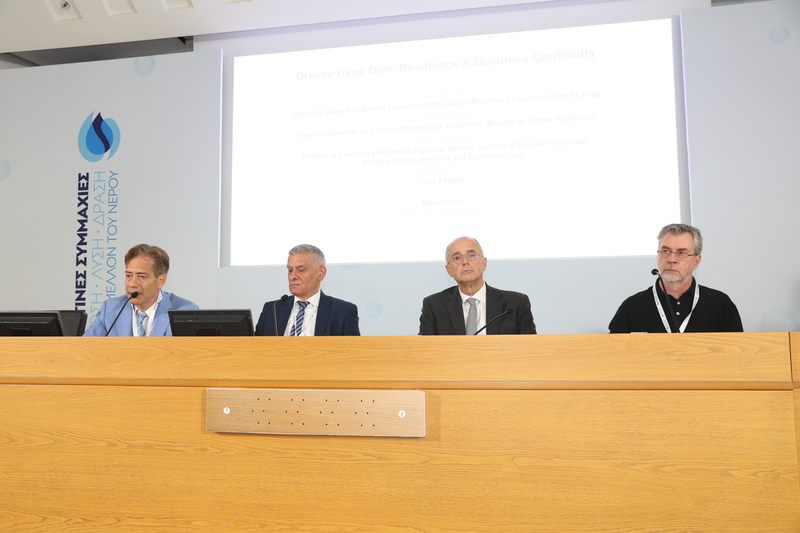
During the panel discussion focusing on the Greek context, Petros Varelidis, Secretary General for the Natural Environment and Water at the Ministry of Environment and Energy, addressed the particular challenges facing island communities and the importance of contingency water supply plans as a matter of national security, stressing that water scarcity is already a foreseeable reality.
Meanwhile, Spyros Papageorgiou, Secretary General for the Protection of Critical Entities at the Ministry of Citizen Protection, presented plans for a centralized national resilience management platform to provide unified monitoring of critical infrastructure. Dimitrios Alexandris, Head of the Emergency Response Planning Directorate at the Ministry of Climate Crisis and Civil Protection, underscored that coordination, cooperation, and the rapid flow of reliable information must begin well before any crisis unfolds.
Resilience is a collective responsibility
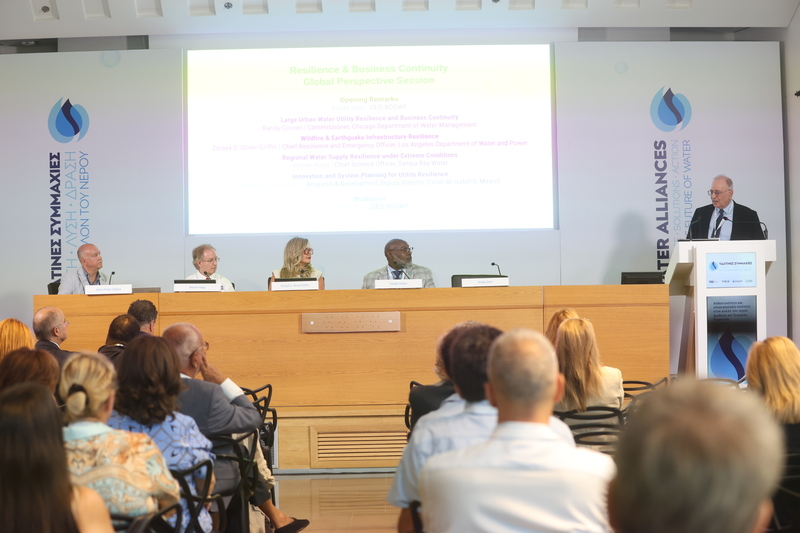
In the international dimension of the conference, senior executives and experts presented strategies and best management practices. International speakers framed resilience not as an isolated operational function, but as a strategic capability that determines an organization’s ability to anticipate, adapt, and respond effectively in an environment of increasing uncertainty. They emphasized that protecting critical infrastructure requires a comprehensive approach combining governance, risk management, operational continuity, cybersecurity, technological innovation, and human capital development. Particular emphasis was placed on the need to shift from a traditional reactive mindset to one of anticipation and preparedness, leveraging data, modern technologies, and early warning systems.
It was further underlined that resilience is a collective responsibility, requiring ongoing collaboration between the public and private sectors, institutions, critical service providers, and society at large. The presentations demonstrated that the ability to maintain critical services under pressure now constitutes a fundamental factor in security, sustainability, and competitiveness.
The shared message from all speakers was that resilience is not merely a crisis management tool, but a strategic investment that strengthens long-term value, public trust, and the capacity of organizations to effectively meet the challenges of the future.