The two major geopolitical crises of recent years — Russia’s invasion of Ukraine and the conflict in the Middle East — have once again highlighted the critical importance of diversifying energy supply sources and routes. Energy infrastructure has returned to center stage, as pipelines, cross-border interconnections, and distribution networks increasingly determine market access, operational costs, and the ability to adapt swiftly to shifts in demand.
In this environment, the reactivation of the VARDAX pipeline by HELLENiQ ENERGY carries particular strategic weight. The pipeline connects the Thessaloniki Industrial Facilities with the facilities of subsidiary OKTA in the Republic of North Macedonia, creating a vital “vertical supply corridor” that ensures reliable access to high-quality fuels.
The value of VARDAX became even more evident following the outbreak of the new Persian Gulf crisis. Its operation helped maintain competitive conditions in the fuel market and improved the availability of crude-derived products that are in short supply internationally. The pipeline has now emerged as critical infrastructure for energy security and economic activity across the wider region.

From the beginning of 2026 through the end of August of the same year, nearly 400 million liters of diesel fuel were transported through the pipeline. The primary destination market is the Republic of North Macedonia, while Kosovo and Serbia are also served.
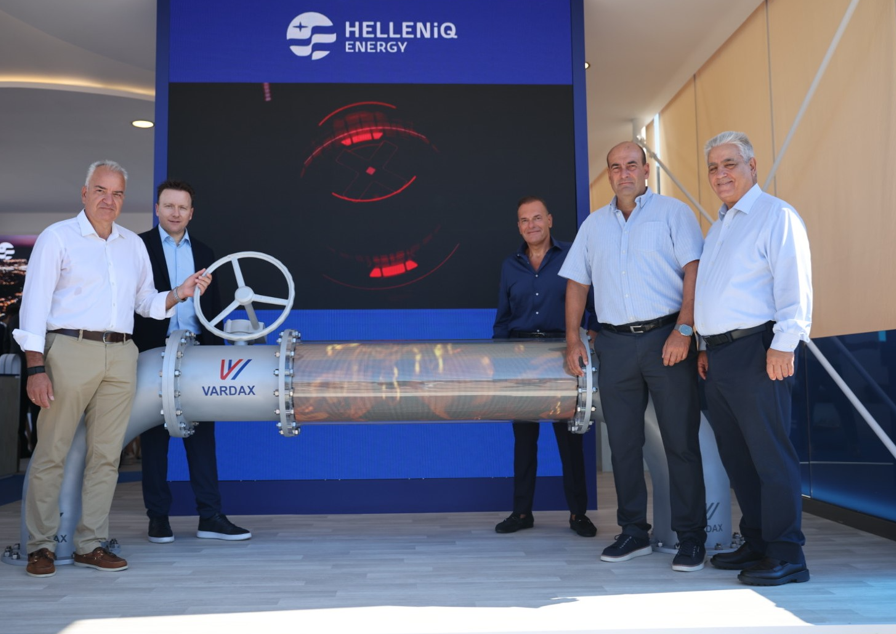
HELLENiQ ENERGY chose VARDAX as the centerpiece of its presence at the 90th Thessaloniki International Fair (TIF). The TIF has long been synonymous with the development prospects of northern Greece and the broader region. In the case of VARDAX, the investment demonstrates how existing infrastructure can take on a new and commercially significant role.
The restoration and modernization of VARDAX represented a strategic choice for HELLENiQ ENERGY, as part of its ambition to lead energy developments in Southeast Europe as the region’s premier energy company.
The pipeline was originally designed to transport crude oil. After 13 years of inactivity, it has been brought back into operation for the transportation of diesel fuel.
To achieve this, HELLENiQ ENERGY implemented a €30 million upgrade program. Works included the modernization of the pipeline network, the reinforcement of monitoring systems, the installation of state-of-the-art leak detection mechanisms, and the upgrading of control procedures.
Direct pipeline transportation simplifies product logistics, reduces the need for large-scale overland movements, and offers greater predictability in commercial flows. For HELLENiQ ENERGY, this facilitates planning, more efficient utilization of production units, and streamlined supply chain management.

According to HELLENiQ ENERGY CEO Andreas Siamissis, VARDAX covers approximately 80% of the Republic of North Macedonia’s fuel needs, while also supporting supply to Serbia and Kosovo.
VARDAX’s presence at the 90th TIF also carries symbolic significance for Thessaloniki. The city has been home to major industrial activity by the Group for decades and remains a cornerstone of its business operations. The pipeline’s reactivation strengthens the link between local production and the markets of the broader region.
At the Thessaloniki Industrial Facilities, HELLENiQ ENERGY is also investing in large-scale energy storage projects and new technologies that will shape the future of the energy system.
These investments, together with modernization, energy autonomy, and energy efficiency projects, form part of HELLENiQ ENERGY’s broader transformation journey. After nearly seven decades at the forefront of energy developments — with refining as its core activity — the company is evolving into a modern, multidimensional energy group with a strong presence across the full energy spectrum and an expanding international footprint.