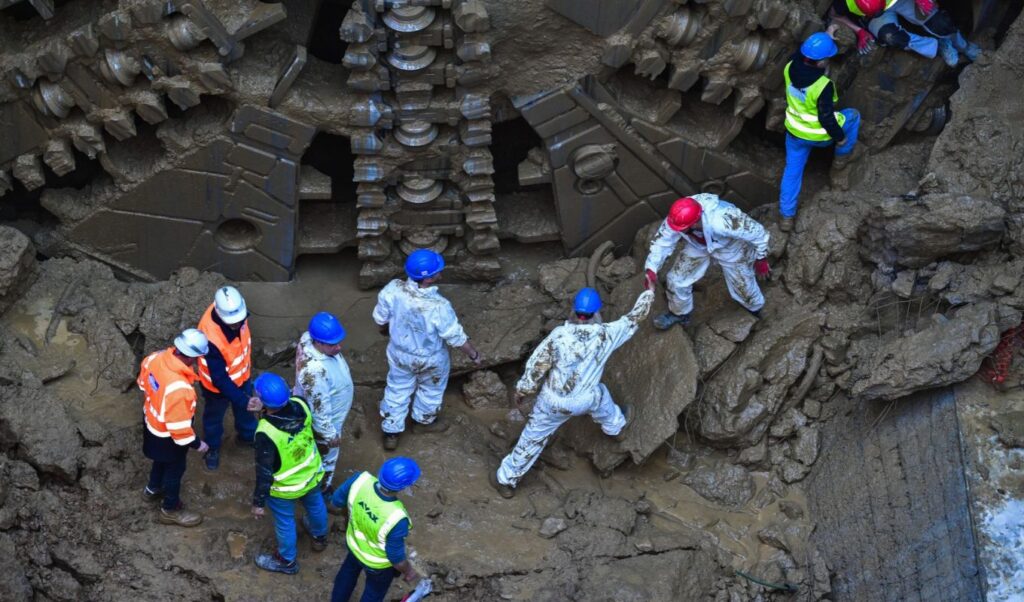
One of the biggest unresolved challenges facing Athens Metro Line 4 is finally moving toward a resolution. After months of negotiations, a technical solution has been found for the construction of the Evangelismos station, significantly reducing the impact on Rizari Park. An agreement with shipping magnate Nikos Patera’s side — which had filed legal objections against the original design — now creates the conditions to overcome a deadlock that had brought this particular construction front to a standstill.
However, just as a way forward emerges at Evangelismos, the prolonged immobilization of the tunnel boring machine in Kypseli continues to raise serious concerns about the project’s progress. The completion date has already been pushed back by more than three years. The original schedule called for Line 4 to open in June 2029, but construction delays in handing over work sites, legal disputes, and technical problems led to an official revision. By decision of Hellenic Metro, the new contractual completion date was set for September 3, 2032. Even this revised timeline is a point of contention with the contractor consortium Avax – Ghella – Alstom, which has requested an extension to February 2034, arguing that accumulated delays have disrupted the sequence of works and cannot be absorbed within the approved schedule.
A new approach
Against this backdrop, the Evangelismos agreement carries significant weight. According to sources, following contacts at both ministerial level and with Hellenic Metro, the parties involved reached a new construction approach that allows the station to be built without the extensive surface excavations envisaged in the original design. Objections had centered on the protection of Rizari Park, as the construction site footprint was affecting part of the green space and its trees.
The chosen solution is based on underground access construction — meaning work crews will reach the excavation zone from below the surface. To achieve this, the existing worksite on Vasileos Konstantinou Avenue will be utilized. This is the same site from which the tunnel boring machine “Athena” emerged after completing the tunnel drive from Gouди to Evangelismos. The new method significantly reduces the construction infrastructure required inside the park, allowing much of the vegetation to be preserved.
Changes are also planned for the placement of the station’s three entrances. The first will be located at the junction of Rizari and Vasileos Konstantinou streets, the second on the side facing Evangelismos Hospital, and the third — which will serve as the main entrance — near the station’s exit toward Rizari Park. Only for this last entrance will limited surface excavation be required, with access from the Hilton side. No expansion of construction activity beyond the park’s boundaries is planned, nor will there be any additional traffic burden on Rizari Street.
Patera’s consent marks a key step toward resolving the impasse, though this does not mean construction can begin immediately. A new Environmental Impact Assessment is currently being prepared, to be followed by an amendment to the Environmental Terms Approval Decision issued by the Ministry of Environment and Energy. The completion of these procedures will determine when this particular construction site can be activated.
On-site inspection
Meanwhile, Kypseli remains the second major problem on Line 4. The tunnel boring machine “Niki,” which set off from Veikos Grove toward Evangelismos, has been at a standstill since May 8, 2026, when excavation work revealed difficult geotechnical conditions and ground movement that caused damage to buildings in the area. Restart has been pushed to 2027, as the required technical assessment has not yet been completed.
Distinguished British professor Lord Robert Mair has taken on a key role in this process, having conducted an on-site inspection in Kypseli. According to sources, his assessment classifies the damage in the “slight” to “moderate” categories of the internationally recognized Burland scale. However, the Greek side has requested that the seismic adequacy of the affected buildings also be examined, so that following restoration works, they maintain at least the same level of structural safety they had prior to the machine’s passage.
Lord Mair’s comprehensive report is expected in early December and will serve as the basis for determining remedial measures. No problem requiring building evacuations has been identified, and technical assessments are converging on the conclusion that tunneling can continue, provided the necessary interventions are implemented.
The delay in Kypseli is now also affecting the overall tunnel completion schedule. The “Athena” has completed its approximately 5.1-kilometer drive from Gouди to Evangelismos, while “Niki” must continue on to the Dikastiria, Alexandras, Exarcheia, Akadimia, and Kolonaki stations before reaching Evangelismos. Completion of the tunneling works is estimated to be achievable within 2027, provided the current problems are resolved.
Originally published in MoneyPro by Parapolitika