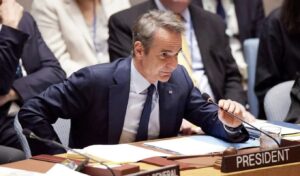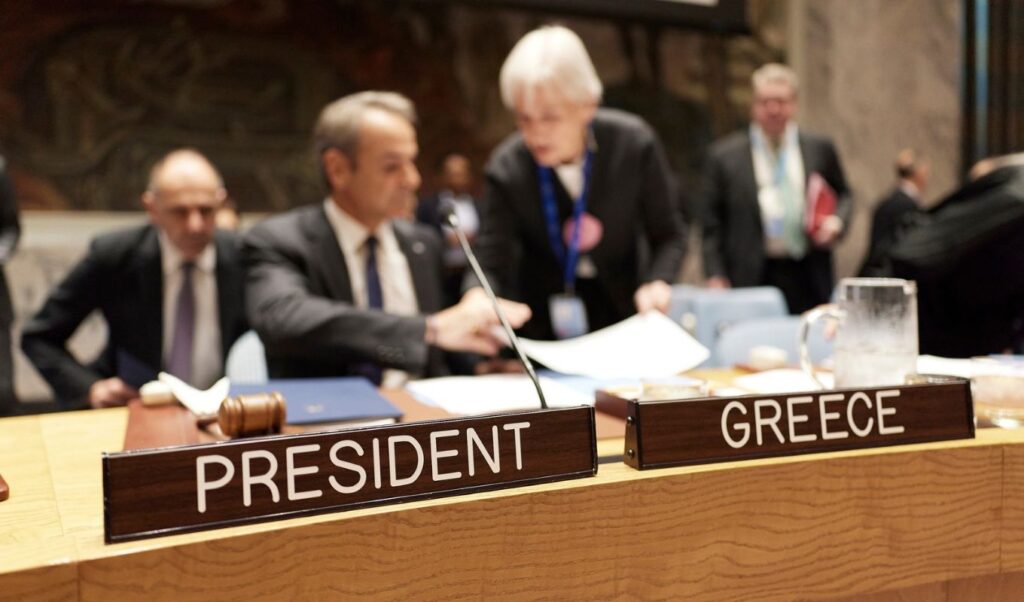
A sharp diplomatic confrontation between the permanent representatives of Greece and Turkey erupted over the Turkey-Libya maritime memorandum during a UN Security Council session held under the Greek Presidency. Athens and Ankara traded sharp exchanges over the legality of the agreement, the Law of the Sea, and the maritime rights of Greek islands.
Read also: Gerapetritis meets Guterres amid international condemnation of the Turkey-Libya maritime deal — the message to Ankara on maritime zones
Turkey’s arguments and its defense of the memorandum
Turkey’s permanent representative to the UN, Ahmet Yildiz, responding to references made by Kyriakos Mitsotakis, argued that the Security Council is not a court for delimiting maritime zones. He defended the Turkey-Libya memorandum, noting that it has been in force since 2019 and does not prejudge the rights of third states.
Addressing the issue of Greek islands, he maintained that Turkey does not dispute their sovereignty, but rather the weight they should be accorded in maritime boundary delimitation. He also revived President Erdogan’s proposal for an Eastern Mediterranean Conference, with a reference to the rights of Turkish Cypriots.
Athens fires back: “It contradicts both geography and international law”
Greece’s permanent representative to the UN, Aglaïa Balta, categorically rejected the Turkey-Libya memorandum, declaring it null and void. She stressed that its purported ratification by the Libyan House of Representatives does not alter its legal character or produce any legal effects. “Geography cannot be reshaped. This is not a slogan,” she stated, adding that no bilateral agreement between two states can infringe upon the sovereign rights of a third country.
The Greek diplomat also invoked Greece’s maritime delimitation agreements with Italy and Egypt, emphasizing that international law cannot be applied selectively.
Dialogue remains on the table — but only on the basis of international law
The confrontation continued as the Turkish representative called for substantive negotiations, expressing hope that talks could begin as soon as possible.
In her closing remarks, Aglaïa Balta reaffirmed that Greece consistently pursues good-neighbourly relations with Turkey, grounded in mutual respect and international law. “We remain committed to dialogue and the peaceful resolution of disputes; however, meaningful dialogue requires respect for international law, sovereignty, and sovereign rights,” she concluded.