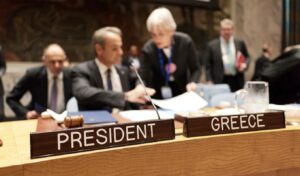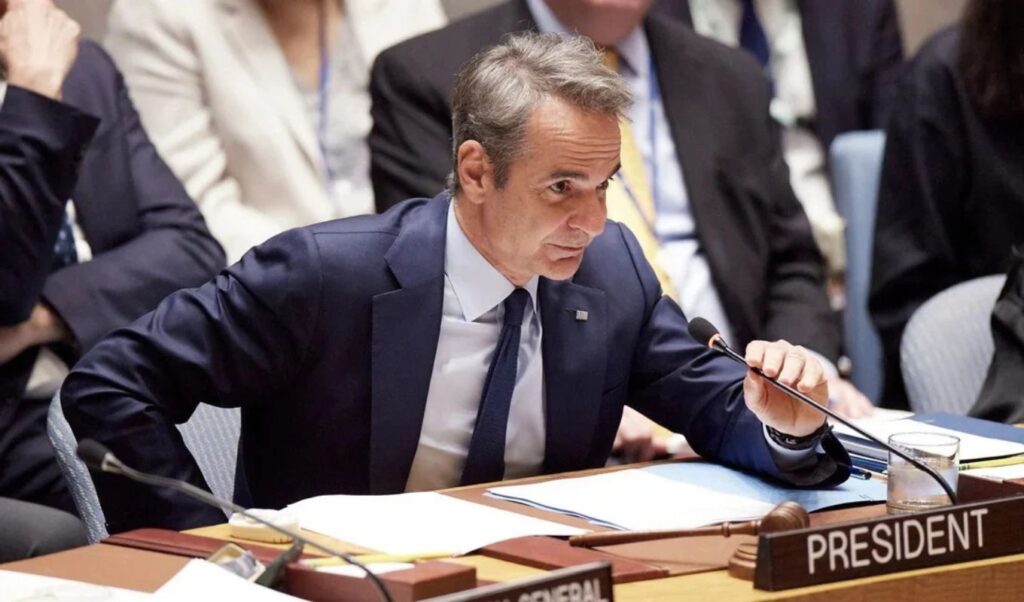
Kyriakos Mitsotakis once again addressed Greece’s position on the Turkey-Libya maritime memorandum, describing it as “illegal, arbitrary” and contradictory “to geography itself,” during his intervention at the UN Security Council, which is currently under the Greek Presidency, on the theme “Maintaining international peace and security: Emerging technologies and maritime security.” He stated specifically: “The so-called Turkey-Libya memorandum on the delimitation of maritime zones constitutes a flagrant violation of the fundamental principles of the International Law of the Sea. It is illegal, it is arbitrary, and it contradicts geography itself.”
Continuing on this issue, Kyriakos Mitsotakis described the memorandum as unprecedented, since it “establishes” a diagonal delimitation, while invoking international law: “International law cannot be applied selectively, and the rules governing our seas cannot be rewritten to serve the ambitions of individual states. Greece and Libya are natural maritime neighbors, with opposite coasts, and have the right, under international law, to delimit their maritime zones through agreement. Turkey and Libya, on the other hand, do not have opposite or adjacent coasts. Yet they have attempted to establish an artificial maritime boundary between themselves. This is absurd. There is no precedent for such a diagonal delimitation.”
He described the agreement as one that is contemptuous of Greece, noting that the maritime boundary drawn by Turkey and Libya “erases” the Greek islands, implying that the two countries disregard them entirely: “These are not uninhabited rocks in the middle of the sea. These are thriving communities, with centuries of history, dynamic economies, where hundreds of thousands of people live.” He concluded: “Geography cannot be rewritten. And sovereign rights cannot be erased by drawing arbitrary lines on a map.”
“No bilateral agreement can override international law”
“International law is absolutely clear: islands are entitled to maritime zones, including the continental shelf and the Exclusive Economic Zone, in accordance with the United Nations Convention on the Law of the Sea, the relevant provisions of which reflect — I repeat — customary law that is binding on all states. No agreement between two states can deprive a third state of its sovereign rights. And no bilateral agreement can override international law,” Kyriakos Mitsotakis stated.
“The recent ratification of the Turkey-Libya memorandum by the Libyan House of Representatives cannot transform an illegal memorandum into a legitimate agreement. Under no circumstances can this memorandum serve as a pretext for challenging lawful activities at sea or for obstructing strategic connectivity projects that our region urgently needs. We cannot allow arbitrary maritime claims to become tools for blocking the economic development and prosperity of an entire region,” the Prime Minister continued.
Mitsotakis at the UN: “What happens at sea affects our future”
He then addressed the recent attacks in the Black Sea, stating that “we condemn them unequivocally,” and emphasized that “a maritime ceasefire is essential.” The Greek Prime Minister, who presided over this high-level open debate, placed particular emphasis on freedom of navigation and maritime security, noting that “Greece defends and will continue to defend international law, as what happens at sea affects the future of all of us.” He also remarked that this is a major global issue that affects borders and markets. The Greek Prime Minister will remain in New York on Friday, October 30, when he will participate via video conference in the International Institute for Strategic Studies Manama Dialogue 2026, held in Bahrain.