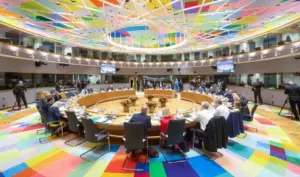
At bilateral, European, and multilateral levels, Greek diplomacy has deployed every available diplomatic and institutional tool to strongly oppose the decision by the Libyan House of Representatives to ratify the illegal Turkey-Libya memorandum. Acting on instructions from Foreign Minister Giorgos Gerapetritis, Greece’s Permanent Representative to the UN, Aglaïa Balta, brought the matter before the UN Security Council, highlighting the dangers this Libyan move poses to security and stability in the Eastern Mediterranean.
The Libyan parliament’s decision to proceed with ratifying the Turkey-Libya memorandum triggered an immediate and coordinated response from the European Union and regional allies. In a joint statement issued last night, all 27 EU member states expressed their strong displeasure, reiterating that “the Turkey-Libya memorandum is null and void and cannot produce legal consequences for third states.” The statement stressed that all countries must respect the sovereign rights of all member states in accordance with EU law and international law, including the United Nations Convention on the Law of the Sea (UNCLOS).
The Turkey-Libya memorandum violates the sovereign rights of third states — “Greece and Cyprus can count on our solidarity”
Earlier, EU High Representative for Foreign Policy Kaja Kallas raised the issue directly in her meeting with Turkish Foreign Minister Hakan Fidan, stressing that the agreement violates the sovereign rights of third states. Kallas’ intervention came just hours after a strong show of support from European Council President António Costa and European Commission President Ursula von der Leyen, both of whom declared the memorandum contrary to the Law of the Sea and legally invalid. In the same vein, European Parliament President Roberta Metsola, responding to a question raised by MEP Eliza Vozemberg during the plenary session, invoked the joint statement by Costa and von der Leyen. Metsola underlined that the concerns are shared and sent a clear message that “Greece and Cyprus can count on our solidarity.”
Egypt also plays a key role on the international response front. In a dedicated post and official statement, the Egyptian side noted that the memorandum of understanding violates the principles of international maritime law and the provisions of the United Nations Convention on the Law of the Sea (UNCLOS 1982) concerning the delimitation of the Exclusive Economic Zone (EEZ) and the continental shelf. Egypt emphasized that the agreement constitutes a clear infringement of its sovereign rights and, reiterating its categorical opposition, rejected any action based upon it while reserving its legal right to protect its maritime borders. Israel adopted the same stance, launching direct criticism at Ankara.
According to reliable sources, Athens is expected in the coming period to take further steps to safeguard the country’s sovereign rights.
These developments are shaping a new environment, placing the Greece–Cyprus electricity interconnection project in a new balance between Greece and Turkey, with the issuance of a NAVTEX at the center — aimed at restarting survey operations for the laying of the GSI cable. The Foreign Minister once again made Athens’ position crystal clear, stressing that Greece is the only country from which permission has been and will be requested.
Turkish Foreign Minister Hakan Fidan took a step back in Brussels yesterday on the question of authorizing cable-laying operations. He stated that “what Ankara is asking for is to be sent a written notification — not merely a verbal one,” carefully avoiding any reference to an authorization process. Foreign Minister Gerapetritis responded immediately, clarifying that once Greece grants the relevant authorization, it becomes possible to provide information regarding the survey and laying of the cable — under the clear condition and explicit understanding that this does not constitute an authorization process by any other party.
The NAVTEX issuance is expected in early November, following Foreign Minister Giorgos Gerapetritis’ return from the UN session in New York, which will take place next week in the presence of the Greek Prime Minister.