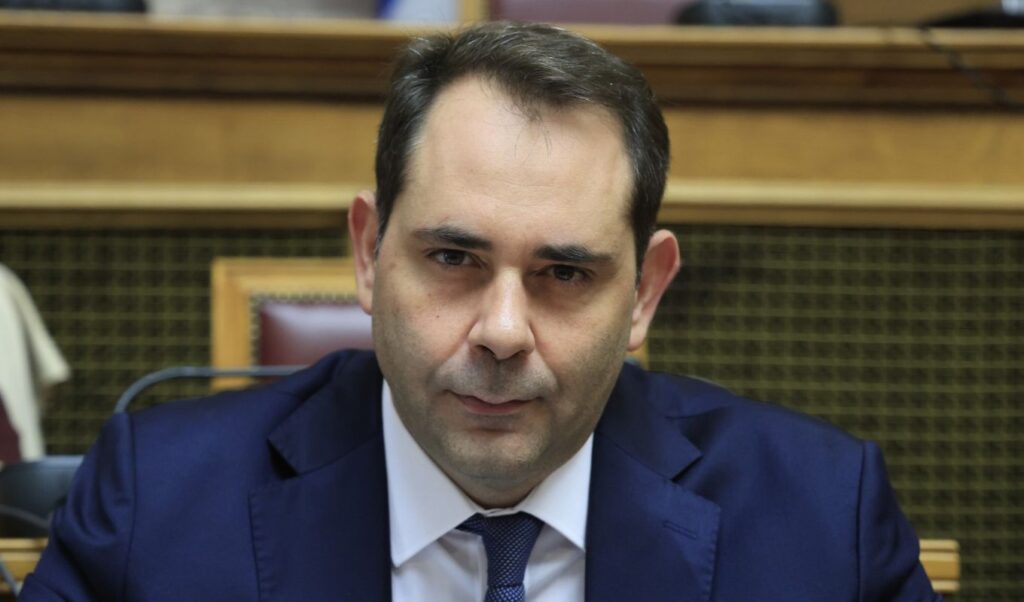
Deputy Minister of National Economy and Finance Thanos Petralias addressed the Standing Committee on Economic Affairs of the Hellenic Parliament during discussions on the draft 2027 Budget. The deputy minister highlighted that Greece continues to reduce its debt and for the seventh consecutive year ranks first in the European Union in debt reduction. Specifically, he noted that the debt-to-GDP ratio is projected to fall to 128.8% in 2027, down from 136.7% in 2026. He also announced that unemployment is expected to drop below 8% — reaching 7.9% in 2027, compared to 8.4% in 2026. Furthermore, he stressed that Greece’s growth rate will remain well above the Eurozone average in 2027, with GDP growth forecast at 2% in 2026 versus the Eurozone’s 0.9%, and 2.3% in 2027 versus the Eurozone’s 1.2%.
Read also: Thanos Petralias: “We will never give what we don’t have”
Thanos Petralias: His statement on the draft 2027 budget
The debate on the draft State Budget for 2027 is taking place amid conditions of intense geopolitical uncertainty, as the ongoing conflicts in Ukraine and the Middle East are driving significant increases in energy prices and negatively impacting economic activity and international trade.
At the same time, fiscal risks are rising across many European economies, which are being called upon to implement austerity measures amid mounting pressure on bond markets.
Despite this particularly challenging external environment, the Greek economy continues for the seventh consecutive year to record growth rates significantly above the Eurozone average.
Key indicators of the Greek economy as outlined in the draft budget:
* The growth rate is expected to reach 2% in 2026 and 2.3% in 2027 — nearly double the Eurozone projections of 0.9% in 2026 and 1.2% in 2027.
* Nominal GDP is projected to increase from €262 billion in 2026 to €274.6 billion in 2027, while investments are expected to grow by 7.9%, compared to just 1.7% in the Eurozone. Within this framework, the investment-to-GDP ratio is approaching 18.6% in 2027, further narrowing the country’s investment gap.
* The unemployment rate is forecast to decline further from 8.4% in 2026 to an average of 7.9% in 2027 — the lowest level since 2008 — while wages per employee are expected to rise by 3.9% in 2027, up from 3.7% in 2026.
* The primary surplus is projected at 3.6% of GDP in 2026 and 3.3% in 2027, while the general government balance as a percentage of GDP is forecast at 0.6% in 2026 and 0.3% in 2027.
Debt reduction: the most significant fiscal achievement
In my view, the most significant fiscal achievement is the de-escalation of general government public debt, which is expected to post the largest reduction in the EU for the seventh consecutive year, falling to 128.8% of GDP in 2027 from 136.7% in 2026.
On the question of wages and disposable income: total employee compensation is expected to increase by 4.4% in 2026 and 4.6% in 2027. The cumulative increase in total employee compensation from 2019 to 2026 stands at 37.6%, with the minimum wage rising by 41.5% and net per capita wages by 32.1%, while cumulative inflation from 2019 to 2026 amounts to 24%. So yes, inflation has absorbed a significant portion of wage gains — but average net wage growth still exceeds the inflation rate. This is further confirmed by real GDP per capita data: after adjusting for inflation, per capita GDP in Greece has risen by 15% from 2019 to 2026, compared to just 6.7% across the European Union. A further 2.6% increase in real per capita GDP is projected for 2027.
In 2027, therefore, the positive trajectory of the Greek economy will continue, despite heightened geopolitical and trade uncertainty and high volatility in energy prices.
A key driver sustaining above-Eurozone growth in 2027 is the package of new government interventions announced at the 90th Thessaloniki International Fair. These measures form a broad and coherent policy framework worth approximately €2.2 billion for 2027, covering all social groups and including significant measures to boost investment and entrepreneurship. It is worth noting that the Thessaloniki Fair measures — combined with the increase in the Public Investment Programme under the energy escape clause and the co-financed component — are estimated to contribute approximately 0.2% to GDP growth this year and an additional 0.3% in 2027.
The fiscal interventions are structured around four key pillars:
(a) boosting disposable income for all social groups, including self-employed workers, private sector employees, pensioners, civil servants, farmers, and people with disabilities;
(b) strengthening private and public investment;
(c) implementing targeted social policy with a focus on housing and demographic challenges; and
(d) enhancing energy autonomy while simultaneously reducing electricity costs.
Allow me to outline the key government interventions planned for the coming months:
On 30 November 2026, a €400 net benefit will be disbursed to pensioners, people with disabilities, and uninsured elderly citizens, along with the payment of rent refunds.
In late December 2026, increased January pension payments will be issued based on inflation and GDP indexation, without any offsetting of personal differentials.
From January 2027, income tax rates for families with three or more children will be reduced to 0% on income up to €20,000; disability benefits will be increased through cost-of-living indexation; public service obligation (PSO) charges on electricity bills will be reduced for all residential connections; a special investment account for the younger generation will be launched; and the “My Home III” (SPITI MOU III) housing programme will commence.
In mid-March, upon the issuance of ENFIA (property tax) assessments, residents in 12,855 settlements of up to 2,000 inhabitants across the country — and 2,200 settlements in Western Macedonia — will be exempt from property tax entirely.
Also from mid-March, when the tax filing season opens, taxpayers will benefit from tax reductions totalling €884 million, with the most significant measures including:
* Reduction of the income tax rate for primary-occupation farmers to 0% on income up to €20,000.
* Reduction of income tax for self-employed professionals and farmers, in line with the cuts introduced for the 2026 tax year.
* Reduction of presumptive taxation for self-employed professionals, with exemptions from surcharges based on turnover and payroll.
* Abolition of the business activity levy in regional Greece and Thessaloniki.
* Reduction of property income tax through the introduction of an intermediate 25% tax rate, in line with the reduction applied for the 2026 tax year.
In parallel, from 1 April 2027, the minimum wage in the private sector will increase, with a corresponding horizontal pay rise for civil servants, while employee social security contributions will be reduced by 0.5%.
Finally, in December 2027, civil servants will receive a Christmas bonus of €500 gross — the first time in 15 years such a payment will be made.
All of the above measures will be legislated in the immediate term through the Thessaloniki Fair measures bill, which has been posted for public consultation and is scheduled to come to a parliamentary vote before the end of November.
Support packages and subsidies worth €862 million
Ladies and gentlemen of the Parliament,
I believe we all agree that the most pressing issue is addressing the energy crisis. In this context, the government is operating on two levels. The first is the short-term management of immediate pressures on households and businesses.
To this end, emergency support packages and subsidies totalling €862 million have already been allocated — in addition to the permanent €400 benefit for pensioners and the expanded rent refund scheme. These include emergency support measures such as a €150 per-child benefit, a fuel pass scheme, fertiliser subsidies for farmers, subsidies for ferry tickets, fishing sector support, a 30% increase in the heating allowance, and fuel subsidies through the distribution network. As announced, these fuel subsidies will be adjusted every 15 days based on international price developments, while remaining within the fiscal space defined by the primary expenditure index — which, as shown on page 40 of the draft budget, is being fully utilised.
Within this framework, the draft budget includes an additional provision of €200 million under general government reserves, allocated to address potential energy cost subsidy needs during the early months of the year.
The second level focuses on medium-term actions — many of which will be implemented within 2027 — aimed at achieving a permanent reduction in energy prices. Greece was the first country in Europe to activate the national escape clause for energy resilience, incorporating interventions worth approximately €1 billion. These include battery storage grants for renewable energy installations, subsidies for heat pumps and solar water heaters, and the ELECTRA, PHOEBUS, and ATHENA programmes, among other initiatives. At the same time, new energy efficiency upgrade programmes for homes and businesses are being planned through resources from the Social Climate Fund, while a major €6 billion investment plan by IPTO (the Hellenic Electricity Distribution Network Operator) is underway — following a €1 billion share capital increase completed a few months ago — with the goal of expanding the national power grid and connecting the islands to the mainland network.
On a path of strong and sustainable growth
Ladies and gentlemen of the Parliament,
With the draft 2027 Budget, the government demonstrates that even in the face of difficult conditions and global geopolitical turbulence, it can keep the economy on a path of strong and sustainable growth while supporting households and businesses without jeopardising the country’s fiscal trajectory.
This is the direction we will continue to follow, building on what we have achieved from 2019 to the present — for a better tomorrow for everyone, and above all for the younger generation, who will inherit a country with lower public debt and stronger prospects for prosperity.